

On July 9, 2025, US President Donald Trump announced a sweeping 50% tariff on all Brazilian imports to the US, set to take effect 1st August. This threatens a significant proportion of Brazil’s total coffee exports (which typically are directed towards the US). The move is expected to prompt Brazil to seek opportunities in China and the Philippines, says GlobalData, a leading data and analytics company.
GlobalData’s recent report “Industry Insights: The impact of tariffs on consumer packaged goods” reveals how which CPG-relevant sectors are most affected by tariffs within specific trade relationships and how companies in these sectors will be affected. For instance, higher tariffs between the US and China could result in Brazilian soybean exporters stealing US exporters’ share of the Chinese market.
Rory Gopsill, Senior Consumer Analyst at GlobalData, comments: “Brazilian coffee exporters should seek alternative markets to the US in the event that the US acts on its threats. They need to target the alternative markets that combine high absolute forecast growth with a high compound annual growth rate (CAGR) to reflect a large, fast-growing coffee market. The Philippines and China offer both.”
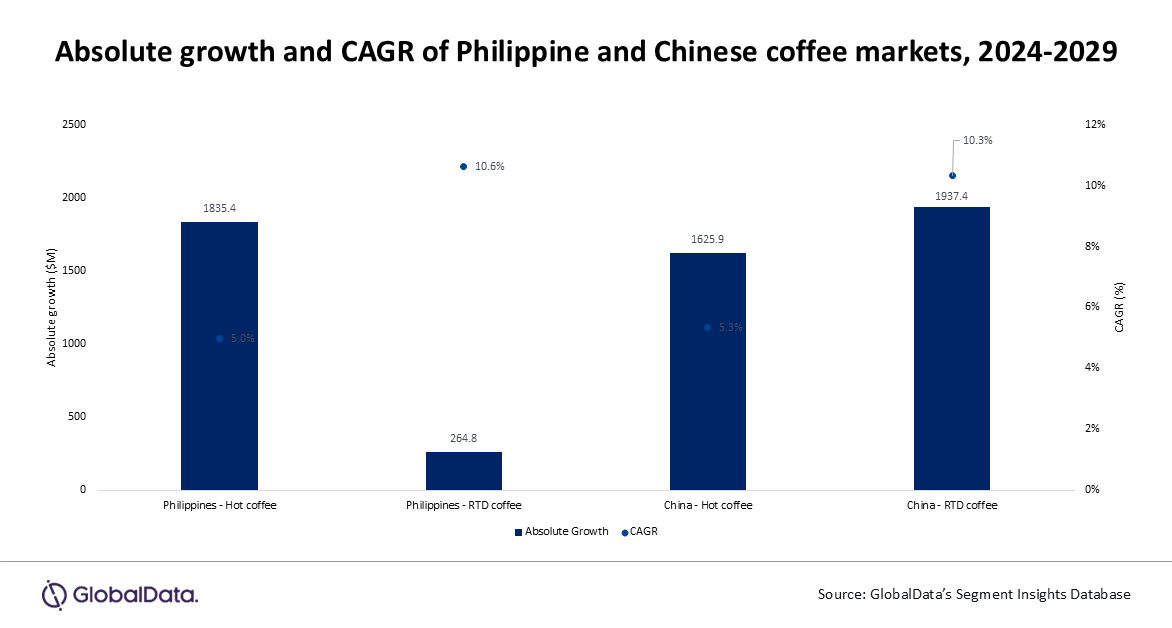
According to GlobalData’s Segment Insights Database, the Philippines was the fifth largest hot coffee market globally in 2024. Moreover, it is forecast to experience the third greatest absolute growth globally in hot coffee retail sales value between 2024 and 2029 (after the US and Japan), growing by $1.8 billion and at a CAGR of 5% in this period. The Philippines’ ready-to-drink coffee market is also forecast to experience the seventh greatest absolute sales value growth ($264.8 million) globally in the same period, achieving a CAGR of 11%.
China was the seventh largest hot coffee market globally in 2024 and is forecast to experience the 4th greatest absolute growth in hot coffee retail sales value between 2024 and 2029, growing by $1.6 billion and at a CAGR of 5% during this period. Ready-to-drink coffee sales value in China is also forecast to experience the second greatest absolute sales value growth ($1.9 billion) globally in the same period.
Tariffs create both opportunities and challenges for US recycling
Brazil is arguably well-positioned to capitalize on these growth opportunities, especially in the Chinese market. The country is already an essential element of the coffee supply chains for numerous Chinese businesses, supplying 32.4% of China’s total coffee imports in 2023, according to The Observatory of Economic Complexity. Brazil also enjoys positive trade relations with China. Both nations are founding members of the BRICS economic bloc, and China already relies heavily on Brazil for agricultural products such as soybeans as it seeks to reduce its reliance on US exports.
Gopsill concludes: “As Brazilian exporters face the potential loss of their competitive edge in the US market, it becomes imperative for them to pivot towards alternative markets that promise robust growth. However, perhaps more broadly, the US decision to impose tariffs on Brazil for reasons grounded in ideology rather than trade economics reflects the need for nation states and CPG companies to factor both macroeconomic and political/cultural issues into their strategies going forward.”
