

Intellia Therapeutics unveiled promising proof-of-concept data for its proprietary lipid nanoparticle (LNP) delivery platform in July this year. This development marks a significant milestone in the emergence of LNPs as a crucial non-viral vector for gene therapy delivery. The success paves the way for trials targeting various new applications of LNP technology, which could reshape the gene therapy landscape, according to a recent report by GlobalData, a leading data and analytics company.
GlobalData’s latest report “Lipid Nanoparticles – Gene Therapy,” reveals that gene therapy sales are projected to exceed $10 billion by 2027. LNPs have gained popularity as carriers for gene therapies due to their high tolerance, low toxicity, and limited side effects, which make them prime candidates for the treatment of a vast range of diseases such as genetic and autoimmune disorders, cancer, and infectious diseases.
LNPs hold advantage over other types of vectors – e.g. viral, bacterial, plasmid etc. – since they induce minimal immune responses and exhibit enhanced physical stability, which make them suitable for repeated and sustained administration of therapies.
Aanya Kataria, one of the co-authors of the report, comments: “The field of lipid LNP technology for gene and mRNA delivery has seen rapid growth in recent years, with 68% of all related patents filed between 2020 and 2023. This surge can be attributed to two key factors: the success of LNP-encapsulated mRNA vaccines developed by BioNTech and Moderna during the COVID-19 pandemic, and the recognition of scientific contributions through the 2023 Nobel Prize for stable mRNA preparations. As a result, LNPs have emerged as the second most preferred vehicle for gene therapy delivery, following adeno-associated viruses (AAVs).”
Since 2020, innovation in gene delivery using LNPs has been accelerating at a remarkable rate. According to Technology Foresights, GlobalData’s innovation intelligence platform, this field exhibits all the hallmarks of an emerging, high-impact innovation with disruptive potential. The report further substantiates this assessment by analysing signals and trends from various alternative datasets, including funding activity, clinical trials, and drug databases, all of which underscore the transformative potential of LNP-based gene delivery technology.
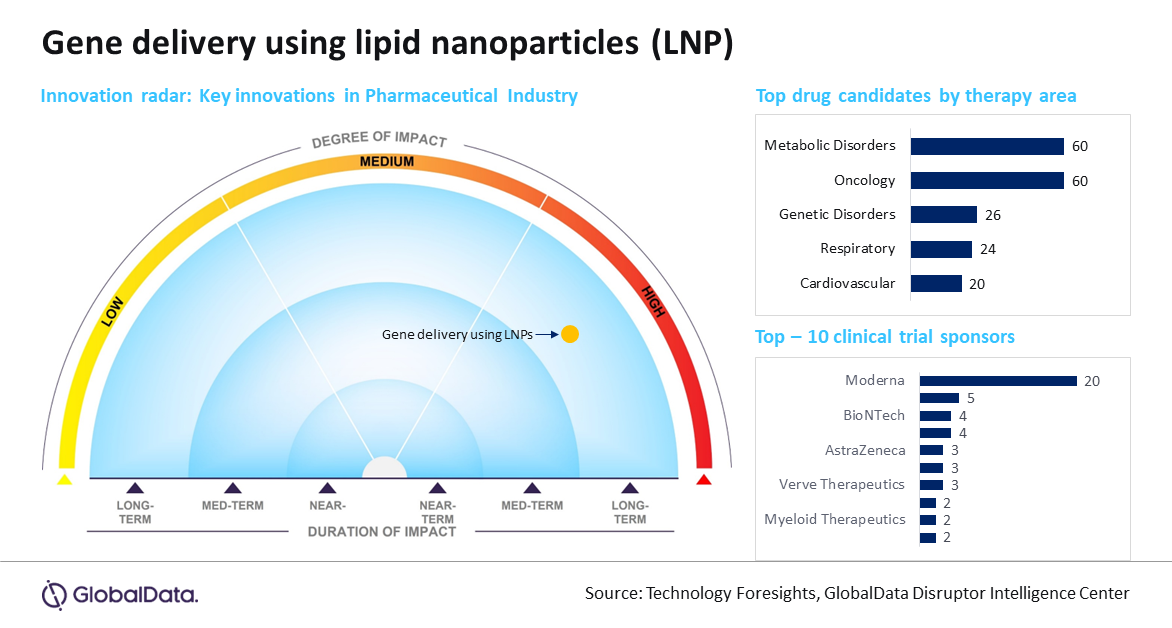
Analysis of LNP innovation leadership on Technology Foresights reveals that large pharmaceutical companies dominate the field, accounting for nearly 60% of all patents. Universities follow with 30%, while startups and small biotech firms contribute 10%.
Key players such as Moderna, Sanofi, and BioNTech are at the forefront of this innovation. Notably, there has been a surge in investment activities from other major pharmaceutical companies seeking to establish leadership in this technology. For example, at least four prominent firms—Merck, Pfizer, GSK, and Takeda—have formed strategic partnerships with startups possessing strong innovation portfolios in lipid nanoparticle technology.
Sourabh Nyalkalkar, Practice Head of Innovation Products at GlobalData, concludes: “Various organizations, including Sanofi, Moderna, IBM, and the University of Toronto, are employing generative AI models to optimize LNP formulations for diverse therapeutic applications. This approach accelerates research in the face of countless possible LNP compositions. LNPs promise to enhance the safety and efficacy of drug delivery and gene therapies while minimizing side effects. Their potential to revolutionize treatments for genetic disorders, cancer, and rare diseases ensures continued interest and investment from both academic and industrial sectors.”
