

The property insurance industry in the Asia-Pacific (APAC) region is projected to grow at a compound annual growth rate (CAGR) of 10.8% from an estimated $93.1 billion in 2023 to $152.2 billion in 2028, in terms of written premiums, according to GlobalData, a leading data and analytics company.
According to GlobalData’s latest report, “Property Insurance Market Trends and Analysis by Region, Line Of Business, Competitive Landscape and Forecast to 2028”, the growth in the APAC property insurance industry is expected to outpace the global average, which is projected to record a CAGR of 8.1% over 2024–28.
Property insurance in APAC is concentrated among the top three markets – China, Japan, and Australia, which are estimated to account for a collective share of 75.2% of the region’s written premiums in 2024. China is expected to lead the property insurance market in APAC, accounting for 36% of the written premiums in 2024, followed by Japan with 23.5% and Australia with a 15.7% share of written premiums.
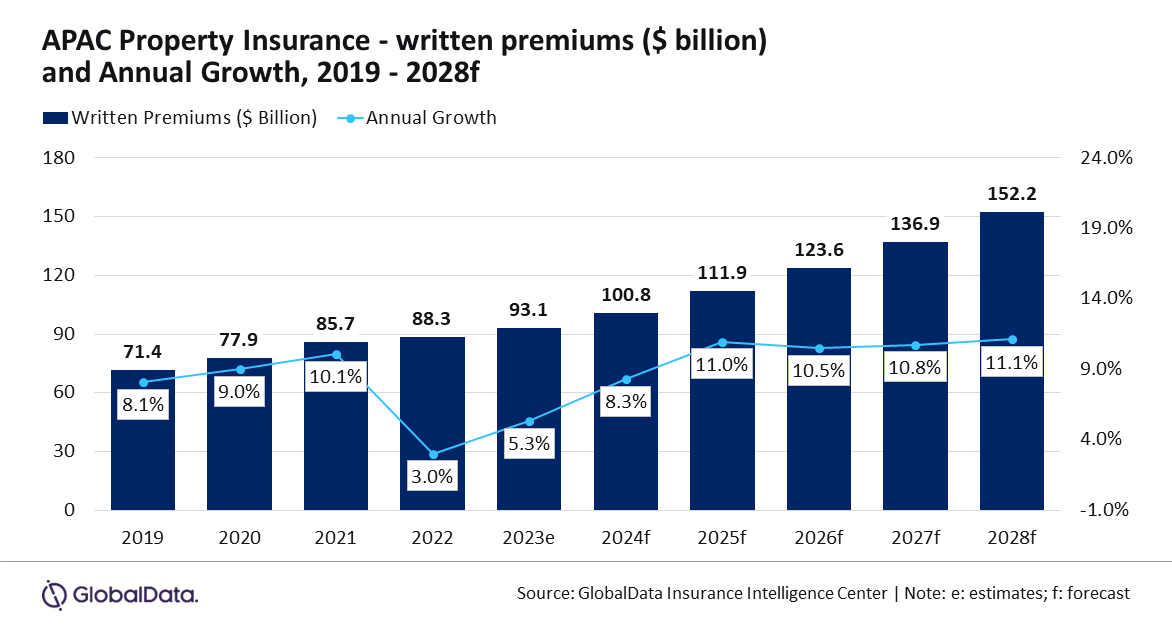
Aarti Sharma, Insurance Analyst at GlobalData, comments: “The APAC property insurance market is poised for significant growth of 8.3% in 2024, driven by disciplined underwriting practices and a rise in premiums for fire and home multi-risk property insurance classes. Favorable regulatory changes and the adoption of advanced technologies such as artificial intelligence (AI) and machine learning (ML) in risk assessment and streamlining the claims process will further fuel the growth of the industry.”
In 2024, the fire and home multi-risk property insurance segments are expected to dominate the property insurance market in APAC due to a surge in natural catastrophic (nat-cat) events.
As per the Insurance Council of Australia (ICA), a severe storm in New South Wales and Queensland in April 2024 registered 19,938 claims with an economic loss of AUD280.3 million ($182.4 million), and the Valentine’s Day storm in Victoria in February 2024 registered more than 27,000 claims with an economic loss of AUD214.8 million ($139.8 million).
Furthermore, worsening losses from natural hazards led the General Insurance Rating Organization of Japan to raise reference rates (benchmark rate) for fire insurance by an average of 5.5% in 2018 to 13% in 2023.
Sharma adds: “The increasing demand for fire and home multi-risk policies can be attributed to the growing awareness of the financial risks of natural disasters and the need for comprehensive coverage. Insurers’ capacity is expected to be limited for loss-making risks and nat-cat exposures due to high reinsurance costs and poor loss ratio performance.”
APAC property insurance growth will also be supported by the adoption of Generative AI and ML in sales, risk modeling, and customer engagement. Risk assessment through advanced analytics provides crucial data insights that identify high-risk areas and aid in risk management and mitigation.
Sharma continues: “Data analysis using AI is helping insurers generate sales leads. Virtual assistants and chatbots are guiding customers through the buying process and helping to interact with customers, offering information on policies and claims status, leading to higher efficiency.”
Favorable regulatory changes are also shaping the property insurance landscape in APAC. In April 2024, China’s National Financial Supervisory Authority (NFSA) issued guidance to promote the high-quality development of green insurance, reinforcing the role of insurance in supporting environmental protection and eco-friendly consumption.
In May 2024, the Commonwealth Government of Australia announced additional funding in its 2022–25 budget to ICA, aimed at enhancing Australia’s disaster preparedness and resilience. The additional funds will enable mitigating risks to homes and communities, which could help alleviate rising insurance costs driven by increased disaster expenses, inflation, and global reinsurance rates.
Sharma concludes: “Premium price increases in fire and home multi-risk due to increased reinsurance costs and exposure to nat-cat events will support the growth of property insurance in APAC over the next five years. Insurers will need to adapt to the changing dynamics of AI and ML and focus on portfolio adjustments to limit high-severity loss exposure while maintaining profitability.”
