

The Chinese general insurance industry is set to grow at a compound annual growth rate (CAGR) of 7.4% from CNY1.6 trillion ($237.2 billion) in 2023 to CNY2.3 trillion ($361.0 billion) in 2028 in terms of gross written premiums (GWP), forecasts GlobalData, a leading data and analytics company.
GlobalData’s Insurance Database reveals that the general insurance industry in China is expected to grow by 7.7% in 2023 and 6.9% in 2024, supported by an increase in vehicle sales, investments in infrastructure projects, favourable regulatory reforms, and a post-pandemic rise in the demand of health insurance.
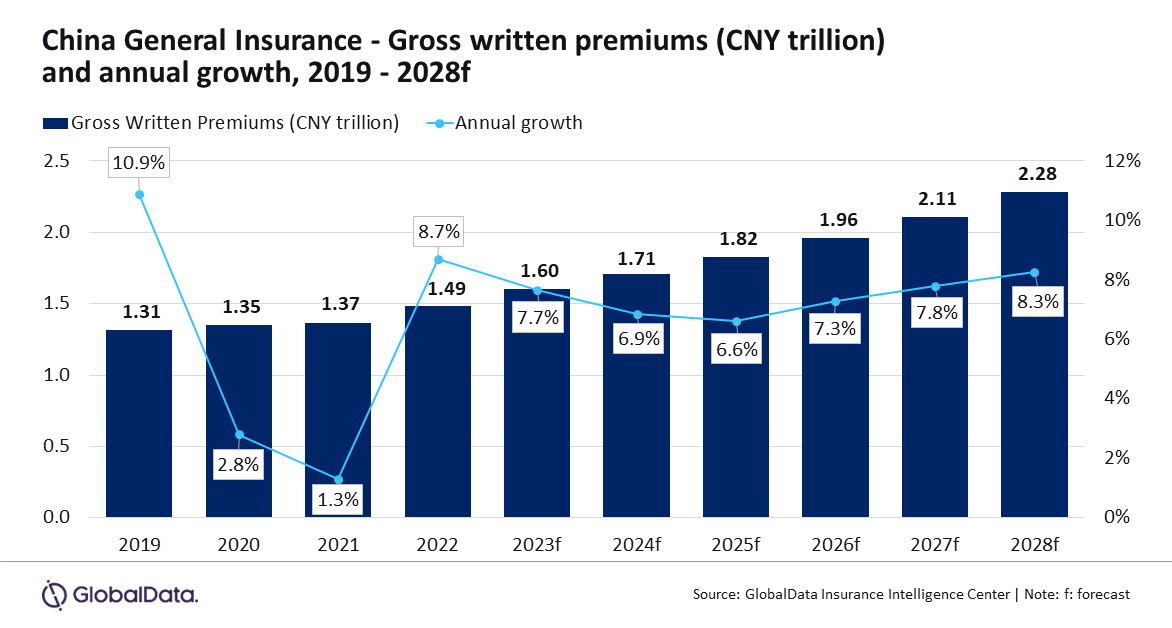
Swetansha Chauhan, Insurance Analyst at GlobalData, comments: “After experiencing a slowdown in 2020 and 2021 due to COVID-19, China’s general insurance industry revived in 2022 and grew by 8.7%, which has continued in 2023. With the government’s push to revive the major sectors of the economy, the general insurance industry looks poised for steady growth over the next five years.”
Motor insurance is the leading line of business, estimated to account for a 54.4% share of the general insurance GWP in 2023. The share of motor insurance has declined from 71.0% in 2017, as general insurers in China diversify their portfolio and progressively reduce their reliance on motor insurance to increase penetration in other lines.
The motor insurance market in China is expected to grow by 6.1% in 2023, driven by an increase in vehicle sales that has grown by 8% from January to August 2023 as compared to the same period last year, as per China Association of Automobile Manufacturers (CAAM). The government’s push to revive the automobile sector by reducing the purchase tax on small-engine vehicles and extending the subsidy for electric vehicles (EVs) until 2027 will support motor insurance growth.”
Swetansha adds: “Higher EV sales have also supported the growth of motor insurance in 2023. Additionally, higher insurance premiums for electric and hybrid vehicles than those for internal combustion engine vehicles, which will support motor insurance growth.”
Favorable regulatory reforms will also support the growth of motor insurance. In January 2023, the country’s regulator raised the premiums’ pricing coefficient limits from 0.65-1.35 to 0.5-1.5 when determining commercial motor premiums. This will provide more freedom to the insurers to determine premium rates based on driving records and promote competition in the market. Motor insurance is expected to grow at a CAGR of 4.5% during 2023 and 2028.
Property insurance is the second largest line of business, accounting for 15.1% share of the GWP in 2023. The Chinese construction industry is expected to register an annual average growth of 6.5% during 2024-2027 supported by investments in infrastructure. The government plans to invest more than $1.8 trillion in infrastructure projects in 2023, and the push to accelerate these projects will support property insurance growth during 2024-28.
Property insurance will also benefit from the growth in the agriculture sector, as China is the largest agriculture-producing country in the world. Agricultural insurance is estimated to grow by 22.2% in 2023, supported by an increased frequency of extreme climate conditions such as heat waves and heavy rains. Property insurance is expected to grow at a CAGR of 12.2% during 2023-28.
Personal Accident and Health (PA&H) insurance is the third largest line of business, accounting for 14% of the general insurance GWP in 2023. PA&H insurance is expected to grow by 3.7% in 2023, primarily driven by increased demand for health insurance after the pandemic and a rise in medical costs due to inflation.
Liability, Financial lines, Marine, aviation, and transit (MAT), and Miscellaneous insurance accounted for the remaining 16.5% of the general insurance GWP in 2023.
Swetansha concludes: “Favourable regulatory developments and government initiatives will support the Chinese general insurance industry’s growth. However, global economic and geopolitical instabilities will remain a major challenge for Chinese general insurers over the next five years.”
