

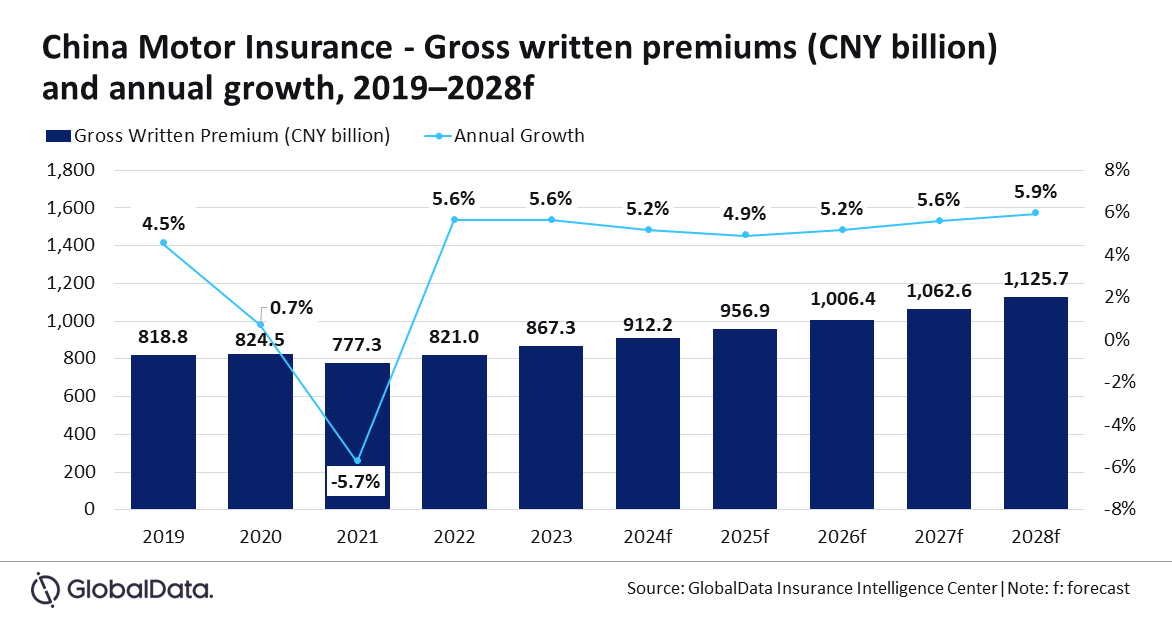
The Chinese motor insurance market is set to grow at a compound annual growth rate (CAGR) of 5.4% from CNY912.2 billion ($127.4 billion) in 2024 to CNY1.1 trillion ($158.9 billion) in 2028, driven by rising vehicle sales and the growing popularity of new energy vehicles (NEV), forecasts GlobalData, a leading data and analytics company.
GlobalData’s Insurance Database reveals that the Chinese motor insurance industry is expected to grow by 5.2% in 2024, driven by growing vehicle sales. According to the China Association of Automobile Manufacturers (CAAM), automobile sales increased by 10.2% to 9.1 million units during January-April 2024 as compared to the same period during the previous year.
Swarup Kumar Sahoo, Senior Insurance Analyst at GlobalData, comments: “An increase in NEV sales has been one of the major factors of growth in the Chinese motor insurance industry. As per CAAM, NEV sales accounted for a 30.4% share of the total vehicles sold during the first ten months of 2023 and grew by 37.8% as compared to the same period in 2022. The trend has continued in 2024, as NEV sales grew by 33.3% in Q1 2024 as compared to the same period in 2023.”
Additionally, higher premium prices of NEVs as compared to internal combustion engine (ICE) vehicles have supported motor insurance growth. As per the China Securities Investor Services Center (ISC), the average premium price of NEV insurance policies stood at CNY4,003 in 2023 against CNY2,209 for traditional motor insurance policies.
Sahoo adds: “Limited availability of claims data for NEVs is posing a challenge for the insurers to assess the risks and adjust the premium prices, which has a direct impact on their profitability. In the absence of ample data, high insurance claims arising from NEVs will have a negative impact on the profitability of the insurers in the short term.”
The accident rates of NEVs are higher as compared to ICE vehicles, which will also prompt insurers to reassess their risk exposure. As per the Insurance and Economic Development Research Center, the use of new technologies without extensive testing has led to higher accident rates among NEVs as compared to traditional fuel vehicles. As a result, NEV premiums rates increased by 20% in 2023.
Considering the future growth prospects of the NEV market, insurers have started investing in new age technologies such as big data, artificial intelligence (AI), the Internet of Things (IoT) and machine learning to enhance their capabilities and reduce associated risks. The adoption of such technologies not only provides real time data but also actionable insights, which increases the underwriting capability, enabling insurers to offer tailored products, especially for NEVs. Insurers can also mitigate fraudulent claims and streamline claims processing.
Sahoo continues: “The existing regulations in China have a benchmark premiums structure in place that restricts insurers from increasing premium prices beyond a certain limit. As a result, small and medium-sized insurers are keeping a distance from offering policies for NEVs. In 2023, People’s Insurance Company of China (PICC) issued 2.82 million NEV insurance policies, which constitutes 34% of the total NEVs in China.”
Considering the trend and growth potential in the Chinese NEV insurance market, NEV manufacturers have started entering the insurance space. In 2023, BYD Property & Casualty Insurance received approval for conducting insurance business in China, whereas in the same year, BMW (China) Insurance Brokerage Co. Ltd. received the license to operate in the insurance brokerage business in China. At the end of 2023, three original equipment manufacturers (OEMs) held insurance licenses to operate in the country, whereas 10 others possessed an insurance intermediary license.
Sahoo concludes: “The lack of claims data on NEVs will impact the profitability of Chinese motor insurers in the short to medium term as insurers will need to regularly assess their risk exposure. Prudent underwriting, investments in technology, and early entry into the NEV insurance market will benefit insurers and support Chinese motor insurance growth over the next five years.”
