
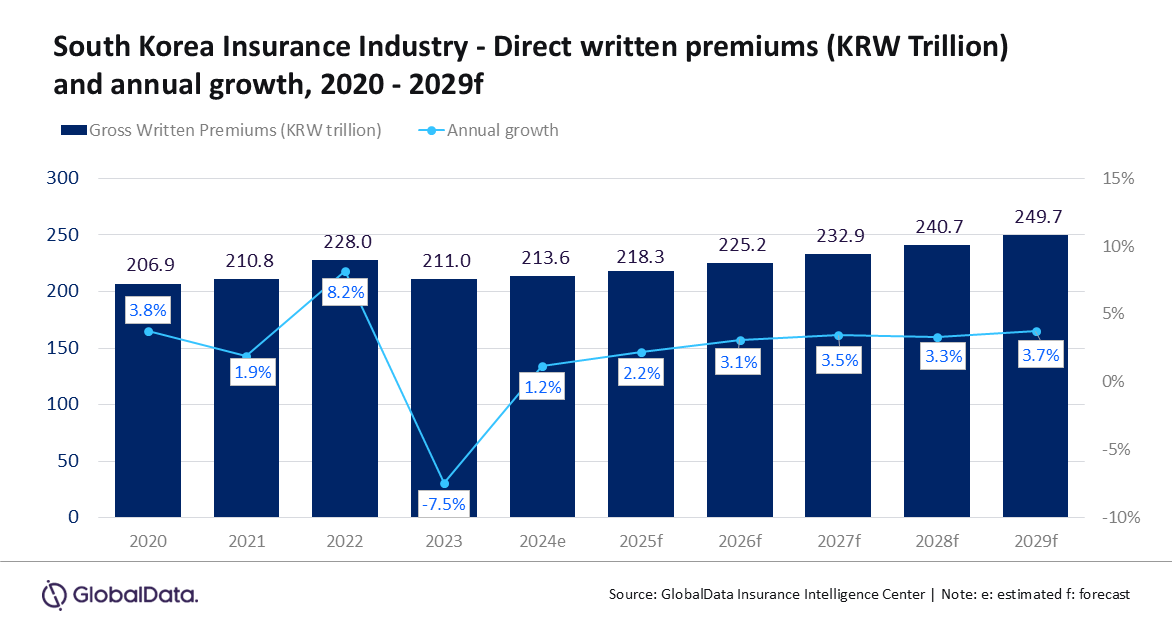
The South Korean insurance industry is expected to grow at a compound annual growth rate (CAGR) of 3.4% during 2025-29, from KRW218.3 trillion ($167.1 billion) in 2025 to KRW249.7 trillion ($191.2 billion) in 2029, driven by demographic changes and the implementation of new reporting standards such as IFRS 17 and K-ICS, says GlobalData, a leading data and analytics company.
Swarup Kumar Sahoo, Senior Insurance Analyst at GlobalData, comments, “South Korea’s insurance industry is undergoing transformative changes due to the adoption of new reporting standards such as IFRS 17 and K-ICS that will improve solvency standards, increase transparency, and prompt insurers to diversify their product offerings. Also, demographic shifts, such as an aging population and declining fertility rates are changing consumer preferences that will support growth for different insurance products.”
As per GlobalData’s Insurance database, the South Korean insurance industry is projected to grow by 2.2% in 2025. Life insurance is expected to account for 84% share of the industry’s DWP in 2025, while general insurance will contribute the remaining 16% share.
South Korea’s life insurance sector is expected to grow by 1.8% in 2025, supported by demographic changes. The country’s demographic shift towards an aging population is a significant driver for the life insurance sector. As per Statistics Korea, the median age is expected to increase to 48.5 years in 2030 and to 52.6 years by 2040. Furthermore, life expectancy is projected to reach 87.2 years by 2040, which will create heightened demand for long-term financial planning and insurance products tailored to the elderly, ensuring sustained growth in the life insurance market.
Moreover, the implementation of IFRS 17 and K-ICS has prompted insurers to focus on lower-risk, long-term insurance products, such as protection and health insurance. This regulatory shift has led to the development of more sophisticated capital strategies and diversified product offerings.
Sahoo adds: “The enhanced transparency and comparability of financial statements under IFRS 17 have also encouraged insurers to create more customer-centric products, further stimulating demand and growth in the life insurance sector. Consequently, the life insurance sector is expected to grow at a CAGR of 3.1% from 2025 to 2029.”
The growth of the general insurance sector will be supported by the increasing demand of policies covering fire and other natural catastrophic (nat-cat) events. With over 30,000 fire accidents reported in 2024, there is a growing demand for insurance policies covering fire and natural hazards. Additionally, the expansion of electric vehicle (EV) charging infrastructure introduces new fire-related risks, further driving the growth of general insurance.
Rising demand for liability insurance policies will also support general insurance growth. Favorable regulatory developments and mandatory insurance classes for both individuals and businesses, encompassing third-party liability and professional indemnity policies, are expected to drive growth in liability insurance. General insurance is expected to grow at a CAGR of 5.1% during 2025-29.
Sahoo concludes: “The South Korean insurance industry presents growth opportunities driven by regulatory reforms, demographic changes, and changing consumer requirements. Rising losses due to an increasing frequency of fire and other nat-cat events and offering customer centric insurance products will remain a focus area for insurers over the next five years.”
