

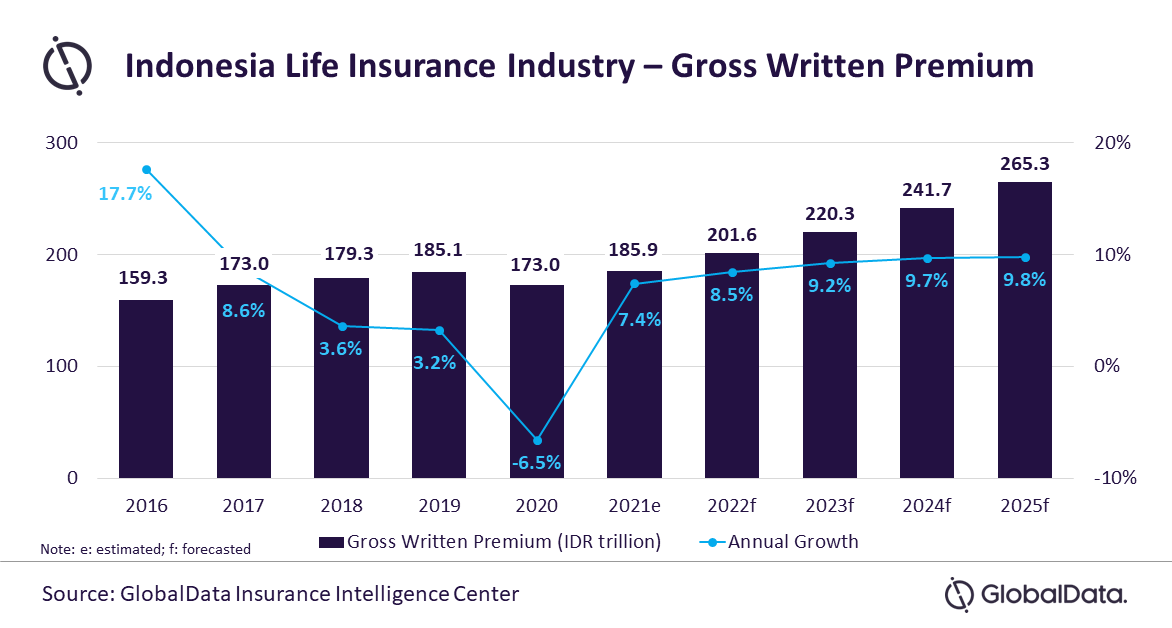
The life insurance industry in Indonesia is projected to grow at a compound annual growth rate (CAGR) of 8.9% from IDR173.0 trillion ($11.8bn) in 2020 to IDR265.3 trillion ($17.4bn) in 2025, in terms of gross written premiums (GWP), according to GlobalData, a leading data and analytics company.
According to GlobalData, the Indonesian life insurance industry is poised for a strong recovery in 2022 driven by increased insurance awareness due to the COVID-19 pandemic and improving economic conditions.
Deblina Mitra, Senior Insurance Analyst at GlobalData, comments: “Life insurance industry in Indonesia rebounded strongly in 2021 with the pandemic highlighting the financial benefits associated with life insurance products, thereby supporting its demand.”
Life insurance growth was also supported by a stable macroeconomic environment led by the government’s accommodating fiscal and monetary policy. These policies created a stable investment environment for insurers and allowed them to offer products with attractive returns. The trend is expected to continue in 2022, and the life insurance industry is projected to grow by 8.5% in 2022.
Endowment is the leading business line in Indonesia’s life insurance industry accounting for over 82% of the GWP in 2020. Stable market returns on unit-linked products despite a pandemic-driven slowdown in 2020 and 2021 supported demand for endowment products. Additionally, in 2020, the regulator allowed many insurers to sell unit-linked products online, thereby increasing its accessibility and aiding growth. These factors will continue to support endowment insurance which is expected to grow by 8.2% in 2022.
Protection insurance products such as term life and personal accident and health (PA&H) collectively accounted for 15% of the life insurance GWP in 2020. Both these lines are expected to record a growth of around 9% each in 2022.
PA&H insurance in Indonesia is mostly sold as an add-on to the government’s universal health insurance scheme. While the universal scheme covers basic healthcare costs, add-on insurance covers the remaining healthcare costs up to the policy limit and provides additional facilities such as shorter-wait time. Around 10% of the population in the country avails add-on insurance.
Growth in private healthcare, as well as traction in remote health services, will emerge as a key growth driver for PA&H insurance. With the rise in the high-income population and people seeking private healthcare, insurers are developing premium health insurance products. Insurers are also enhancing the partnership with digital healthcare providers to increase coverage. Examples include Prudential’s partnership with online healthcare startup Halodoc and Alodokter which provides affordable healthcare services including health insurance packages.
Mitra concludes: “Indonesia’s low life insurance penetration rate of 1.1%, compared to emerging economies’ average of 2.3%, provides ample opportunity for life insurance growth in the country. Increasing awareness and conducive macroeconomic environment are expected to support its growth over the next five years.”
