

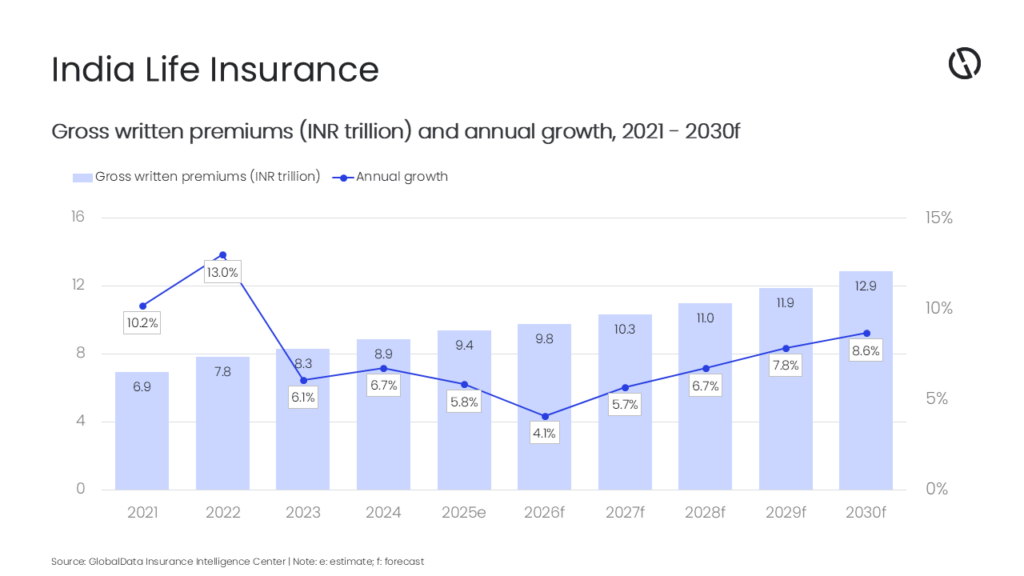
India’s life insurance industry is projected to grow at a compound annual growth rate (CAGR) of 7.2%, increasing from INR9.8 trillion ($108.8 billion) in 2026 to INR12.9 trillion ($140.7 billion) by 2030, in terms of gross written premium (GWP), according to GlobalData, a leading intelligence and productivity platform.
GlobalData’s Insurance Database estimates that India’s life insurance industry will grow by 4.1% in 2026. The growth will be driven by industry liberalization, tax policy reforms, and the launch of a digital insurance marketplace, Bima Sugam. These developments are poised to enhance coverage and help close the country’s protection gap over 2026–30.
Manogna Vangari, Insurance Analyst at GlobalData, comments: “India’s life insurance landscape is poised for transformation. From February 2026, India’s life insurance industry allowed 100% foreign ownership, unleashing global capital to expand coverage in underserved areas and drive innovation with advanced technology and best practices. Intensified competition from fully foreign-owned firms is expected to lower premiums and improve offerings, and domestic insurers must adapt swiftly.”
After the 18% GST on life and health insurance premiums was removed in September 2025, regulators mandated that insurers pass on the full savings to policyholders. As a result, the industry has achieved notable affordability gains. Consequently, policies have become noticeably more affordable, reducing financial burden for customers, even as insurers managing increased costs over time.
Vangari adds: “Regulatory reforms–such as 100% FDI, stricter conduct norms, enhanced policyholder protections, and lighter capital requirements for reinsurers– combined with innovation in product design, such as milestone‐linked term plans, deferred annuities and hybrid products, enhancements to unit linked insurance plan (ULIPs), and improved underwriting have broadened demand, particularly among rural populations, entrepreneurs, and non‐resident Indians, supporting the goal of Insurance for All by 2047.”
According to the Insurance Regulatory and Development Authority of India (IRDAI), new business premiums grew by 18.1% year‐over‐year in February 2026, reversing a decline of 11.6% in February 2025. Growth was widespread across both individual and group segments.
GlobalData expects this momentum to continue. New business direct written premiums are projected to exceed INR4.4 trillion ($48.7 billion) in 2026, a 4% increase over 2025 and to grow at a CAGR of 7.2% through 2030. Meanwhile, linked business, including ULIPs and investment‐linked policies, is estimated to comprise about 21.6% of total life GWP in 2026 and to grow at 10.9% annually through 2030.
Additionally, single‐premium policies are forecast to grow by 3.6% in 2026 and to achieve a CAGR of 7.9% between 2026–30. Pension insurance is expected to make up approximately 13.6% of life insurance GWP in 2026, with a CAGR of around 6.6% over the same period.
Starting in June 2026, the IRDAI‐backed Bima Sugam marketplace will begin offering zero‐commission, standardized insurance products, beginning with new‐vehicle motor policies, followed by health, and then term life, aimed at reducing premiums, increasing transparency, and simplifying the customer experience from purchase through renewals and claims.
Unlike private aggregators that reward agents with commission, Bima Sugam will replace those commissions with a modest platform fee (about 5–7%), which should directly lower policyholder costs. The entire process will be fully digital and paperless, enhancing ease of use and speed.
Vangari concludes: “The combined changes—GST removal, regulatory reforms, product innovation, and the launch of Bima Sugam are expected to reinforce affordability, broaden access, and drive penetration. However, eliminating GST also removes input tax credits for insurers, squeezing margins. The industry’s projected growth rate of 7.2% CAGR through 2030 will depend on whether foreign capital inflows and scale efficiencies can offset these margin pressures without sacrificing service quality.”
