

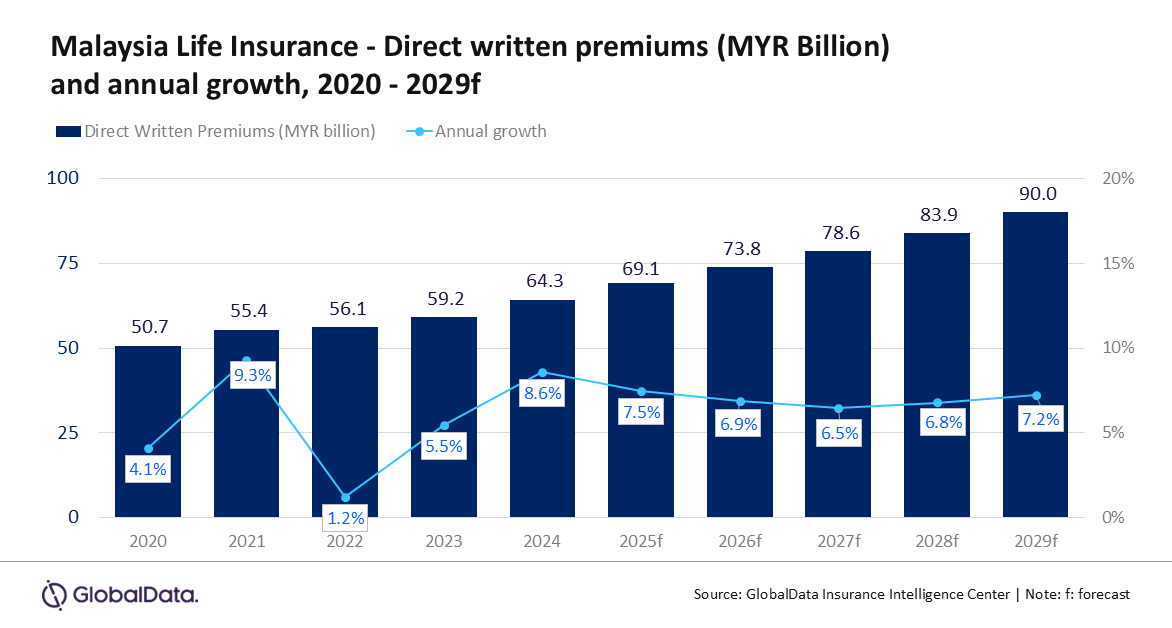
The life insurance market in Malaysia is projected to grow from MYR69.1 billion ($15.6 billion) in 2025 to MYR90.0 billion ($20.4 billion) in 2029, registering a compound annual growth rate (CAGR) of 6.8% in terms of direct written premiums (DWP), according to GlobalData, a leading data and analytics company.
According to GlobalData’s Global Insurance Database, the Malaysian life insurance market is estimated to register 7.5% growth in 2025, driven by steady demand for protection-based and savings-linked products. This growth will be further supported by rising household incomes, digital adoption by insurers, and government initiatives aimed at expanding financial inclusion.
Swarup Kumar Sahoo, Senior Insurance Analyst at GlobalData, comments: “The Malaysian life insurance market is witnessing a transformative phase. The market’s expansion is attributed to heightened consumer awareness, government initiatives on microinsurance, and the increasing penetration of life insurance products. The rise in policy ownership among Malaysians, from 41.5% in 2019 to 45.5% in 2024, indicates a positive trend towards greater financial security among them.”
The Perlindungan Tenang framework, part of the government’s microinsurance initiative, recorded more than 530,000 subscriptions for microinsurance and microtakaful products in 2024. This highlights the demand for and the role of microinsurance in offering financial security, especially for individuals in lower-income brackets. The growing acceptance of life insurance products among this consumer segment is likely to enhance market inclusivity and resilience.
On January 2, 2025, Bank Negara Malaysia launched a regulatory framework for Digital Insurance Technology Operators (DITOs) to drive digital transformation in the insurance sector. This initiative, part of the Financial Sector Blueprint 2022–26, aims to enhance market inclusion and efficiency. The opening of DITO license applications has led to a surge in interest, reflecting a commitment to innovation and addressing protection gaps in the Malaysian insurance market.
Sahoo add: “The focus on combining technology with empathetic customer support is expected to boost satisfaction and loyalty, ultimately driving premium growth. The DITO framework is anticipated to create a more competitive landscape, increasing access to insurance products for underserved populations and fostering market growth.”
Endowment insurance remains the leading life insurance product, expected to account for 78% of the life insurance DWP in 2025. This product type appeals to consumers seeking a blend of insurance coverage and savings or investment opportunities. The increasing demand for investment-linked policies, which saw a 24.8% increase in new business premiums, indicates a growing preference for dynamic insurance solutions that facilitate wealth accumulation.
Sahoo continues: “In contrast, traditional non-linked products experienced slower growth, highlighting a shift in consumer behavior. The introduction of innovative products that combine healthcare protection with flexible coverage options further underscores the importance of aligning offerings with consumer needs. With a projected CAGR of 6.9% for endowment insurance during 2025-29, the market is poised for stable growth, presenting opportunities for insurers to diversify and enhance customer engagement strategies.”
Whole life insurance is expected to be the second largest segment, accounting for 7% of the life insurance DWP in 2025. This line of business is anticipated to experience consistent growth from 2025 to 2029, supported by demographic changes in Malaysia. The DWP for whole life insurance is expected to rise as the aging population increases the demand for long-term financial security and retirement planning solutions.
Other life insurance lines, such as term life and other life insurance products, are estimated to account for the remaining 15% share of the life insurance DWP in 2025.
Sahoo concludes: “The outlook for the life insurance market in Malaysia remains optimistic. The combination of regulatory enhancements, technological advancements, and increased consumer awareness will drive sustained growth in the sector over the next five years. Insurers that prioritize innovation and customer-centric offerings are likely to capture a larger market share, ensuring a resilient and competitive insurance landscape in Malaysia.”
