

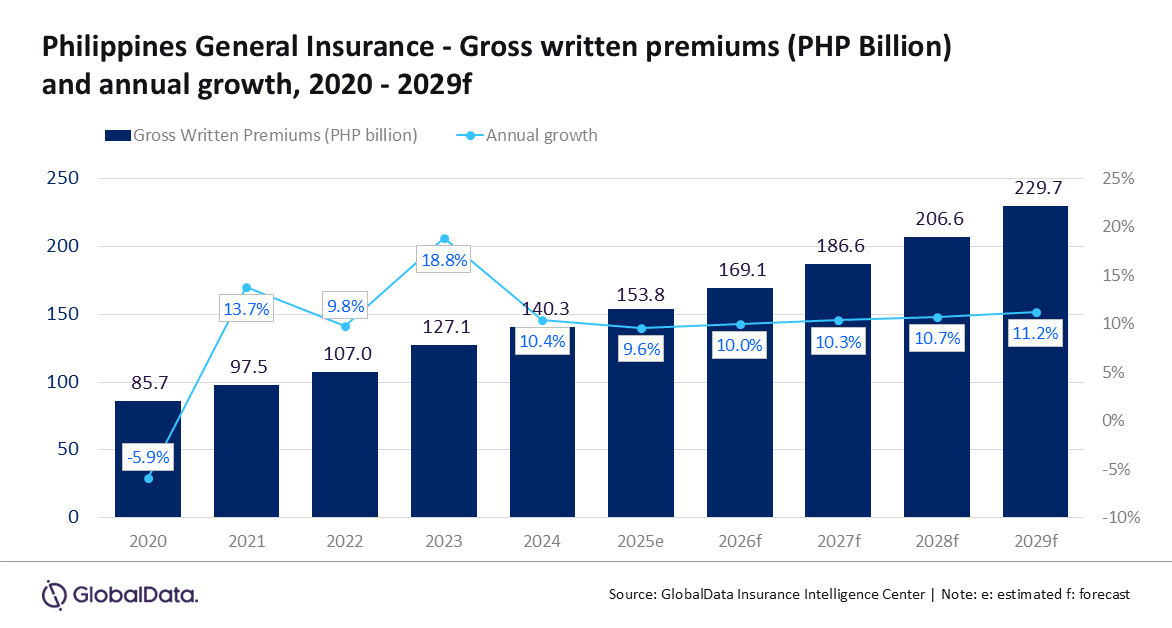
The general insurance industry in the Philippines is projected to grow at a robust compound annual growth rate (CAGR) of 10.6%, increasing from PHP153.8 billion ($2.7 billion) in 2025 to PHP229.7 billion ($3.9 billion) by 2029, in terms of gross written premium (GWP), according to GlobalData, a leading data and analytics company.
According to GlobalData’s Philippines General Insurance Report, the general insurance market in the Philippines is estimated to reach PHP153.8 billion ($2.7 billion) in 2025, reflecting an annual growth rate of 9.6%. This growth is attributed to the rising demand for comprehensive insurance solutions due to frequent natural disasters, the expansion of digital platforms that enhance accessibility, and the introduction of parametric insurance products that provide immediate financial relief.
Swarup Kumar Sahoo, Senior Insurance Analyst at GlobalData, comments: ” Heightened climate risks and digital transformation are reshaping the general insurance market in the Philippines. The government’s proactive approach to disaster response and the introduction of parametric insurance are crucial in addressing the protection gap, while digital initiatives are making insurance more accessible to underserved communities.”
The current insurance penetration rate in the Philippines remains low at below 1.9%, indicating a substantial opportunity for growth. The government’s initiatives to enhance disaster preparedness, the rising awareness of insurance products, particularly among low-income households, and the growing popularity of microinsurance products are expected to increase insurance industry penetration.
Property insurance is the largest line of business and is expected to account for 39.5% of the general insurance GWP in 2025. The country faces significant climate risks, with an annual average of 20 storms and typhoons impacting it. The introduction of parametric insurance solutions is anticipated to provide quicker payouts based on predefined parameters, thereby enhancing the resilience of local governments and communities to climate-related disasters. This shift towards comprehensive insurance solutions is essential, given the current catastrophe protection gap of 98% compared to the global average of 58%, according to the World Risk Index.
Sahoo adds: “The property insurance market is also benefiting from government initiatives aimed at expanding coverage for farmers and enhancing disaster resilience. The Philippine Crop Insurance Corporation (PCIC) is collaborating with local governments to implement satellite mapping technology to expedite claims processing, further boosting consumer confidence and supporting the growth of the property insurance sector.”
Motor insurance, the second leading line of business, is expected to account for 23.5% of the general insurance GWP in 2025. It is projected to grow at a CAGR of 7.3% during 2025-29. Regulatory measures, such as the proposed increase in insurance coverage for private car passengers, are likely to elevate premiums as insurers adjust to higher liability risks.
Additionally, the push for electric vehicle (EV) adoption, supported by tax exemptions, may reshape the motor insurance landscape, prompting insurers to adapt their policies to accommodate the characteristics of EVs.
Marine, aviation, and transit insurance are projected to account for 7.9% of the general insurance GWP in 2025, supported by a rise in imports and exports. According to the Philippines Statistics Authority, total exports rose by 5.7% in Q1 2025, whereas imports increased by 8.4%. The Philippine Ports Authority anticipates continued growth in cargo and passenger volumes, supported by infrastructure investment.
Other general insurance lines, such as financial lines, liability, and miscellaneous, are estimated to account for the remaining 29.2% share of the general insurance GWP in 2025.
Sahoo concludes: “The Philippines’ general insurance market will continue its strong performance during 2025-29. The increasing frequency of climate-related disasters and the rise of microinsurance products are expected to enhance insurance penetration and accessibility. As the market continues to evolve, the focus on enhancing accessibility and inclusivity will be crucial in addressing the protection gap and fostering a resilient insurance landscape in the Philippines. Losses due to natural disasters and the expected reciprocal tariff from the US will change the dynamics and are expected to pose a threat to insurers’ profitability.”
