
Following the news that the UK Law Commissions has released its final report on the regulatory framework for autonomous vehicles;
Benjamin Hatton, Insurance analyst at GlobalData, a leading data and analytics company, offers his view:
“The regulatory framework suggested by the UK Law Commissions will be a key trigger for the progression of autonomous vehicles. Clear definitions of liability, along with a black-and-white determination of a car’s driverless capabilities, should help to pave the way for greater support and acceptance in the development of self-driving vehicles. The report is clear in its suggestions: users of vehicles operating under ‘self-driving features’ should be legally protected in the event of a collision.
“For insurers, explicitly stating where liability falls in the event of an accident has been a major sticking point. By redefining the driver as a ‘user-in-charge’ and allocating responsibility to the manufacturer, insurance should become more straightforward for providers. The introduction of fully self-driving cars in the future will mark a shift in the way motor insurance risks are established as driver error is fundamentally removed.
“Until the point that vehicles are definitively self-driving, the driver is still accountable for incidents where the technology can only be considered as “driver-assisting”. This will give insurers a good indication of the pathway towards this new technology, allowing them to gain a better understanding of the technology, through trials and tests, before developing insurance policies.
“With a growing number of legal cases surrounding incidents involving partially automated vehicles, the framework will aid insurers in assessing liability more effectively. As autonomous vehicles collect and report vast swathes of data in real-time, making this data accessible will also act as a hugely important asset to investigators in assessing driver or technological fault.
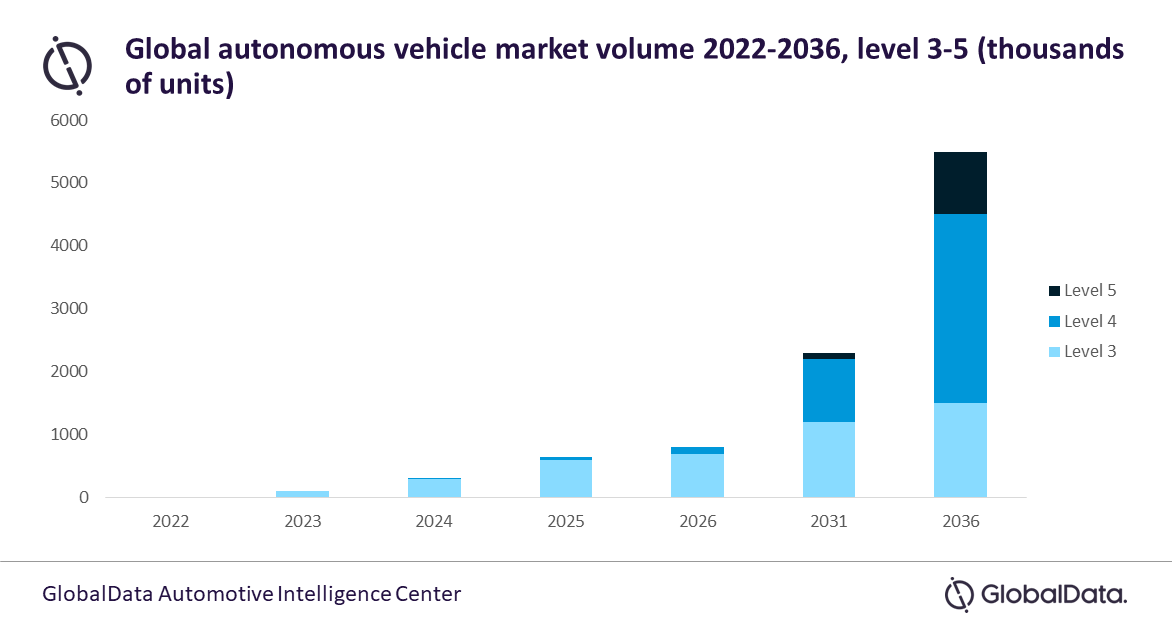
“Of course, there is still a long way to go in enacting these suggestions into law. The point at which a vehicle’s technology moves from driver-assisting to autonomous is not yet explicitly defined. Nor has the capacity of manufacturers to create fully autonomous vehicles been realised yet. We predict for full autonomous vehicles (level 5) to begin production around 2030, as suggested by figure 1, with around 1 million level 5 vehicles produced in 2036. As the technology continues to develop and as more information is generated, a clearer timeframe on the rollout of truly autonomous vehicles will be seen. The process is still in its relative infancy, but insurers will be pleased to see a pathway for autonomous vehicles slowly come to the fore.”
