

The structural heart occlusion (SHO) devices market registered aggressive growth in recent years, with a compound annual growth rate (CAGR) of 25% from 2015-2022. Driven mainly by Boston Scientific’s Watchman FLX device, this market has grown over 150% in 2022 compared to 2019, far outpacing other cardiovascular device markets. The SHO devices market is forecast to exceed $7 billion by 2033, according to GlobalData, a leading data and analytics company.
Joselia Carlos, Medical Devices Analyst at GlobalData, comments: “Physicians implant the Watchman FLX device in the left atrial appendage (LAA) of patients with atrial fibrillation to prevent the formation of a blood clot that would lead to a stroke. Physicians typically prescribe blood-thinners first before resorting to LAA implanted occlusion devices (e.g., the Watchman FLX). However, if patients have contraindications against blood-thinners, LAA implanted occlusion devices then become the recommended treatment option.”
The market value of the LAA implanted occlusion devices experienced a high CAGR of 25%, increasing from $132 million in 2015 to $1.79 billion in 2022. According to Boston Scientific’s 2022 financial report, the Watchman FLX has been implanted in over 300,000 patients since its FDA and CE mark approvals, both in 2019. As a result of the Watchman FLX, Boston Scientific currently holds a 94% market share of the LAA implanted occlusion device market.
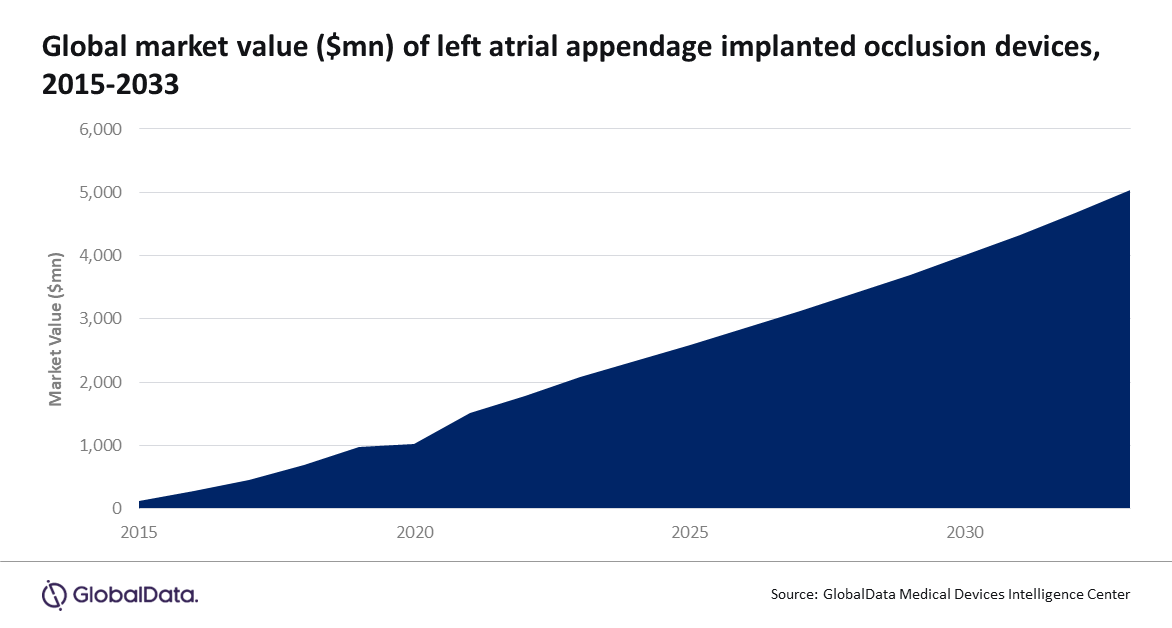
Carlos adds: “At one point, the version prior to the Watchman FLX, the Watchman 2.5, practically had 100% market share because it was the only LAA implanted occlusion device that was FDA-approved at the time. Then, in 2021, Abbott gained FDA approval for their LAA implanted occlusion device—the Amplatzer Amulet. While Abbott successfully gained some market share, Boston Scientific’s Watchman device remains the number one device for LAA implanted closure procedures.”
While the Watchman device is widely used in the US and Europe, this exponential growth cannot be assumed in other countries once the Watchman becomes commercially available in those nations. For example, since the Watchman device’s introduction in India in 2017, only about 50 LAA closure procedures have been done in the whole country, according to GlobalData’s estimates.
Carlos concludes: “There is a strong opposition against the use of the Watchman device amongst doctors in India because of three reasons—the procedure is expensive, associated adverse events, and the procedure’s complexity. Even though the Watchman device has been incredibly successful in the US and Europe, it has yet to break through in some countries.”
