
Pulsed-field ablation (PFA) catheters are now available in several countries across North America, Europe, Asia-Pacific, and Middle East and Africa. Interestingly, the average selling price of PFA catheters is approximately $2,000 to $3,000, more than the average ablation catheter. PFA catheters have become increasingly popular amongst physicians, so much so that that the electrophysiology (EP) ablation catheter market value is expected to reach $15 billion in 2033, forecasts GlobalData, a leading data and analytics company.
Joselia Carlos, Senior Medical Device Analyst at GlobalData, comments: “PFA catheters are popular amongst physicians because of their technology. Traditional thermal ablation procedures (i.e., radiofrequency or cryoablation) use highly intensive energy that typically damages nearby structures such as the esophagus and pulmonary vein. PFA creates lesions in cardiac tissue nonthermally via electroporation and within milliseconds, decreasing the likelihood of injuring nearby structures.”
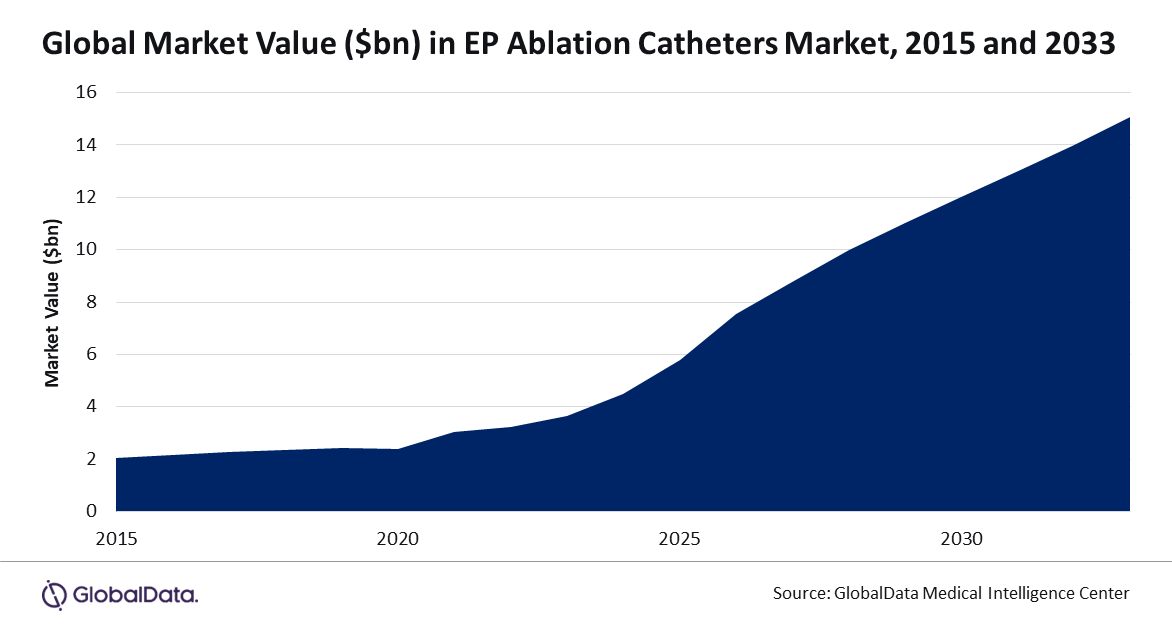
Approximately 1.7 million EP ablation procedures are forecasted to occur in 2024, with 20% of these procedures being treated by PFA. By 2030, PFA will treat 75-80% of EP ablation procedures and will eventually plateau around this percentage.
Carlos adds: “PFA has certainly cannibalized the market, but it will not take over completely. Some restrictions for implementing PFA include geographic availability, high procedure cost, and technicalities behind the procedure. In these cases, physicians will resort to legacy procedures—most notably, radiofrequency and cryoablation.”
Boston Scientific is currently spearheading the market with its Farapulse System, as it possesses 64% of shares, followed by Medtronic with its PulseSelect, and Biosense Webster with its Varipulse System. In 2024 alone, Boston Scientific acquired over 20% of shares in the EP ablation catheters space after the US market release of its Farapulse System.
Despite Boston Scientific’s exponential growth, Biosense Webster still remains the US market leader in the EP ablation catheters space due to its US release of the QDOT Micro Tip Catheter, whose volume growth grew by 70% between 2023 and 2024 alone.
Carlos concludes: “Boston Scientific’s Farapulse System is currently physicians’ most preferred PFA catheter, likely because of more familiarity with the device since it has been in the international market the longest and has achieved better results in clinical trials than the other two catheters. However, Biosense Webster solidified its position as the US market leader in the EP ablation market by its constant innovation efforts and new product releases.”
