

Liver fibrosis is a key characteristic that represents the severity of liver illnesses and is an important factor that helps forecast the progression of liver disorders toward cirrhosis. Although liver biopsies are currently considered to be the gold standard for the diagnosis and histological assessment of nonalcoholic fatty liver disease/nonalcoholic steatohepatitis (NAFLD/NASH), they are not without limitations (Li et al., 2022; Zeng et al., 2022). However, noninvasive procedures could evolve for diagnosing and monitoring NAFLD/NASH in future, says GlobalData, a leading data and analytics company.
Sravani Meka, Senior Immunology Analyst at GlobalData, comments: “There has been much interest in developing non-invasive tests (NITs) to detect markers of fibrosis. These NITs are usually categorized based on the test’s modality (such as imaging or serum blood tests) or its components (direct markers versus indirect markers of fibrosis).
“Serum biomarkers identified via multi-biomarker panel blood tests and non-invasive imaging tests (Transient elastography (VCTE), Shear wave elastography (SWE), and Magnetic resonance elastography (MRE)) can be used to identify patients with liver steatosis, stage level of fibrosis, and diagnose NAFLD/NASH.
“While non-invasive imaging and serum blood tests are cost-effective, accessible, and have high reproducibility compared to a liver biopsy, they also have their fair set of limitations.”
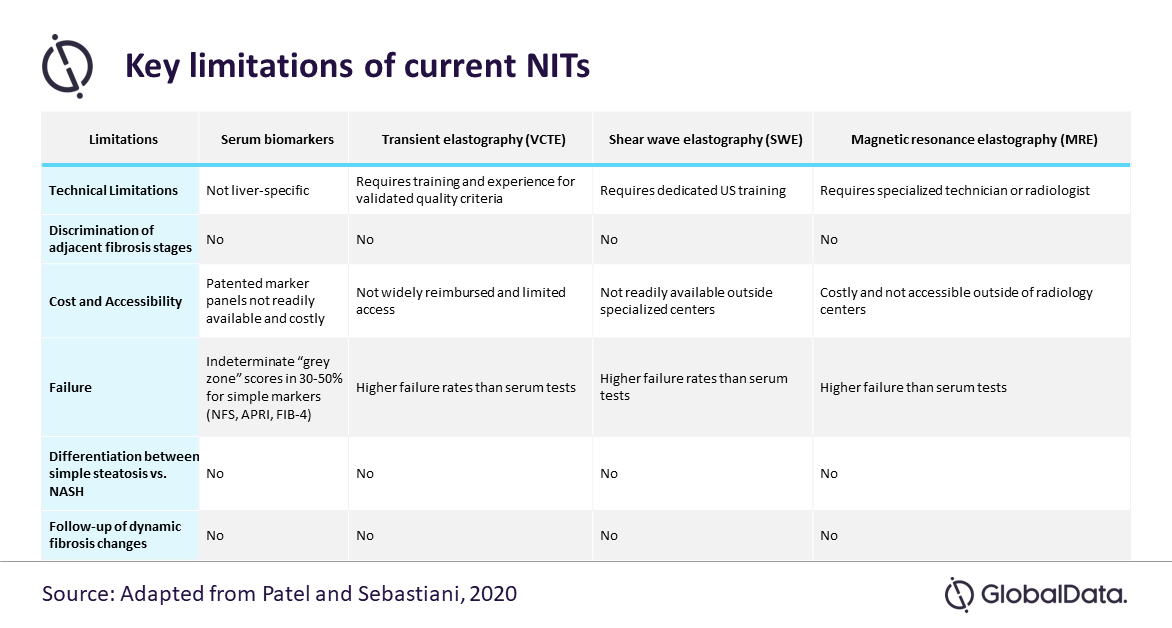
Sravani continues: “Despite these limitations, the American Association for the Study of Liver Diseases (AASLD) recently published its 2023 NAFLD Practice Guidance to suggest the use of vibration controlled transient elastography (VCTE), a patented technology used by Echosens’s FibroScan for detecting and diagnosing NAFLD in high-risk individuals, including those with type 2 diabetes.”
FibroScan is a non-invasive device that assesses the ‘hardness’ (or stiffness) of the liver via transient elastography (an ultrasound-based technology).
Sravani concludes: “However, with the possibility of the first set of approvals for NASH therapies around the corner, data on the performance of NITs used in current Phase III clinical trials could help address the limitations of current NITs for the diagnosis and treatment monitoring in NASH. In addition to making the diagnosis process more economical and accessible, the use of NITs in lieu of a liver biopsy could help shape the future treatment paradigm of NAFLD/NASH.”
