

The burden of diagnosed prevalent cases of amyotrophic lateral sclerosis in the 8MM* is forecast to increase at an annual growth rate (AGR) of 0.71% from approximately 81,100 in 2025 to over 86,800 cases in 2035, according to GlobalData, a leading intelligence and productivity platform.
GlobalData’s latest report, “Amyotrophic Lateral Sclerosis (ALS): Epidemiology Forecast to 2035,” estimates that the US will have the highest number of diagnosed prevalent cases of amyotrophic lateral sclerosis across the 8MM with just over 36,200 cases in 2035. Japan, Canada, and the 5EU** are estimated to have approximately 15,900, 4,700, and 27,500 diagnosed prevalent cases of amyotrophic lateral sclerosis in 2035, respectively.
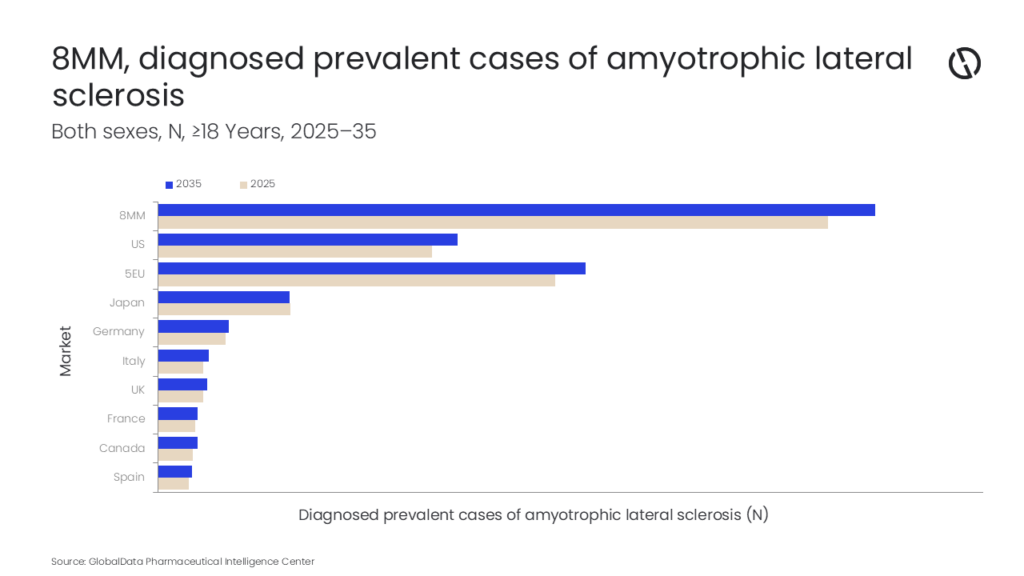
Amyotrophic lateral sclerosis tends to develop in older adults. According to GlobalData epidemiologists, prevalence rates were increasing in all markets. This could, in part, be attributed to aging populations.
Judith Visser, Epidemiologist at GlobalData, comments: “The increasing prevalence rates of amyotrophic lateral sclerosis may be explained by aging populations. Differences between markets could be attributed to differences in the population structures.”
Aging populations are common among developed countries globally. Older populations are more susceptible to a range of health conditions due to biological processes and changes within the body.
GlobalData epidemiologists also observed that the prevalence of genetic variants varied across the markets.
Visser concludes: “The c9orf72 variant is the most common genetic variant in ALS throughout Western Europe, whereas the SOD1 variant is the most common genetic variant throughout Asia, including Japan. Differences in the prevalence of genetic variants can be because of migration patterns and evolutionary reasons.”
*8MM: The US, France, Germany, Italy, Spain, the UK, Japan, and Canada.
**5EU: France, Germany, Italy, Spain, the UK.
