

Biopharma companies are increasingly choosing to manufacture their newer FDA-approved innovator and biosimilar products at facilities in China, signaling growing industry confidence in using the country as one of the bases for its manufacturing, according to GlobalData, a leading intelligence and productivity platform.
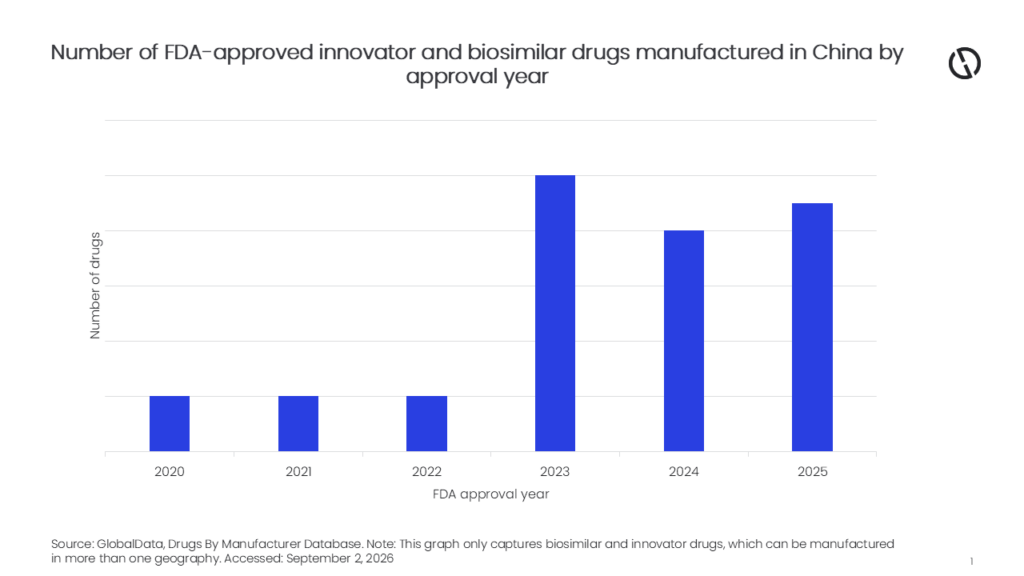
Katia Djebbar, Pharma Analyst at GlobalData, comments: “The FDA-approved products currently being manufactured in China in 2026 includes two innovators and biosimilars that were approved in each year from 2020 through 2022. That number increased five-fold to 10 products approved in 2023, representing just under 7% of innovators and biosimilars approved by the FDA that year. While 2023 was the peak year, products approved in 2024 and 2025 were broadly consistent with the increased use of Chinese manufacturing facilities by biopharma companies.
“Although the overall numbers remain low for now, the share of FDA-approved innovator and biosimilar products whose manufacturing mix included a facility in China still rose from approximately 1.8% between 2020 and 2022 to an average of 6.7% between 2023 and 2025.”
US-based companies accounted for just over half of the biopharma companies choosing China in 2026 as a manufacturing location for innovator and biosimilar drugs approved by the FDA between 2020 and 2025. Johnson & Johnson is one of these companies, outsourcing the API manufacturing of its monoclonal antibody Imaavy (nipocalimab-aahu) to WuXiBiologics Co. Approximately 21% of these drugs are outsourced to WuXi Biologics, a contract development and manufacturing organization (CDMO) specializing in the API and dose manufacturing of proteins and peptides.
Djebbar adds: “Monoclonal antibodies account for the majority of WuXi Biologics’ contracts, including GSK’s Jemperli (dostarlimab), which generated cumulative revenue of $1.9 billion by the end of 2025, according to GlobalData’s Sales and Forecast Database.”
However, the US has already taken steps to counter this growing appeal of China-based manufacturing. In June 2026, WuXi AppTecwas designated as a “Chinese military company” by the US Department of Defense under Section 1260H of the BIOSECURE Act. Although the designation was subsequently blocked in August 2026, the episode highlights a potential pathway for US policymakers to target and limit reliance on Chinese CDMOs and their supply chains.
In addition, the Pharmaceutical Investment Oversight and Accountability Act, introduced in July 2026 to investigate US reliance on foreign pharmaceutical supply chains, highlights US lawmakers’ concerns over the reliance on foreign, and particularly China-based, manufacturing of FDA-approved drugs and their ingredients.
Djebbar concludes: “Ultimately, biopharma companies will need to assess where to manufacture their newer, FDA-approved drugs if the US continues to tighten measures aimed at onshoring pharmaceutical supply chains. The US, pharma’s largest single-country market, and China, pharma’s second-largest single-country market, both need reliable supplies. A dual-location strategy followed by J&J for Imaavy (its API produced in China and the US) and GSK with Jemperli (API production handled by sites in China and Ireland) could be the way forward.”
