

Antibody drug conjugates (ADCs) are a rapidly growing therapeutic class, and Chinese companies are leading the ADC trend, accounting for half of the top 10 developers as they seek to capitalize on potential returns. The significant level of Chinese innovation and presence within the new cancer therapy space underlies the country’s emergence as a key player within the ADC market, according to GlobalData, a leading data and analytics company.
ADCs combine the specificity of monoclonal antibodies with the potency of cytotoxic drugs, via a linker, to selectively target and eliminate cancerous cells. This antibody-directed killing of cancer has the potential to substantially increase the outcomes of current cancer therapies, such as chemotherapy.
Jasper Morley, Pharma Analyst at GlobalData, comments: “ADCs are not a new technology, as there are currently 17 approved ADC drugs, which generated $8.5 billion in 2023. However, recent advancements in linker technologies and conjugation methods have revitalized interest in this space. As such, ADCs are leading a new era of targeted cancer therapy, with sales forecast to increase by 433% and generate over $45 billion in revenue by 2030.”
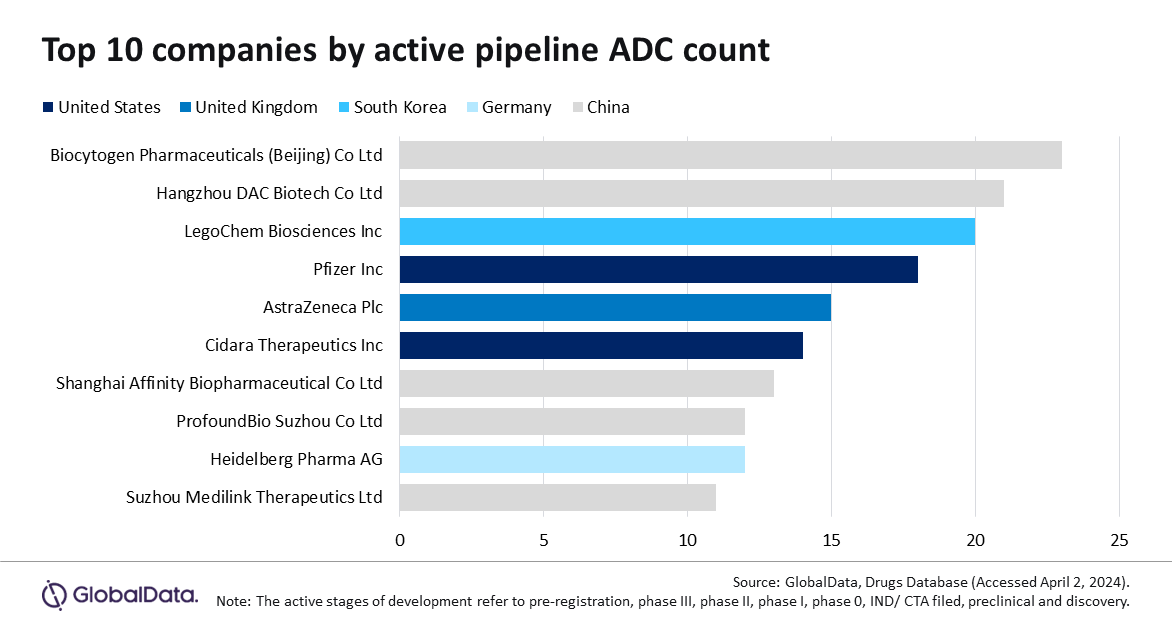
Biocytogen Pharmaceuticals is the leading company by active pipeline ADC count, with 23 active ADCs in development. However, its drugs are yet to reach clinical stages, as six are preclinical and 17 are in the discovery stage.
Alternatively, ProfoundBio is in eighth place by active pipeline ADC count with 13 drugs. This company has developed two distinct proprietary linker-drug technology platforms and is the most advanced out of all of the Chinese companies, with three drugs in Phase II. One of its drugs, Rina-S, is a potential best-in-class ADC that was granted Fast Track designation by the FDA in early 2024 for the treatment of ovarian cancer.
Hangzhou DAC, Shanghai Affinity, ProfoundBio, and Suzhou Medilink are headquartered within the Yangtze River Delta region in China.
Morley continues: “The Yangtze River Delta region is home to some of China’s top research institutions, such as Zhejiang and Shanghai Jiao Tong University, and it is one of the most economically advanced and prosperous areas of China. These factors play an important role in attracting talent and investment, enabling innovation within pharmaceutical R&D.”
Morley concludes: “The prime location of Chinese companies offers a rich ecosystem of academic institutions, attracting both talent and investment. The associated high levels of innovation by these Chinese companies in a drug class that is gaining prominence mirror the region’s emergence as a powerhouse within the pharmaceutical space.”
