

The diagnosed incident cases of glioblastoma (GBM) in the eight major markets (8MM*) are set to increase at an annual growth rate (AGR) of 0.81% from over 61,000 in 2025 to over 66,000 in 2035, forecasts GlobalData, a leading intelligence and productivity platform.
GlobalData’s latest report, “Glioblastoma (GBM): Epidemiology Report and Forecast[SP1] to 2035,” reveals that the 5-year diagnosed prevalent cases of glioblastoma (GBM) are projected to increase at an AGR of 0.99% from 48,000 in 2025 to 53,000 in 2035.
China will have the highest number of diagnosed incident cases of GBM in the 8MM, with approximately 29,000, whereas Japan will have the fewest diagnosed incident cases with approximately 1,800 in 2035.
This distribution is the same for the 5-year diagnosed prevalent cases of GBM, where China will also have the highest number of 5-year diagnosed prevalent cases of GBM in the 8MM, with approximately 25,000, while Japan will have the fewest 5-year diagnosed prevalent cases at approximately 1,600.
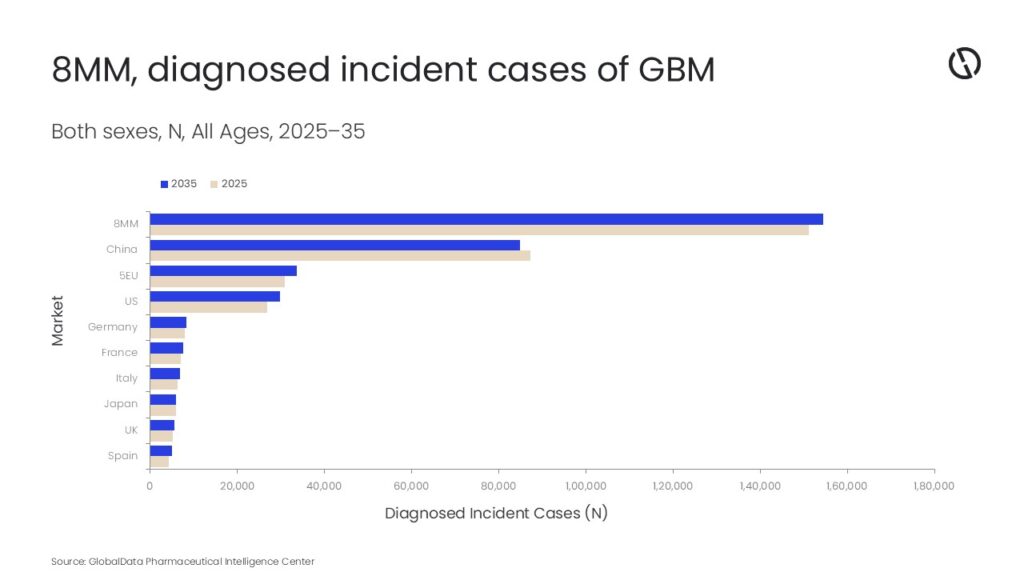
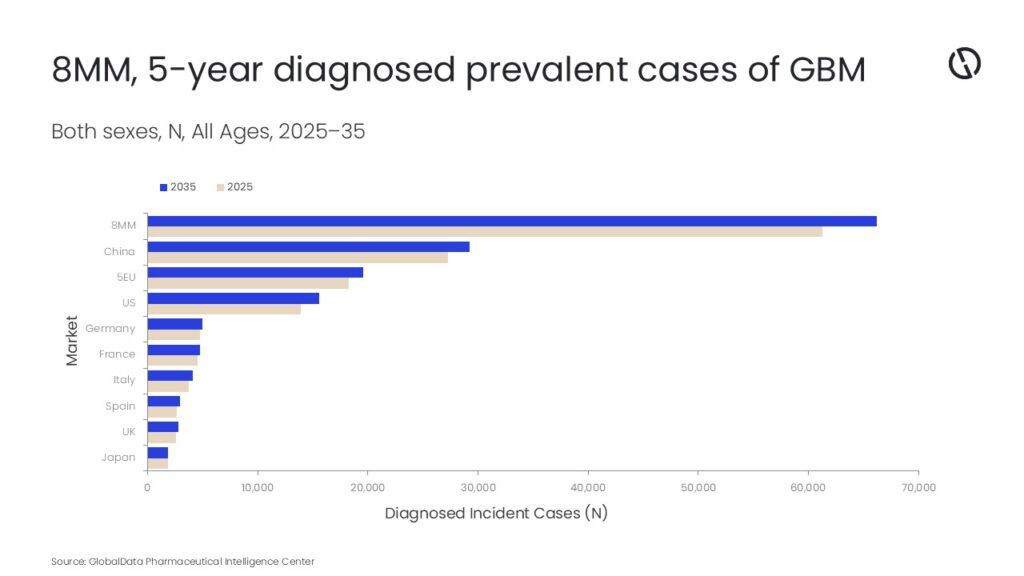
In 2025, China accounted for approximately 45% of all diagnosed incident cases of GBM in the 8MM due to its large population. In the 5EU, Germany accounted for the highest number of diagnosed prevalent cases of GBM, with approximately 10,000, and 25% of all 5EU diagnosed incident cases of GBM.
China accounted for approximately 48% of all 5-year diagnosed prevalent cases of GBM in the 8MM in 2025, with 25,000 cases. Germany accounted for the highest number of 5-year diagnosed prevalent cases of GBM in the 5EU, with approximately 3,500 cases, comprising 25% of all 5EU cases.
Casey Freimuth, Senior Epidemiologist at GlobalData, says: “Due to the aggressive nature of stage IV gliomas, as well as tumor heterogeneity and genetic profiles that engender treatment resistance, the prognosis of glioblastoma is exceptionally poor.”
Biomarkers such as MGMT methylation and EGFR amplification, as well as mutations in IDH1/IDH2, TERT promoter, BRAF-V600E, HLA-A2, and NTRK, all have an impact on the efficacy of treatment and the progression of disease. Treatment is a combination of resection, radiotherapy, and chemotherapy.
Freimuth concludes: “The only modifiable risk factor for glioblastoma is ionizing radiation. Therefore, efforts should be focused not on reducing incidence but improving prognosis. Further research into targeted chemotherapy and increased focus on screening may increase 5-year survival.”
*8MM: The US, France, Germany, Italy, Spain, the UK, Japan, and China.
**5EU: France, Germany, Italy, Spain, the UK.
