

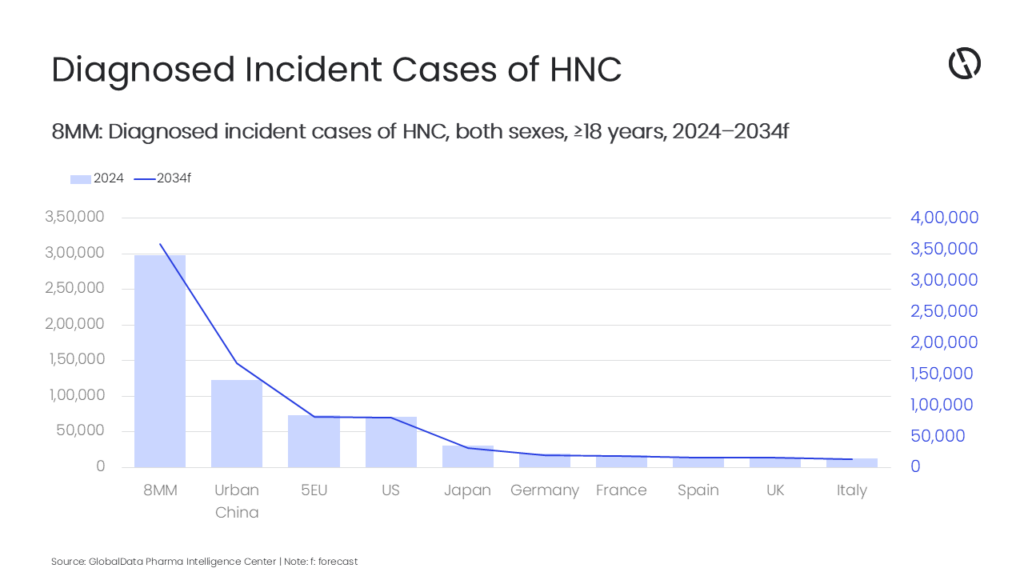
Diagnosed incident cases of head and neck cancers (HNCs) are rising steadily across the eight major markets (8MM*), with urban China set to outpace all others as incidence grows at a 3.55% annual rate through 2034. This trend highlights a pivotal epidemiological transition, where aging populations and evolving risk factors are reshaping disease profiles and intensifying demands on oncology prevention, screening, and treatment strategies, according to latest analysis from GlobalData, a leading intelligence and productivity platform.
GlobalData’s report, “Head and Neck Squamous Cell Carcinoma Epidemiology Analysis and Forecast to 2034,” reveals that the combined diagnosed incidence of HNCs across 8MM is projected to reach 0.35 million cases by 2034, up from 0.29 million in 2024. This growth represents a steady annual growth rate (AGR) of 2.02%.
Urban China is forecast to expand at an AGR of 3.55% (2024-2034). Other leading markets include Spain, with an anticipated growth of 2.33%, and the US at 1.19%.
Suneedh Manthri, Project Manager, Epidemiology at GlobalData, comments: “The escalating burden of HNCs in urban China is primarily driven by population aging and a rising age-standardized incidence rate. While traditional risk factors such as tobacco use and alcohol consumption continue to contribute significantly through multiplicative synergistic effects, the emergence of human papillomavirus (HPV) as a critical etiological driver, particularly in oropharyngeal sub-sites, is shifting the disease’s demographic profile. These carcinogenic factors typically operate over a prolonged latency period, with their cumulative impact manifesting decades after initial exposure.”
Head and neck squamous cell carcinomas (HNSCC) constitute most malignancies in the oral cavity and pharynx, representing more than 90% of cases. These tumours originate from the mucosal epithelium of the upper aerodigestive tract.
While the etiological landscape is complex and continues to be characterized, 2025 data confirm a significant epidemiological shift: a surging incidence of HPV-related oropharyngeal squamous cell carcinoma (OPSCC) is now outpacing traditional tobacco-related cases in several urban and developed regions.
Despite this shift, tobacco use remains a dominant and geographically diverse risk factor, implicated in 80% to 90% of oral cancer diagnoses, often acting synergistically with alcohol consumption to multiply carcinogenic risk.
Manthri concludes: “While tobacco and alcohol remain deeply entrenched drivers, the rapid rise of HPV-related cancers signals a shift that will require recalibrated public health policies, targeted vaccination strategies, and earlier, site-specific diagnostic interventions to curb long-term disease impact.”
#Head and Neck Cancer (ICD-10 = C00–C14 and C30–C32)
*8MM: The US, 5EU (France, Germany, Italy, Spain, the UK), Japan, and urban China.
