

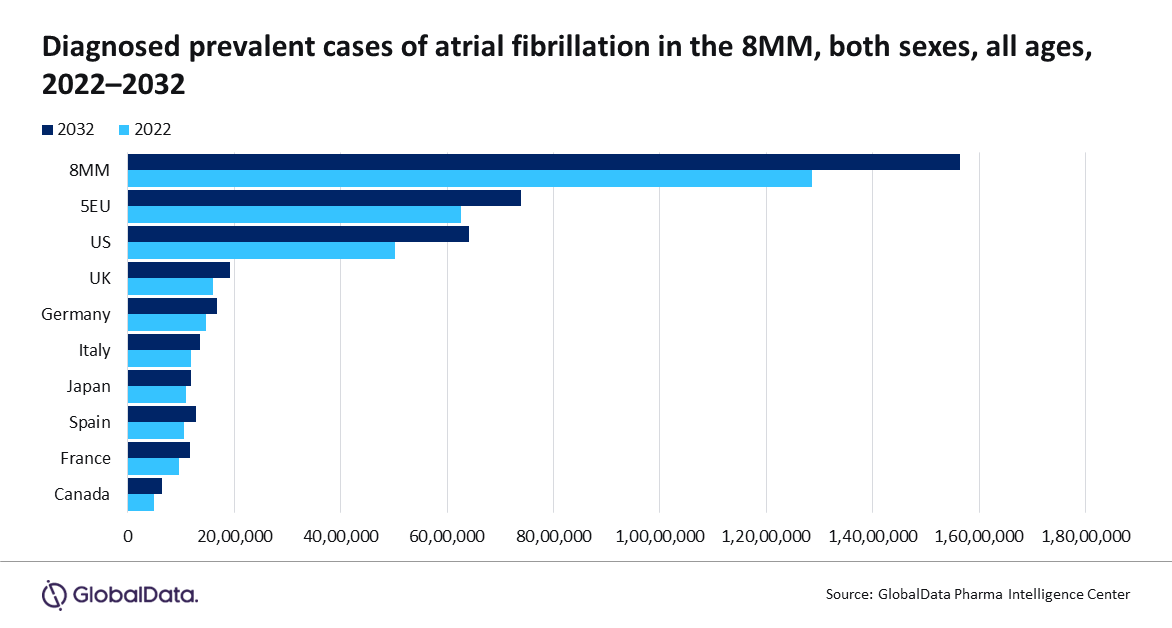
The diagnosed prevalent cases of atrial fibrillation (AF) in the eight major markets (8MM*) are set to register an annual growth rate (AGR) of 2.16% from 12.86 million in 2022 to 15.64 million in 2032, forecasts GlobalData, a leading data and analytics company.
GlobalData’s latest report, “Atrial Fibrillation – Epidemiology Forecast to 2032,” reveals that in 2032, the US will have the highest number of diagnosed prevalent cases of AF among the 8MM at 6.41 million cases, whereas Canada, with nearly 0.65 million cases, will have the lowest number. The major drivers for the overall increase in the diagnosed prevalence of AF can be attributed to better diagnosis and population dynamics.
Antara Bhattacharya, Healthcare Analyst at GlobalData, comments: “GlobalData’s research shows that in 2022, approximately 51% of diagnosed prevalent cases of AF were paroxysmal. CHADS2 stroke risk score of two or more accounted for approximately 44% of the diagnosed prevalent cases of AF in the 8MM in 2022.”
In men, CHA2DS2 – VASc stroke score of two or more accounted for approximately 73% of the diagnosed prevalent cases of AF, while in women, CHA2DS2 – VASc stroke score of three or more accounted for approximately 80% of the diagnosed prevalent cases of AF in the 8MM in 2022. Moreover, adults ages 60 years and above accounted for approximately 91% of the diagnosed prevalent cases of AF in the 8MM, while those ages 40–59 years accounted for only 9% of the cases in 2022.”
AF can be asymptomatic, and signs can vary considerably from person to person, making it difficult to diagnose. AF risk increases with advancing age. Also, AF occurs slightly more commonly in men compared to women. This is in line with the GlobalData estimates for sex-specific diagnosed prevalent cases.
Bhattacharya concludes: “While assessing elderly patients, identification of established risk factors can assist clinicians in having a high index of suspicion for AF to formulate appropriate therapeutic plans. Optimal management of the identified risk factors play a role in preventing AF in the elderly population. Since there is higher risk of stroke in AF patients, both men and women, early diagnosis and treatment is critical. Early diagnosis can prevent mitral stenosis, heart valve irregularities, and delayed therapy especially in advanced stages of chronic kidney disease, thus expediting better treatment outcomes.
“Since non-vitamin K antagonist oral anticoagulant therapy is recommended for high stroke risk CHA2DS2 – VASc scores, early diagnosis can also be crucial in preventing major bleeding risk for patients on anticoagulation therapy. Additionally, early management and treatment of AF patients in the emergency department can significantly reduce hospital admissions, and consequently reduce the burden on healthcare providers.”
