

The diagnosed prevalent cases of overweight and obesity combined in the seven major markets (7MM*) are set to increase at an annual growth rate (AGR) of 0.61%, from over 245 million in 2025 to 260 million in 2035, forecasts GlobalData, a leading intelligence and productivity platform.
GlobalData’s latest report, “Overweight and Obesity: Epidemiology Report and Forecast,” reveals that the diagnosed prevalent cases of overweight in the 7MM are projected to increase at an AGR of 0.19%, from 122 million in 2025 to 124 million in 2035. The diagnosed prevalent cases of obesity are forecast to increase from 123 million in 2025 to 136 million in 2035, at an AGR of 1.02%.
The US will have the highest number of diagnosed prevalent cases of overweight in the 7MM in 2035, at approximately 57 million, whereas Spain will have the fewest diagnosed prevalent cases, at approximately nine million. This distribution is not the same for the diagnosed prevalent cases of obesity, with the US having the highest number at approximately 94 million, while Japan will have the fewest, at approximately four million.
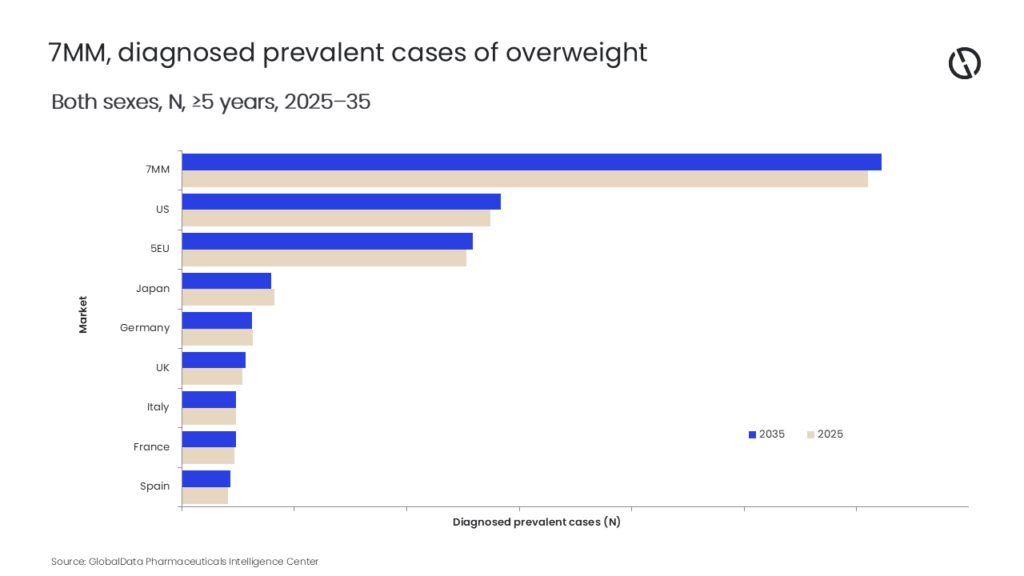
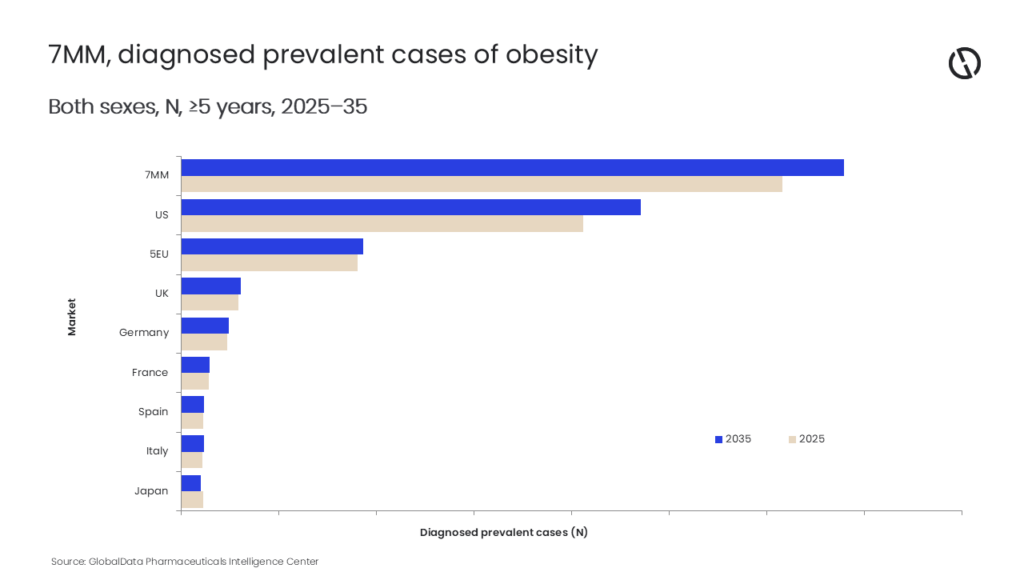
In 2025, the US accounted for approximately 56% of all diagnosed prevalent cases of overweight and obesity combined in the 7MM, due to its large population and historically high disease burden of excess body weight. In the 5EU, the UK and Germany both accounted for the highest number of diagnosed prevalent cases of overweight and obesity combined, with approximately 23 million and 22 million, respectively, both accounting for about 26% of all 5EU diagnosed prevalent cases of overweight and obesity combined.
In the 7MM, approximately 53% of diagnosed prevalent cases of obesity were diagnosed with Class I obesity, while Class II and III obesity constituted 26% and 22% of cases, respectively.
Zachary Natale, Managing Epidemiologist at GlobalData, comments: “In recent years, an impactful variable in obesity’s epidemiology has been the rapid proliferation of novel anti-obesity medications (AOMs) in the consumer markets of the 7MM. Clinical trials have demonstrated the efficacy of treatment with glucagon-like peptide-1 receptor agonists (GLP-1R agonists) and other novel AOMS producing significant weight loss. Furthermore, these medications have shown promising results in the prevention or treatment of several obesity-related comorbidities.”
According to the report, overweight and obesity are expected to grow in prevalence but at a flattening rate. The impact of pharmaceuticals such as GLP-1R agonists may alter these trends, with increasing adoption of these medications across the 7MM.
Natale concludes: “Despite the promising landscape of obesity in the era of novel AOMs, the structural drivers of the obesity epidemic should not be ignored. Obesogenic diets are enabled by a backdrop of food systems and industries that rely on the mass production of unhealthy foods. Similarly, sedentary lifestyles have become more prevalent in recent years due to factors such as increased average screen time and social isolation among a significant contingent of the population.”
*7MM: The US, France, Germany, Italy, Spain, the UK, and Japan.
**5EU: France, Germany, Italy, Spain, the UK.
