

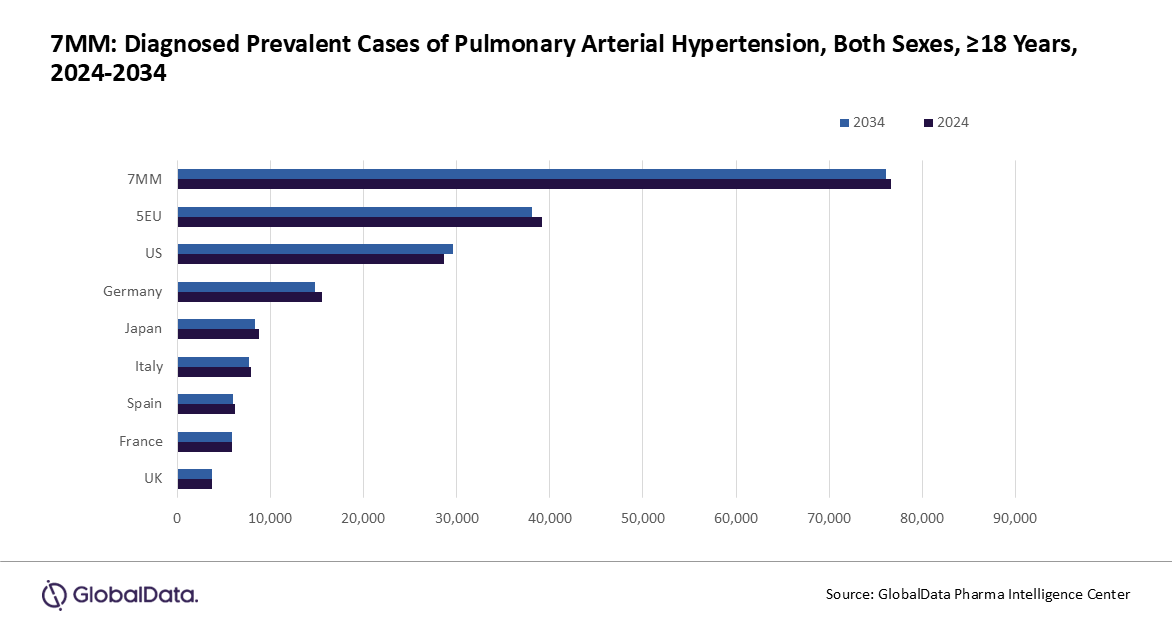
The diagnosed prevalent cases of pulmonary arterial hypertension (PAH) in the seven major markets (*7MM) are projected to decrease from 76,645 in 2024 to 76,035 in 2034 at an annual growth rate (AGR) of negative 0.08%, forecasts GlobalData, a leading data and analytics company.
GlobalData’s latest report, “Pulmonary Arterial Hypertension (PAH) – Epidemiology Analysis and Forecast to 2034,” reveals that in 2034, the US is forecasted to experience the greatest number of diagnosed prevalent cases of PAH among the 7MM, totaling 29,591 cases, while the UK is projected to have the lowest count at 3,773 cases.
PAH is a rare, progressive disorder of unknown cause, characterized by vascular proliferation and remodeling of the small pulmonary arteries. A significant number of risk factors and pathophysiological conditions are suspected to play roles in disease progression. In PAH, blood vessels in the lungs are narrowed, blocked, or destroyed. PAH represents Group 1 within the World Health Organization (WHO) clinical classification for pulmonary hypertension.
PAH can be idiopathic, heritable, or associated with different conditions such as connective tissue disease (CTD), congenital heart disease (CHD), human immunodeficiency virus (HIV) infection, and exposure to toxins or drugs. Due to its unclear multifactorial mechanisms, and despite many treatment advancements over the past few decades, the long‐term prognosis of patients with PAH remains poor.
Bharti Prabhakar, MPH, Associate Project Manager, Epidemiology at GlobalData, comments: “Even though PAH is rare in terms of incidence and prevalence, it is a debilitating condition in terms of its impact on quality of life. Due to its unclear multifactorial mechanisms, and despite many treatment advancements over the past few decades, the long‐term prognosis of patients with PAH remains poor. PAH can lead to right ventricular overload, intense right heart failure, and subsequent death due to increased pulmonary artery pressure.”
PAH is a rare disease with a largely unknown pathogenesis. It is now commonly believed that the development of PAH depends on individual susceptibility or predisposition, which is genetically determined. GlobalData’s analysis shows that over 80% of both newly diagnosed cases and existing cases of PAH in the 7MM occurred in adults aged 18 to 69 years. This suggests that the risk of PAH in individuals increases with increasing age and is more common in middle-aged adults. PAH occurs twice as frequently in women as in men. These findings are in line with studies that reported the incidence and prevalence of PAH.
Prabhakar concludes: “In the past decade, there have been major advances in the understanding of the mechanism of disease development, diagnostic process, and treatment of PAH. However, patients with PAH are still referred to physicians late in the disease process at a time when hemodynamic abnormalities are at an advanced stage.
“The survival rates for PAH, although still low, appear to have improved compared with historical estimates. Although we do not have strong epidemiology data to support an increasing trend in the forecast model, the prevalence of PAH and the burden associated with it may increase due to improved survival. Continued efforts are required to improve the management of patients with PAH and to understand the epidemiology trends over time.”
*7MM: The US, 5EU (France, Germany, Italy, Spain, the UK), and Japan.
