

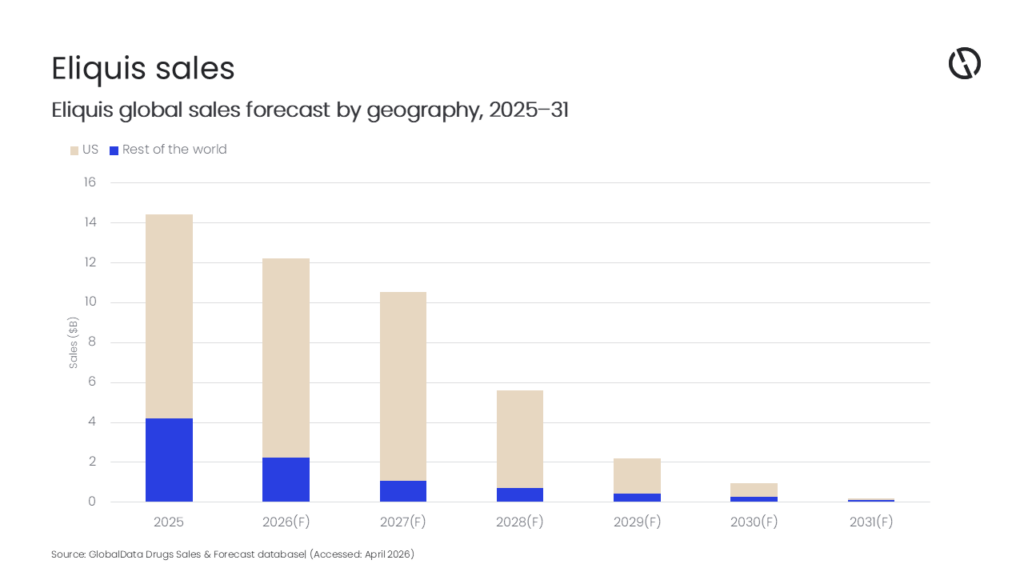
Eliquis (apixaban) is on course for one of the largest single-asset revenue collapses in pharmaceutical history. Its sales are forecast to fall from $14.4 billion in 2025 to just $205 million globally by 2031, a 98.6% erosion, as the BMS- and Pfizer-partnered anticoagulant loses patent protection in Europe in 2026 and the US in 2027, with generic entry and peak revenue destruction arriving in 2028, according to GlobalData, a leading intelligence and productivity platform.
Eleni Tokali, Senior Pharma Analyst at GlobalData, comments: “The collapse ranks among the largest single-asset loss-of-exclusivity (LOE) events the industry has seen. This is not a gradual fade; it is a near-total revenue wipeout for one of pharma’s most dominant brands.”
According to GlobalData’s Drugs Sales & Forecast Database, the erosion is geographically sequenced. Excluding the US, Eliquis’s rest of world revenues are forecast to fall nearly 75% by 2027 as European generic entry takes hold through tendering and formulary switching. The US — representing close to 90% of brand revenues by 2027 — faces additional pressure from the Inflation Reduction Act (IRA), which imposed a Medicare maximum fair price of $231 per 30-day supply in January 2026, reducing net revenues two years ahead of the patent cliff. When US generic entry arrives in 2028, a near-50% single-year revenue decline is projected.
Tokali adds: “What sets the US cliff apart is the IRA’s role in front-loading the damage. By the time generics arrive in 2028, Eliquis will already be operating at a government-capped price — leaving BMS with minimal room to defend revenue when substitution begins.”
BMS has responded with aggressive M&A: the $14 billion acquisition of Karuna Therapeutics and $4.1 billion acquisition of RayzeBio represent deliberate bets on neuroscience and radiopharmaceuticals as replacement growth platforms. The September 2024 FDA approval of Cobenfy — the first new class of schizophrenia treatment in decades — marks the first clinical validation of that strategy.
Tokali concludes: “The Eliquis cliff is one of the starkest examples yet of what single-asset concentration risk looks like at blockbuster scale. BMS has moved quickly with Karuna and Cobenfy — but no pipeline transition can fully absorb a $14 billion revenue wipeout in six years.”
