

Since the FDA first awarded a regenerative medicine advanced therapeutic (RMAT) designation in 2017, activity in this space remained relatively modest until 2023. However, the number of RMAT designations increased sharply in 2024, reaching a record of 48 RMAT designations in 2025, reflecting the expanding regenerative medicine landscape and suggesting that a larger number of these therapies are progressing towards regulatory review, according to GlobalData, a leading intelligence and productivity platform.
In December 2016, the RMAT designation was signed into US law, designed to expedite the development and review of regenerative medicine therapies that are intended to treat, modify, reverse, or cure a serious condition. From 2017 to 2023, the number of RMAT designations remained relatively low, averaging 13.9 per year.
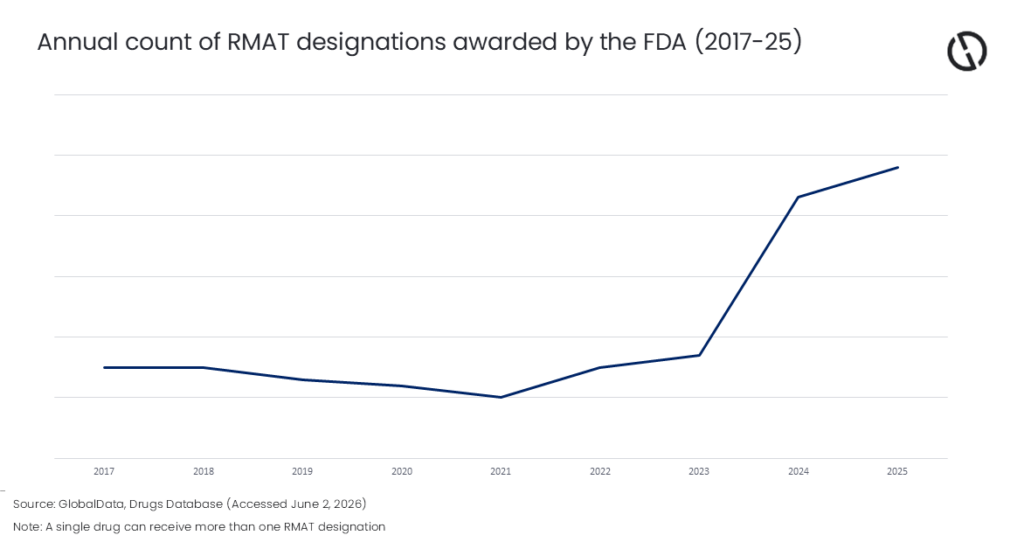
A total of 43 RMAT designations were awarded in 2024. Collectively, the RMAT designations awarded in 2024 and 2025 accounted for 48% of all RMAT designations awarded since the program began, highlighting the recent acceleration in FDA RMAT designation activity.
Jasper Morley, Pharma Analyst at GlobalData, comments: “The surge in RMAT designations awarded from 2024 coincides with the maturation of the cell and gene therapy (CGT) pipeline. CGTs represent a key component of the regenerative medicine landscape, as these therapies use engineered cells or genetic modification to restore, replace, or modify biological function.”
According to GlobalData’s Drug Database, 2,315 CGT products are currently in Phases I, II, or III of clinical development. This is the highest number of CGTs recorded, with a compound annual growth rate (CAGR) of 7.35% since 2020.
Morley continues: “As this expanding pipeline progresses through clinical development, an increasing number of regenerative medicines are generating the preliminary clinical evidence required for RMAT designation eligibility. Consequently, the pool of qualifying therapies has increased, contributing to the marked rise in RMAT designations observed in recent years. Conversely, the introduction of the RMAT designation may itself have supported growth in the CGT pipeline by providing developers with an expedited regulatory pathway, encouraging investment in and clinical development of regenerative medicine products.”
Of the 73 individual drugs that received at least one RMAT designation in 2024 or 2025, Cabaletta Bio’s resecabtagene autoleucel received four RMAT designations, the highest number awarded to any product during this period. This chimeric antigen receptor (CAR) T cell therapy is designed to restore immune homeostasis and demonstrates the increasing maturity of regenerative medicine products entering later-stage clinical development, with ongoing Phase II and III trials across multiple autoimmune indications.
Morley concludes: “Driven by the expanding clinical-stage regenerative medicine pipeline, the RMAT program has entered a period of accelerated growth. This trend suggests growing momentum in regenerative medicine development, which may result in increased regulatory review and activity in upcoming years.”
