

The month of November is dedicated to raising awareness regarding pertinent health issues affecting men such as mental health and suicide prevention, prostate cancer, and testicular cancer. Prostate cancer is the fourth most common cancer worldwide and the second most common cancer in men after skin cancer, according to the World Cancer Research Fund International. Men’s Health Awareness Month highlights the need for effective and innovative screening programs as well as novel treatments for prostate cancer, which is a major public health burden worldwide and especially within the UK, says GlobalData, a leading data and analytics company.
GlobalData’s epidemiologist forecast that the incident cases of prostate cancer in the UK are predicted to increase by 5.78% (60,133 cases) from 2024 to 2028. However, it appears that awareness raised by initiatives such as Men’s Health Awareness Month are encouraging men toward screening as GlobalData’s epidemiologists also forecast that diagnosed prevalent cases are set to increase by 6.3% from 2024 to 2028.
Sonnika Lamont, Pharma Analyst at GlobalData, comments: “Fortunately, prostate cancer is one of the most successfully treated types of cancers if caught early, which is why encouraging early screening measures is extremely important— especially as men with early prostate cancer are often asymptomatic, or present generic symptoms that can be caused by other health problems.”
The increased diagnosis will hopefully be supported by a wealth of novel predictive tools; for example, research was recently published in JAMA Network Open showing two magnetic resonance imaging (MRI) based risk calculators can predict prostate cancer risk among adults in Europe and North America with some accuracy. Although there is still a long way to go towards the development of an effective predictive screening tool for prostate cancer.
GlobalData forecasts that the prostate cancer market size is set to increase by a whopping 25% from $475.84 million in 2024 to $596.22 million by 2028. Hopefully, this is indicative of the innovation set to occur throughout this time. GlobalData’s Trials Intelligence platform supports this, as data indicates that the number of prostate cancer clinical trials using an innovator drug has steadily increased over the last decade in parallel to the amount of marketed prostate cancer therapies.
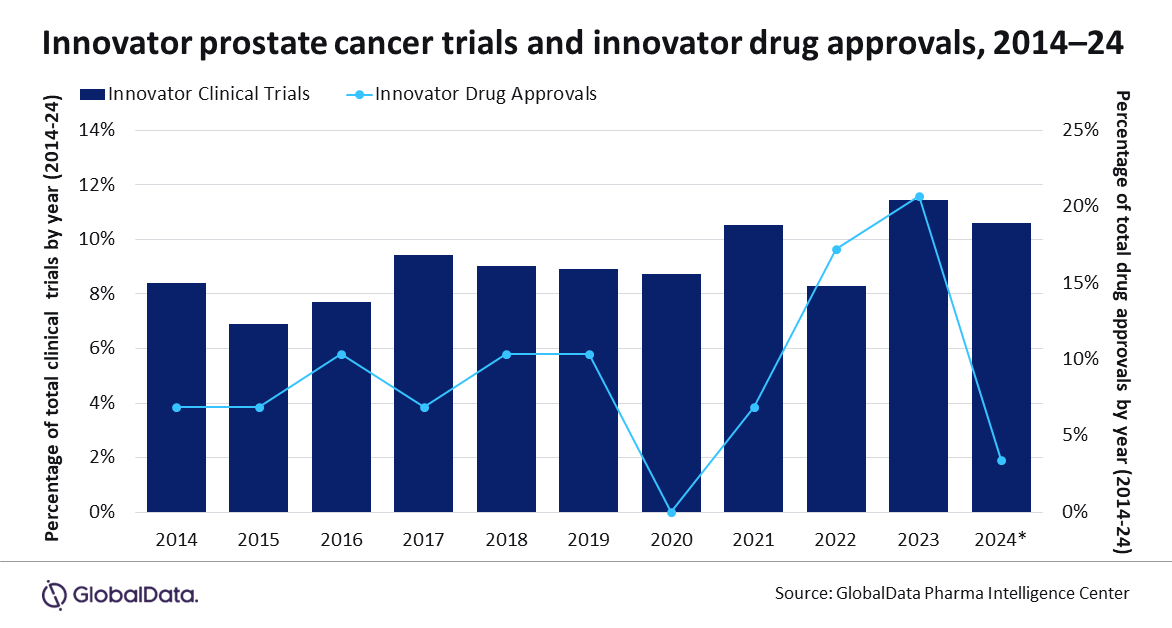
Similarly, the number of drugs approved for prostate cancer has increased since 2014. Although there appears to be a slight dip in the number of innovator trials and therapies in 2024, the year is not complete, so there is still time to see these figures recover and possibly surpass previous years.
Lamont concludes: “Overall, the data predicts a promising future for the diagnostic and treatment landscape of prostate cancer, and initiatives such as Men’s Health Awareness Month are vital for early detection, which provides the greatest opportunity for potential sufferers to improve their chance of survival and quality of life.”
