

Merck & Co’s blockbuster oncology product Keytruda (pembrolizumab), which has generated over half of the company’s total revenue in the last three years, faces key patent expirations and market rivalry from 2028. Consequently, Keytruda’s projected 2032 revenues are slated to plummet by 57% relative to 2025 performance. However, the company’s non-oncology portfolio is forecasted to double footprint over the coming six years and propel overall top-line growth, according to GlobalData, a leading intelligence and productivity platform.
Since its approval by the FDA in 2014, Keytruda has gained approval across more than 40 oncological indications. The immune checkpoint inhibitor generated peak sales of $31.7 billion, representing 58% of Merck’s total sales in 2025. However, it’s US market exclusivity expected to expire in 2028, followed by Europe in 2031 and Japan in 2033. With sales for Keytruda forecast to decline to $13.6 billion by 2032, a 57% reduction from its 2025 peak, a substantial revenue gap is left for Merck to fill.
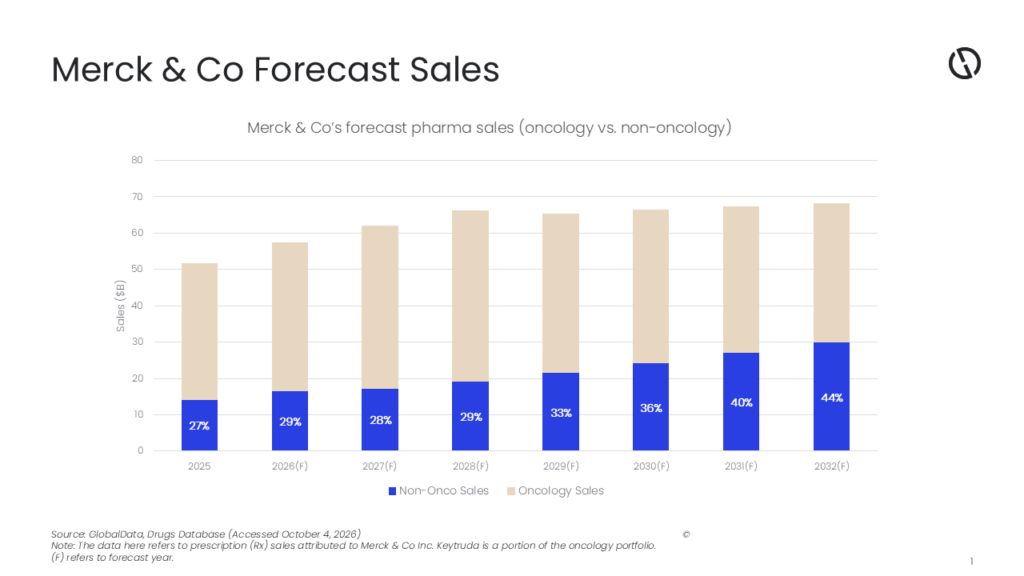
In 2025, Merck’s non-oncology portfolio generated $14.1 billion, only 27% of its overall pharma sales of $51.8 billion. Alternatively, oncology generated $37.7 billion. Through the subcutaneous version of Keytruda and upcoming blockbuster launches, oncology is set to remain Merck’s largest therapy area in 2032, generating $38.5 billion. However, this represents growth of just 2% from 2025, a significant slowdown compared with the 104% increase in oncology sales between 2020 and 2025.
Jasper Morley, Pharma Analyst at GlobalData, comments: “Sales from Merck’s non-oncology portfolio are expected to double between 2025 and 2032, ultimately reaching $29.9 billion and accounting for 44% of the company’s total forecast pharma sales of $68.4 billion.
“This growth is expected to be driven by six non-oncology therapy areas, with infectious disease remaining as the largest contributor. Having generated $5.8 billion in 2025, infectious disease sales are forecast to increase by 54% to $9.1 billion by 2032.”
Merck’s established vaccine portfolio is expected to remain a major contributor to infectious disease sales. Despite losing market exclusivity in 2016, ProQuad is forecast to generate $2.77 billion in 2032. Another significant contributor is MK-1406, a Phase III seasonal influenza candidate expected to launch in 2027 and reach sales of $1.86 billion by 2032.
Cardiovascular is forecast to be Merck’s fastest-growing therapy area, with sales expected to increase fourfold from $1.76 billion in 2025 to $7.76 billion by 2032. This growth will be largely driven by Winrevair, Merck’s leading non-oncology product, which was approved in 2024 for the treatment of pulmonary arterial hypertension. Following sales of $1.4 billion in 2025, Winrevair is forecast to achieve a fivefold increase, reaching $6.9 billion by 2032. By then, the drug is expected to account for approximately 89% of Merck’s cardiovascular sales.
Morley Concludes: “Overall, Merck’s expanding non-oncology portfolio is expected to play an increasingly important role in cushioning the impact of Keytruda’s patent cliff. While oncology is expected to remain Merck’s largest therapy area by 2032, the expansion of non-oncology sales will reduce the company’s reliance on Keytruda and provide a more diversified revenue base.”
