

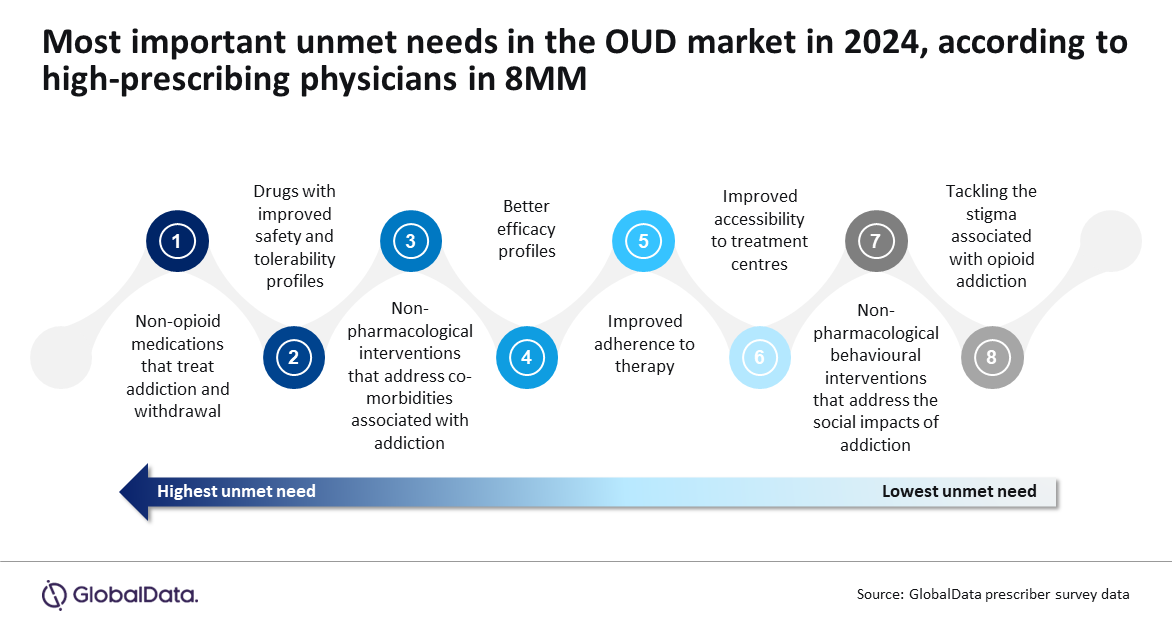
Opioid Use Disorder (OUD) is a chronic neurological disorder that is described as the consequences associated with repeated, compulsive use of opioid drugs and prolonged self-administration of opioid drugs. In August 2024, 110 high-prescribing psychiatrists, addiction specialists, neurologists, and primary care physicians from eight major markets (8MM*) were surveyed by GlobalData on the key unmet needs in treatment of OUD. Non-opioid medications that treat addiction and withdrawal, and drugs with improved safety and tolerability profiles were consistently ranked by respondents as the most important unmet needs in the OUD market (ranking from 1 to 9, where 1 indicated the most significant need and 9 the least important). This trend was seen throughout the 8MM, according to the leading data and analytics company.
Jos Opdenakker, Pharma Analyst at GlobalData, comments: “There is a gap in the market for safer non-opioid medications that treat addiction and withdrawal when considering the drawbacks of current treatment options, the standard of care being substitution of opioids with complete and partial opioid agonists (methadone and buprenorphine, respectively).”
Key opinion leaders (KOLs) interviewed by GlobalData and surveyed prescribing physicians cast doubt over the safety profile of methadone, citing that it prolongs the QT interval (the term “long QT” refers to the heart’s electrical activity as graphed on an electrocardiogram) on the ECG, which creates a higher risk for fatal arrhythmias and highlighted the risk of ‘diversion’, referring to illicit use and sale of these drugs on the streets.
According to GlobalData’s Drug Database, six out of the seven agents currently in late-stage development (Phase IIb–III) are non-opioids. This includes a cannabinoid product, as well as a PPARγ agonist, a sodium-dependent dopamine transporter inhibitor, an androgen receptor antagonist, and a pannexin 1 inhibitor. KOLs are skeptical regarding the ability of these therapeutic candidates to replace methadone and buprenorphine as front-line treatments.
Opdenakker continues: “Cannabidiol products offer a safer non-opioid treatment option for mild OUD patients; however, in the moderate and severe segment, they are likely to enter the market as adjunctive treatments to the existing first-line therapies, but would not likely displace methadone or buprenorphine as front-line treatments for OUD.”
The results of a Phase II a study evaluating cannabidiol (Epidyolex) efficacy as an adjunct treatment to patients on opioid agonist therapy suggest that cannabidiol is an effective and well-tolerated pharmacologic intervention as an adjunct to medication assisted therapy (MAT) to reduce the risk of relapse.
Opdenakker concludes: “Any novel treatments for OUD will have to demonstrate significantly improved efficacy in order to displace the gold standards of treatment, methadone and buprenorphine. Both methadone and buprenorphine are widely available in different formulations and are well-recognized by OUD patients. High-efficacy non-opioids remain an exploitable opportunity, and any non-opioid products developed for the treatment of OUD would likely see strong uptake and would dramatically alter the OUD market.”
8MM- US, France, Germany, Italy, Spain, UK, Australia, and Canada
