

The increase in attention-deficit/hyperactivity disorder (ADHD) diagnoses across the seven major markets (7MM*) is closely tied to the adoption of standardized screening tools and updated clinical guidelines. These developments, particularly in the US, have led to more accurate identification of ADHD cases, especially among adults, helping to address the disorder’s significant socioeconomic and mental health impacts, says GlobalData, a leading data and analytics company.
ADHD is a clinically heterogenous disorder whose diagnosis relies on a combination of questionnaires (self-, parent-, or teacher-reported), clinical interviews, and, in some cases, neuropsychiatric testing. The accurate diagnosis of ADHD is important as, if left untreated, it is associated with negative socioeconomic outcomes such as poor scholastic performance, unemployment, criminality, and increased risk of developing other mental health conditions such as substance abuse disorder.
GlobalData’s latest report, “Attention Deficit Hyperactivity Disorder (ADHD): Market Opportunity Assessment and Forecast to 2032,” reveals a steady increase in the diagnosed prevalent ADHD cases across the 7MM*, with a compound annual growth rate (CAGR) of 0.4% from 2022 to 2032.
This growth is primarily driven by the US, which has the largest ADHD population, accounting for 80% of the diagnosed ADHD population in the 7MM, and the highest projected growth rate from 2022 to 2032 at a CAGR of 0.6%. The adult segment is the main driver of this increase, with diagnosed cases in the US expected to rise from 16.9 million in 2022 to 17.9 million by 2032, at a CAGR of 0.7%.
Lorraine Palmer, Pharma Analyst at GlobalData, comments: “While the reason for the continued increase in ADHD diagnosed prevalent cases in recent years, particularly in adults, is not clear, it has occurred alongside increasing awareness of the prevalence of ADHD into adulthood and updates in established diagnostic guidelines in the 7MM that have made the diagnostic criteria for adult ADHD clearer for clinicians.”
A recent survey** by GlobalData highlighted the reliance on American clinical guidelines across the 7MM. The most frequently utilized guideline for ADHD diagnosis and treatment across the 7MM was the American Academy of Pediatrics’s Clinical Practice Guideline for the Diagnosis, Evaluation, and Treatment of Attention-Deficit/Hyperactivity Disorder in Children and Adolescents, which 50.4% of surveyed clinicians adhered to. The DSM-V was the second most used guideline, with 41.6% of surveyed clinicians reporting its use.
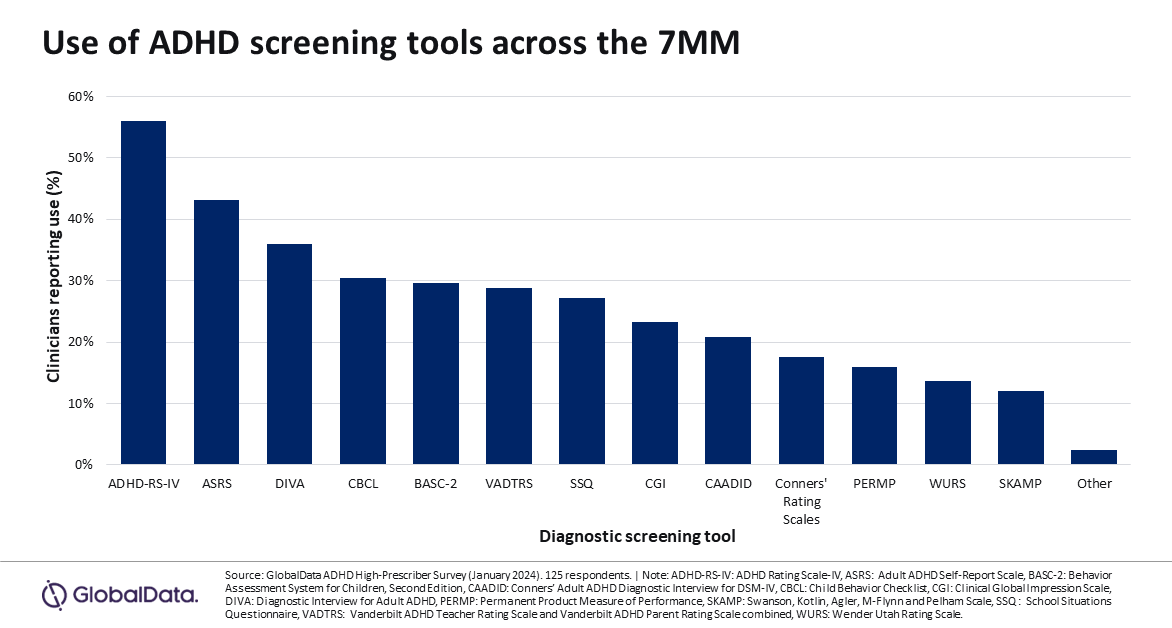
Palmer adds: “ADHD screening tools assist clinicians in the diagnosis of ADHD and most are adapted from established diagnostic guidelines. For example, the most frequently used screening tool according to GlobalData’s high-prescriber survey is the ADHD Rating Scale (ADHD-RS), a pediatric screening tool that is based on the DSM guidelines. The next most frequently used screening tools were the adult screening tools the Adult ADHD Self-Report Scale (ASRS) and the Diagnostic Interview for Adult ADHD (DIVA).”
A total of 56% of surveyed clinicians reported the use of the ADHD-RS screening tool as a diagnostic aid, while 43% and 36% reported the use of the ASRS and DIVA, respectively. The high frequency of use screening tools may reflect the broader trend of increasing diagnosis of ADHD across the 7MM, particularly in adults.
Palmer concludes: “The availability of clear ADHD diagnostic criteria coupled with established screening tools is important for clinicians to identify the heterogenous symptoms of ADHD in both the adult and pediatric populations. These standardized practices and tools aid the accurate diagnosis of ADHD and could be associated with the continued increase in ADHD diagnosed prevalent cases.”
*7MM countries- France, Germany, Italy, Spain, the UK, the US, and Japan.
**2024 ADHD high prescriber survey: GlobalData surveyed 125 high-prescribing physicians, who represented the 7MM. The survey was launched in January and completed in February 2024.
