

Known for their low-dose therapeutic efficacy and high target affinity, high-potency active pharmaceutical ingredients (HPAPIs) are in high demand by biopharma companies, which often outsource their production. Approximately 41% of innovator and biosimilar HPAPIs come from contract development and manufacturing organizations (CDMOs). With strategic acquisitions and expansions of HPAPI facilities reshaping the HPAPI outsourcing market, four CDMOs—Lonza, Siegfried, Aspen, and Veranova—are competing for leadership, with two of them, Lonza and Siegfried, pulling out in front, according to GlobalData, a leading intelligence and productivity platform.
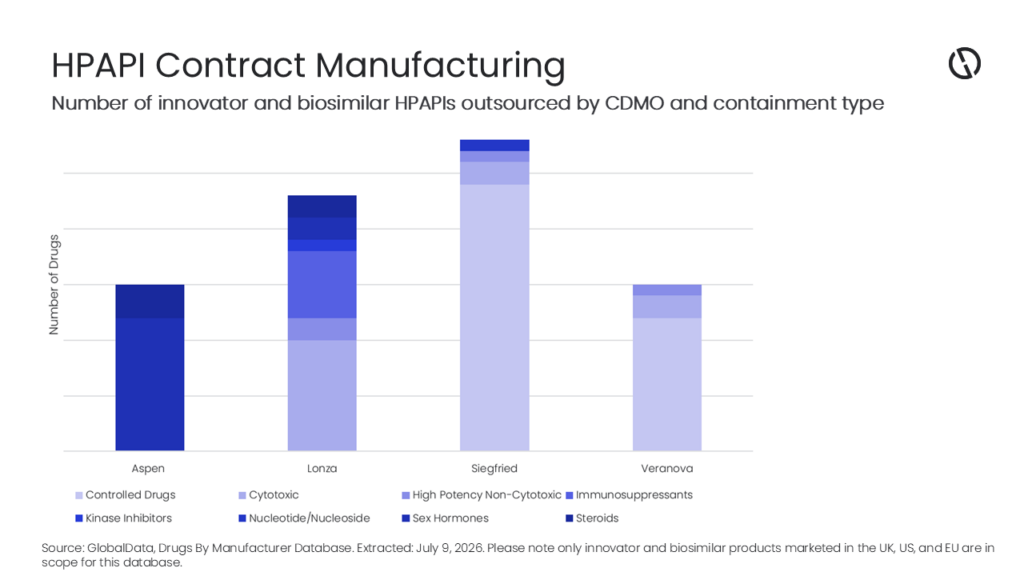
Katia Djebbar, Pharma Analyst at GlobalData, comments: “HPAPIs are typically categorized as cytotoxic, high-potency non-cytotoxic, or others requiring containment (including sex hormones and controlled drugs), and need to be manufactured in specialized, regulated facilities to ensure safety for the environment and operators. Within this sector, Siegfried leads with 28 HPAPI drugs, followed by Lonza with 23.”
Lonza was previously ahead but has since been overtaken by Siegfried following its acquisition of Noramco, which included two US HPAPI sites in Wilmington, Delaware, and Athens, Georgia. Finalized in May 2026, the deal added 13 controlled drugs to Siegfried’s contract manufacturing portfolio and expanded its presence in the US, where the majority of outsourced HPAPI manufacturing takes place. Also included in this deal was the acquisition of Extractas Bioscience’s Westbury site on the Australian island of Tasmania, further globalizing Siegfried’s supply chain.
Meanwhile, South Africa-based Aspen manufactures all innovator and biosimilar HPAPIs outsourced to it at its Dutch facilities. As the sole contract manufacturer of HPAPIs in the Netherlands, according to GlobalData’s Drugs By Manufacturer Database, Aspen’s portfolio places the country in the global top five for innovator and biosimilar HPAPI contract manufacturing.
Djebbar adds: “Lonza and Siegfried, both Switzerland-based companies, manufacture a large portion of their HPAPIs in facilities within their home country but, unlike Aspen, their production sites have a wider geographic distribution. This includes the US, Europe, and, in Lonza’s case, Singapore, reflecting the broader trend toward supply chain globalization.”
For its part, Lonza has a diverse portfolio of small molecule and biologic HPAPI contracts, though it mainly focuses on the immunosuppressant and cytotoxic products that play a key role in oncology. By contrast, 86% of Siegfried’s HPAPI contracts involve controlled-drug manufacturing, primarily marketed for central nervous system indications.
Aspen and Veranova also appear to be adopting a specialization strategy, with Aspen focusing on sex hormones and Veranova on controlled drugs. Specialization appears to be a successful approach for three out of the leading four CDMOs, offering one rationale for Siegfried’s acquisition.
Djebbar concludes: “However, Lonza has announced new strategies that may enable it to challenge Siegfried’s lead. In June 2026, the CDMO announced plans to expand its HPAPI capacity at its Visp site in Switzerland, focusing on antibody-drug conjugate (ADC) payload-linker capabilities to support the growing ADC market. With Lonza leading in contract manufacturing of biologic and cytotoxic HPAPIs, the company seems well placed as the biopharma industry looks to those two growth areas.”
