

Recent developments in the field of bispecific T-cell engagers (BiTEs) have led to the approval of three therapies for relapsed/recurrent multiple myeloma (RRMM): Elrexfio (elranatamab) developed by Pfizer, Tecvayli (teclistamab) and Talvey (talquetamab) developed by Johnson & Johnson. Clinical data of the three have been surprising, surpassing previously anticipated response rates. With an ever-growing number of patients entering the RRMM population, these BiTEs are poised to become the pre-eminent therapeutic option, recording sales of nearly $9 billion by 2030, according to GlobalData, a leading data and analytics company.
GlobalData analyst consensus forecasts predict total global sales of Tecvayli, Talvey, and Elrexfio to reach $6.4 billion, $2.0 billion, and $542 million by 2030, respectively.
Thomas Wales, MSc, Oncology & Hematology Analyst at GlobalData, comments: “Tecvayli provided a therapeutic option in an area of significant unmet need. The MajesTEC-1 trial showed Tecvayli had an overall response rate of 61.8%, with 28.2% of patients demonstrating complete response rates. Talvey and Elrexfio have shown similar results in these metrics. Furthermore, the overall survival (OS) of patients treated with Tecvayli has reached a median duration of 18.3 months. These results are promising, as triple-class refractory multiple myeloma is associated with a dismal prognosis of less than a year.”
Tecvayli was the first BiTE to see accelerated FDA approval in RRMM based on its MajesTEC-1 study. The current FDA approvals of Tecvayli, Talvey, and Elrexfio are conditional and highly dependent on a risk evaluation and mitigation program owing to their high rates of cytokine release syndrome (CRS). BiTEs are also troubled with concerns over their short half-lives and frequent dosing. These issues led to the discontinuation of Amgen’s AMG420 in 2020.
Wales continues: “The MajesTEC-1 trial has shown that patients treated with Tecvayli had a grade 1-3 CRS rate of 72.1%. The trial also demonstrated a high rate of grades 3 and 4 anemia and neutropenia. With Elrexfio’s safety data being more positive in these areas, Pfizer could become a fierce competitor with Johnson & Johnson, offering an efficacious and potentially more tolerable alternative.”
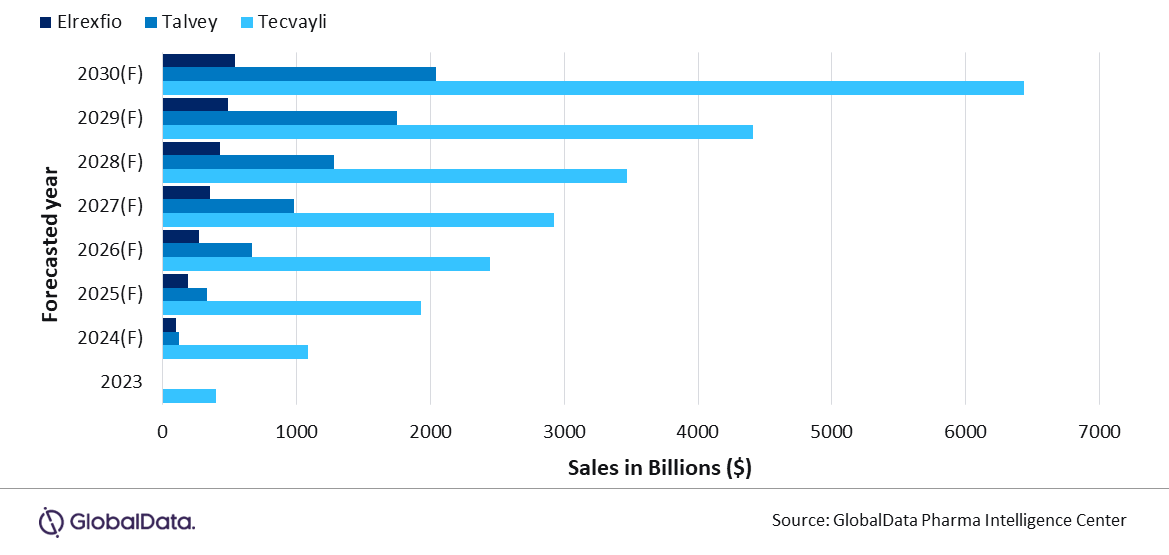
Wales concludes: “Ultimately, the potential benefits of these BiTEs are too attractive to pass up, especially in a therapeutic area severely lacking tangible benefits. Through a slow and steady state of trial and error, the RRMM therapy area has received three clinically proven therapies that will dominate the post-third-line treatment landscape for RRMM. Johnson & Johnson, having the most BiTEs and its first-to-market advantage, will see the lion’s share in the RRMM market.”
