

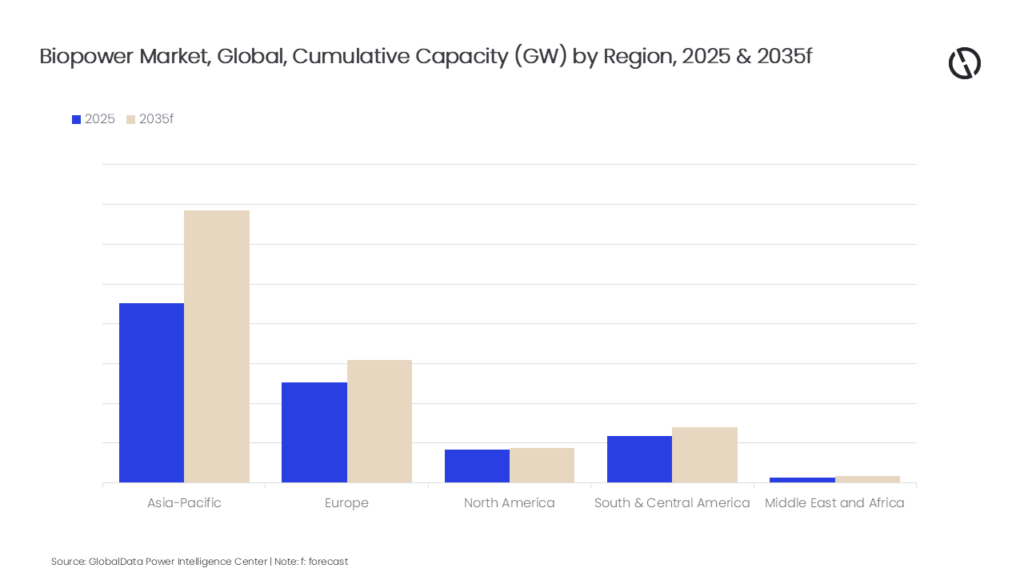
The global biopower sector has seen its growth shift in recent years, with a small number of Asian markets accounting for the majority of new capacity while several countries in Europe and North America restructure their support frameworks. The Asia-Pacific (APAC) region is forecast to increase its share of global biopower capacity from around 42% in 2025 to roughly 55% by 2035, says GlobalData, a leading intelligence and productivity platform.
GlobalData’s latest report, “Biopower Market, Update 2026 – Global Market Outlook, Trends, and Key Country Analysis” reveals that China held the largest cumulative biopower capacity in APAC at 47.4GW in 2025 and is estimated to account for more than half of all forecast additions over the period. Europe followed, with around 28% of global capacity in 2025, expanding modestly as its established fleet approached saturation. North America was the only region to record a decline in installed capacity during 2020-25, as retirements outpaced new build.
Mohammed Ziauddin, Power Analyst at GlobalData, comments: “Rising urban waste volumes, the availability of agricultural residues, and the value of dispatchable renewable generation in grids with high solar and wind penetration continue to support investment in the sector. Growth in several Asian markets is increasingly supported by locally available agricultural residues and municipal waste, particularly in China, which has developed one of the world’s largest waste-to-energy fleets.”
Renewable municipal waste accounted for over 40% of China’s biopower capacity in 2025, providing both a feedstock for power generation and a waste treatment service, while residue-based projects similarly draw on by-products of large agricultural and processing industries. Projects of this type can have economic drivers beyond electricity revenues, including waste treatment fees and integrated access to low-cost residues, although policy support remains important across all these markets.
Policy support for conventional biomass power has become more selective across several mature markets, with incentives increasingly directed toward applications offering additional system value. Japan announced that new woody biomass plants of 10MW or more using general timber will no longer be covered by feed-in-tariff and feed-in premium support from FY2026, while smaller and waste-based facilities remain eligible. South Korea’s December 2024 reform of Renewable Energy Certificate (REC) support ended eligibility for new biomass plants and phased down weightings for state-owned facilities, while retaining support for domestically sourced biomass.
In the UK, a new low-carbon, dispatchable Contract for Difference for the country’s largest converted biomass plant caps the annual subsidised load factor at 27% from 2027, substantially below its previous operating profile, and pays the plant to generate when the system requires it. Germany is transitioning a large existing biogas fleet from guaranteed remuneration toward competitive tendering, with around 3,000 plants reaching the end of their 20-year support contracts by 2030.
Ziauddin adds: “Support for conventional biomass electricity is being restructured rather than removed in the markets where the sector was first established. Policy is increasingly assessing what additional value a given application provides, whether that is dispatchable capacity, useful heat, waste treatment, or renewable gas, rather than treating all biomass generation equally. This is reshaping which projects proceed rather than reducing the role of bioenergy overall.”
Feedstock composition also varies by market. Solid biofuels made up the largest share of global biopower capacity in 2025, followed by renewable municipal waste and biogas. Brazil and Thailand draw primarily on bagasse from their sugar industries, the US and the Nordic countries on black liquor and wood residues from pulp and paper production, while Germany and Italy rely largely on agricultural biogas.
Ziauddin concludes: “The trajectory of the biopower market over the next decade will depend on three factors: feedstock security, the design of support mechanisms, and the system value a project delivers beyond electricity alone. Competition for sustainable biomass is increasing as biomethane, sustainable aviation fuel, and industrial heat draw on overlapping feedstock pools, while import-dependent markets remain exposed to price and sustainability pressures in the pellet trade.
“Countries with domestic residue availability and integrated waste management systems are better positioned to sustain growth, and frameworks that reward dispatchability, heat recovery, and waste treatment alongside generation are likely to determine where new capacity is built.”
