

Australia operates one of the world’s fastest-decarbonizing power systems, marked by a rapid structural shift away from thermal baseload generation toward solar, wind, and storage. With the retirement of major coal-fired power stations accelerating and the federal 82% renewable electricity target for 2030 approaching, the country is deploying substantial market and policy mechanisms to safeguard system reliability. However, accelerating coal retirements increases the urgency of replacing dispatchable capacity, says GlobalData, a leading intelligence and productivity platform.
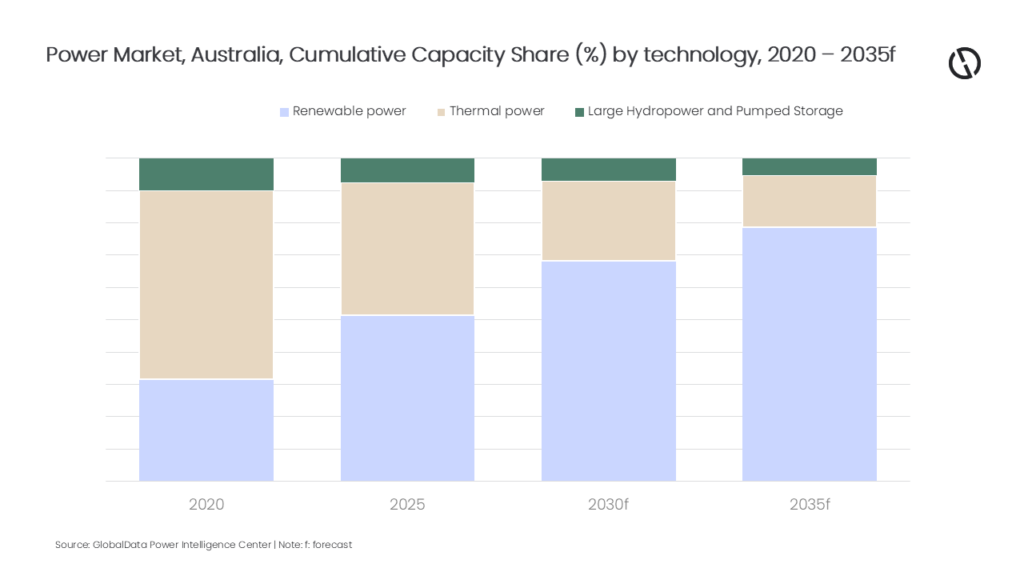
GlobalData’s latest report, “Australia Power Market Trends and Analysis by Capacity, Generation, Transmission, Distribution, Regulations, Key Players and Forecast to 2035,” reveals that the country’s cumulative installed capacity is projected to expand at a compound annual growth rate (CAGR) of 6.2% between 2025 and 2035. Over the same forecast period, the share of renewable capacity share is set to rise from just over 51% to nearly 79%, while the share of renewable electricity generation is anticipated to more than double, exceeding 72% by 2035.
Attaurrahman Ojindaram Saibasan, Power Analyst at GlobalData, comments: “The scheduled retirement of foundational coal-fired assets, including Australia’s largest station, Eraring, by 2027 and Yallourn by 2028, is rapidly restructuring the national generation profile. To bridge the looming dispatchable capacity gap, the Capacity Investment Scheme is underwriting 32GW of new renewable and clean firming capacity by 2030 through competitive revenue underwriting mechanisms, providing developers and financiers with long-term revenue certainty.”
The retirement of coal capacity also increases the need for resources that can balance variable renewable output and maintain reliability during periods of peak demand. The Capacity Investment Scheme, Renewable Energy Zones (REZs), utility-scale batteries, pumped storage, demand response, and flexible gas generation will therefore play complementary roles as Australia shifts to a higher-renewables electricity system.
Saibasan adds: “Australia’s challenge is no longer simply to build renewable generation. It must ensure that clean power is backed by sufficient firming capacity and delivered through a grid that can connect new supply with demand. Transmission projects such as HumeLink, VNI West, Project EnergyConnect, and Marinus Link are essential to unlock Renewable Energy Zones and reduce the risk of curtailment and reliability shortfalls.”
Australia’s projected power-sector buildout will require substantial investment across renewable generation, firming capacity, and grid infrastructure. GlobalData expects power-sector investment to exceed $60 billion between 2026 and 2030, with solar PV accounting for the largest share of expenditure, followed by onshore and offshore wind.
Saibasan concludes: “Australia’s investment outlook is shaped by a broader set of factors, including renewable-energy targets, rising electricity demand, grid constraints, and the need for firming. Delivery will depend on policy execution, transmission approvals, financing conditions, and the timely completion of projects.”
