

Brazil is entering a new phase of power sector development as reforms to the electricity market, offshore wind regulation, and low-carbon hydrogen policy support investment in a more diversified renewable energy system. Solar PV growth, rising demand for grid flexibility, and a substantial offshore wind development pipeline are extending the country’s power sector beyond its traditional hydropower base, according to GlobalData, a leading intelligence and productivity platform.
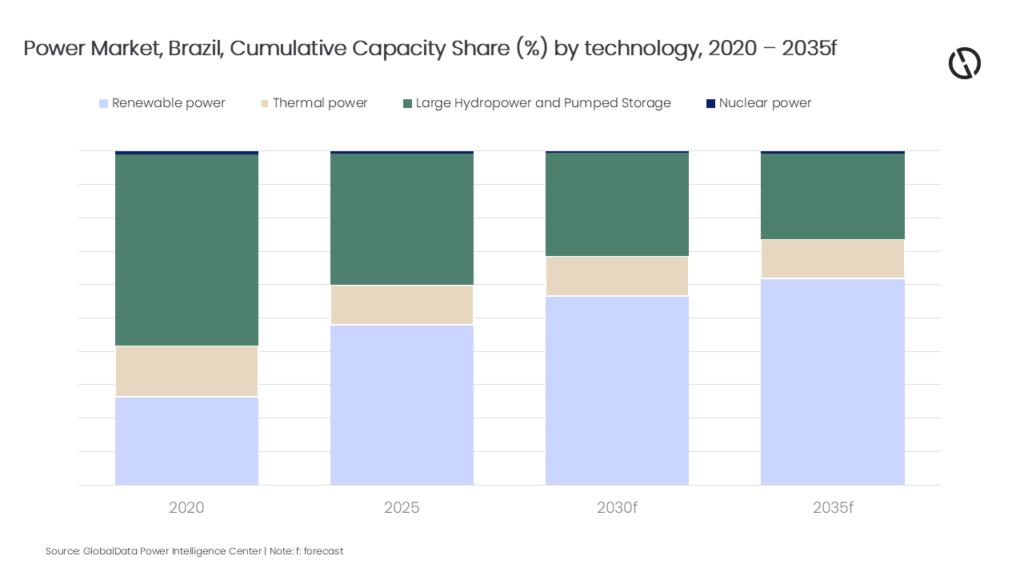
GlobalData’s latest report, “Brazil Power Market Trends and Analysis by Capacity, Generation, Transmission, Distribution, Regulations, Key Players and Forecast to 2035,” reveals that Brazil’s cumulative installed power capacity is projected to grow at a compound annual growth rate (CAGR) of 4.7% between 2025 and 2035. Over this timeframe, renewable capacity share is forecast to rise from 48.0% to nearly 62%, while renewable electricity generation to approach 50% of the total matrix.
Attaurrahman Ojindaram Saibasan, Power Analyst at GlobalData, comments: “Brazil has the resource base and investor interest to broaden its renewable power mix substantially. Solar PV will remain the principal near-term growth engine, while offshore wind represents a longer-term opportunity. The pace at which offshore projects progress will depend on clear rules for auctions, seabed leasing, environmental licensing, and grid access.”
In the near term, solar PV will be the primary engine of capacity additions, supported by deep permitting queues alongside projects under construction and financed. Onshore wind continues to expand across Brazil’s high-yield Northeast region, while natural gas capacity under construction provides critical flexible balancing to manage hydrological risk during dry periods.
Saibasan adds: “Solar PV is on track to surpass large hydropower as Brazil’s single largest power source in terms of installed capacity by 2035. As variable generation expands rapidly across the Northeast and distributed solar penetrates distribution grids, expanding transmission corridors and reinforcing system reliability become urgent priorities. The 2025 Power Sector Reform Law supports this transition by gradually opening the free contracting market to all consumers and establishing a framework for grid-scale energy storage.”
Investment activity reflects the evolving priorities. Brazil’s power sector is forecast to attract close to $93 billion in new capital investment between 2026 and 2030, with solar PV securing approximately 58% of total expenditure, followed by onshore wind and natural gas. Furthermore, the enactment of the Low Carbon Hydrogen Framework positions Brazil to leverage its low-cost renewable power for domestic industrial decarbonization and clean fuel exports.
Saibasan concludes: “Brazil enters the next decade with robust fundamentals: high-quality renewable resources, an expanding free power market, and significant investor appetite. Meeting long-term targets—such as cutting net greenhouse gas emissions by 59% to 67% by 2035—will require synchronized execution across grid expansion, licensing approvals, and regulatory certainty for storage and offshore wind to ensure the matrix remains clean, secure, and affordable.”
