

The Czech Republic is on the cusp of one of its boldest energy transformations in decades as it bets heavily on nuclear power to replace coal and reach its clean energy goals. With plans underway for new large reactors and small modular reactors (SMRs), the path ahead post 2035 is ambitious—and fraught with regulatory, financial, and timeline risks, according to GlobalData, a leading intelligence and productivity platform.
GlobalData’s latest report, “Czech Republic Power Market Trends and Analysis by Capacity, Generation, Transmission, Distribution, Regulations, Key Players and Forecast to 2035,” reveals that while nuclear power is being locked in as a foundational source for reliability, emissions abatement, and supply stability, realization of the planned units will require streamlined permitting, consistent policy support, and robust financing.
Attaurrahman Ojindaram Saibasan, Power Analyst at GlobalData, comments: “The Czech Republic is making bold nuclear moves between Dukovany II and SMRs at Temelín but these are expected to translate into operational capacity only after 2035, due to long approval timelines, extensive environmental impact assessments, and the need to prepare the grid.”
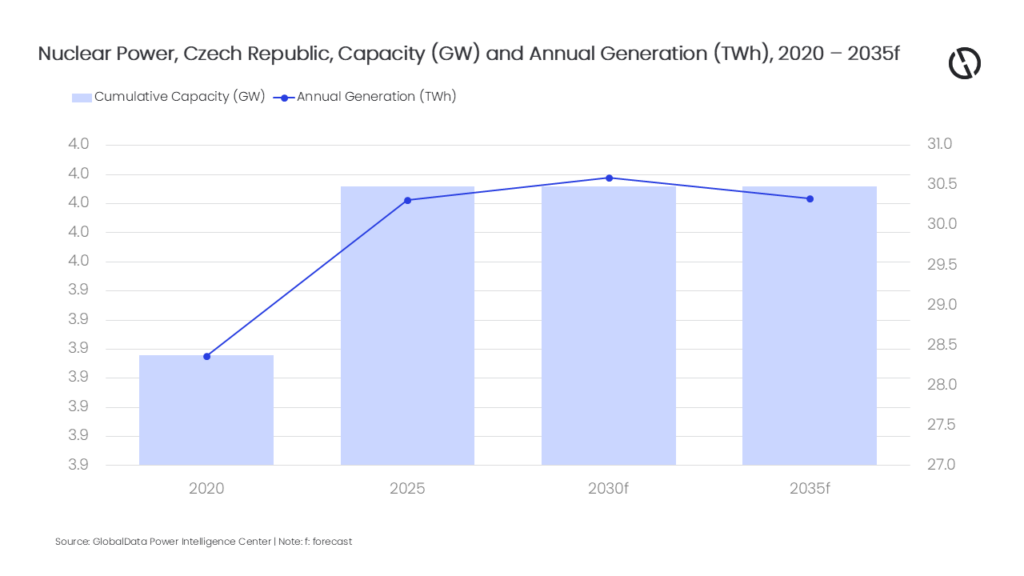
The government has selected KHNP to lead the construction of two APR-1000 reactors at Dukovany, with consruction to begin in 2029 and first output targeted around 2036. At Temelín, ČEZ has committed to an early works contract with Rolls-Royce SMR, including the preparation of design, licensing, and permitting documentation while exploring SMR deployment at former coal-plant sites.
Saibasan adds: “Beyond construction contracts, governing bodies must resolve financing models, licensing timelines, and regulatory safety frameworks. SMRs require new licensing arrangements and community engagement; large reactors need coordinated supply chains and dispatch arrangements that account for nuclear capacity in markets dominated by renewables.”
Expanding nuclear capacity comes as electricity demand is forecast to rise steadily through 2030 driven by industry, heating, transport, and broader electrification. The Czech Republic must balance the coal phase-out slated for around 2033 with having dispatchable low-carbon resources in place. Grid upgrades and storage remain a secondary complement to nuclear in overcoming dark hours or grid inertia challenges.
Saibasan concludes: “For developers and investors, the Czech Republic offers a substantial nuclear investment opportunity—if deadlines are honored, regulatory risk is managed, and nuclear projects are treated with the urgency that the coal exit demands.”
