

Kazakhstan’s electricity consumption has been on a steady rise, driven by industrial expansion, urbanization, digitalization, and electrification. The nation’s power demand is predominantly fueled by energy-intensive industries, mining, oil and gas operations, and residential sector growth. This surge in industrial activity has led to a heightened demand for electricity; annual consumption escalated from 83.9TWh in 2020 to 90.9TWh in 2024. This upward trend is anticipated to persist, with projections suggesting an increase to 111TWh by 2035, according to GlobalData, a leading data and analytics company.
GlobalData’s latest report, “Kazakhstan Power Market Outlook to 2035, Update 2025 – Market Trends, Regulations, and Competitive Landscape,” reveals that the industrial sector occupied the dominant share in the country’s power consumption, accounting for 56% in 2024. This was followed by the commercial sector with 19.2% and the residential sector with a share of 19.1%. The transport sector held a share of 4%, whereas other segments contributed to a 1.8% share.
Attaurrahman Ojindaram Saibasan, Senior Power Analyst at GlobalData, comments: “In the industrial sector, the fields of metallurgy, mining, and oil refining continue to be the predominant consumers. The emergence of new projects in battery metals and green hydrogen has the potential to further escalate demand. Additionally, the residential sector is experiencing an upsurge in demand, attributable to the increased energy consumption of households. This rise is a direct consequence of urbanization and elevated living standards, which in turn lead to a higher proliferation of electrical appliances as well as heating and cooling systems.”
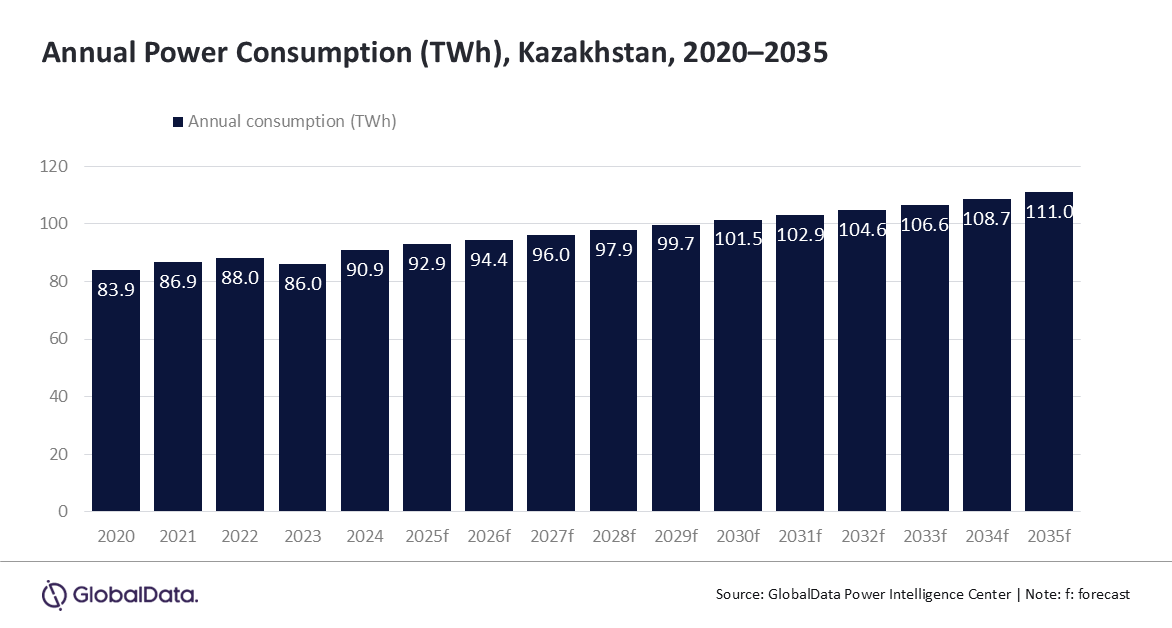
In 2024, the country experienced a 3.8% year-on-year increase in GDP, attributable to the growth of the industrial and manufacturing sectors. Kazakhstan’s energy-intensive industries, which include mining, metallurgy, and oil refining, account for approximately 60% of the nation’s electricity consumption. The trend of urbanization, coupled with a rise in household energy use, is generating further demand.
Saibasan concludes: “The Kazakh government estimates that the country would need at least 17.5GW of new capacity to meet the local demand by 2035. The Ministry of Energy (MoE) has proposed the following structure for the new energy capacity required by 2035 as follows: over 5.1GW of gas-based thermal capacity, over 2.1GW from hydropower plants, over 1.4GW of coal-based thermal capacity, over 6.5GW from renewable power, and over 2.4GW of nuclear power capacity. This is expected to bring in more investments into the sector.”
