

Switzerland is entering a pivotal phase in its energy transition. With parliament having lifted the decades-old ban on granting framework permits for new nuclear power plants, the country is reopening the nuclear question just as it accelerates renewables, storage, and grid resilience efforts. Decisions taken over the next few years will be crucial in shaping whether Switzerland secures clean energy goals while preserving supply reliability through 2030 and beyond, according to GlobalData, a leading intelligence and productivity platform.
GlobalData’s latest report, “Switzerland Power Market Trends and Analysis by Capacity, Generation, Transmission, Distribution, Regulations, Key Players and Forecast to 2035,” reveals that solar PV remains front and center among new capacity pipelines and investment flows. While hydropower and pumped storage stay foundational for seasonal and winter balancing, the portfolio mix is becoming more diversified as solar leads in recent auctions and policy measures.
Attaurrahman Ojindaram Saibasan, Power Analyst at GlobalData, comments: “A major policy shift occurred in mid-2026, when the Swiss Federal Assembly passed an indirect counterproposal to the “Stop the Blackout” popular initiative. This legal amendment folds into the Nuclear Energy Act a provision allowing framework (general) permits for new nuclear power plants. In doing so, Switzerland formally revoked the ban on new nuclear construction established in 2017. Though no nuclear new builds are yet underway, this change adds a new supply option to be considered alongside renewables, storage, and flexibility instruments.”
Investment in solar PV (alongside battery storage and demand-side flexibility) will play a central role in expanding generation capacity through 2035. Recent regulatory reforms such as permitting acceleration laws effective from April 2026 and incentive revisions starting January 2026 are intended to smooth the path for solar, grid expansion, and storage projects. These reforms aim to cut delays, reduce administrative burdens, and improve economic viability especially in regions with strong solar potential.
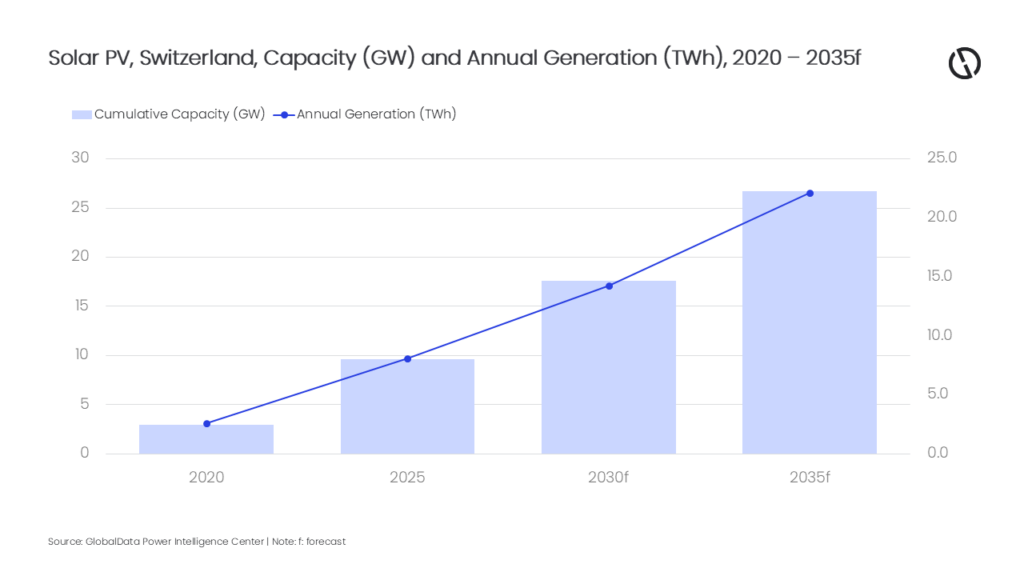
Saibasan adds: “However, lifting the ban on new nuclear plants complicates some of the earlier assumptions. While solar is outpacing other renewables in pipeline volume and deployment speed, nuclear is once again legally viable; it could become a complement to mitigate winter supply shortages, especially given hydropower’s seasonal constraints and increasing demand for electricity. The timeline for new nuclear projects, however, remains uncertain: framework permits need to be defined, public acceptance addressed, financing models established, and environmental and safety regulation finalized.
Switzerland’s electricity demand is also expected to grow through 2030 due to industrial modernization, electrification of heating and cooling, and increasing electric vehicle uptake. Without sufficient expansion in flexible resources such as storage, curtailment mechanisms, grid upgrades and now possibly nuclear, there is risk of supply strains during winter and congestion on distribution networks during peak solar output periods especially in mountainous and alpine regions where grid infrastructure is more fragile. Solar potential in high-altitude zones is being encouraged by policy, though performance in winter is highly dependent on local irradiance, snow cover, and system orientation.
Saibasan concludes: “Hurdles are substantial with local opposition to both new renewables and nuclear installations—especially in sensitive alpine areas—can delay permitting and provoke legal appeals. Environmental assessments and licensing procedures, though accelerated in law, still require implementation and capacity at federal, cantonal, and municipal levels. Unified grid planning is complicated by fragmentation among utilities and transmission/distribution entities; insufficient coordination risks regional bottlenecks. Off-take, cost structure, and long-term financing for non-solar renewables and nuclear remain to be fully defined under the new legal regime.
Switzerland’s energy transition is now entering a more complex phase. Solar PV and storage remain likely workhorses, but the reopened path for nuclear permits adds a strategic option. The extent to which Switzerland can maintain uninterrupted supply especially in winter while meeting climate goals, will depend on how quickly the nation can execute on permitting reforms, clarify investment frameworks, and modernize its grid with a diversified portfolio that may finally include new nuclear, alongside renewables and flexibility solutions.”
