

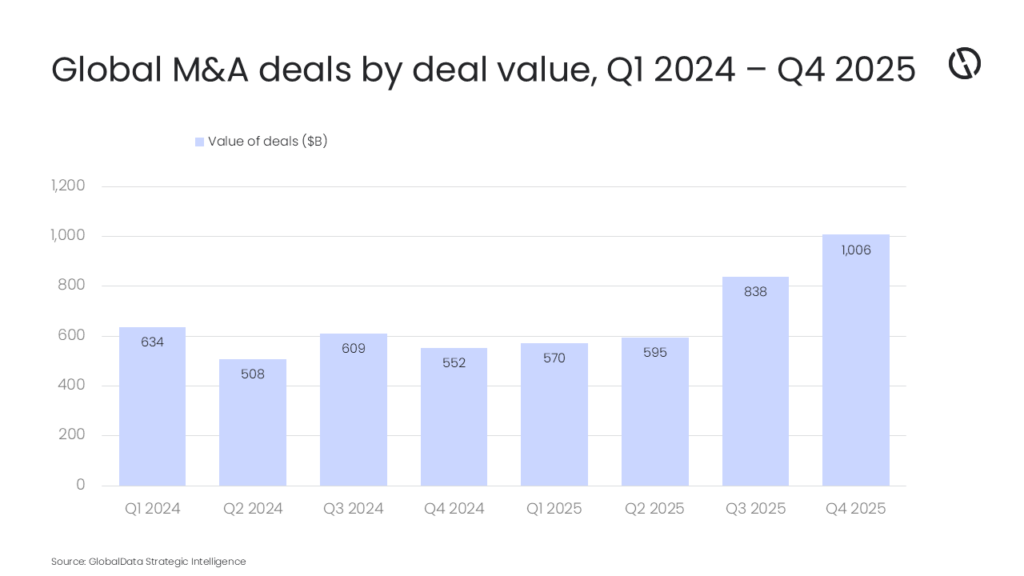
Global mergers and acquisitions (M&A) deals hit $3 trillion in 2025, up 31% from the previous year, helped by a steady fall in interest rates and the impact of US tariffs on global supply chains. With $184 billion in supply chain-related transactions across 21 deals, covering sectors such as industrials, consumer, and materials, supply chain resilience was a key theme driving M&A momentum last year, according to GlobalData, a leading intelligence and productivity platform.
GlobalData’s latest Strategic Intelligence report, “Global M&A Deals in 2025 – Top Themes by Sector: Strategic Intelligence,” reveals that in 2025, the combined value of mega-deals, defined as transactions valued at $1 billion or more, rose by 34% to $2.4 trillion, up from $1.8 trillion in 2024.
Priya Toppo, Strategic Intelligence Analyst at GlobalData, comments: “Rising geopolitical tensions, especially in terms of tariffs, shifting demographics, heightened ESG regulations, ongoing labor shortages, and accelerated digital transformation have all further intensified the focus on supply chain-related M&A deals. Companies are increasingly prioritizing resilient, localized, and technology-driven supply chains to mitigate risks and enhance operational efficiency. This was especially true in the consumer, industrials, materials, and healthcare sectors.”
The biggest supply chain deal was the Essential Utilities merger with American Water Works for $30.1 billion. It was followed by Sycamore Partners’ acquisition of Walgreens Boots Alliance for $23.7 billion and Keurig Dr Pepper’s acquisition of JDE Peet’s for $23.1 billion.
Toppo continues: “An ongoing trend is the dominance of North America in M&A deal activity, accounting for 11,403 deals worth $1.9 trillion in 2025. However, Europe and APAC (excluding China), saw a YoY decline in deal value.”
Toppo concludes: “The M&A outlook for 2026 is cautiously optimistic, fueled by potential interest rate cuts and the need to adjust to the new tariff landscape. However, large deals may still face challenges in the US due to ongoing regulatory scrutiny.”
