

In the most anticipated political event of the year, the US presidential elections will see two generally unpopular candidates, Joe Biden and Donald Trump, battle for America’s vote. Election coverage has largely focused on each candidate’s unfavorable traits and left little room to discuss the wider implications should they win. A second term for Biden will likely focus on making his first-term agenda a success, while a Trump second term will focus on tax cuts and tougher protectionist policies, says GlobalData, a leading data and analytics company.
GlobalData’s latest report, “Thematic Intelligence: Deep Dive into the 2024 US Elections” looks into the domestic and global implications of a Biden and Trump second term in the White House. It also explores how the makeup of the US Congress will impact the degree to which the victorious presidential candidate can fulfil their campaign promises.
Carolina Pinto, Analyst, Thematic Intelligence team at GlobalData, comments: “Unsurprisingly, the economy and the cost-of-living crisis is one of the most important issues among US voters. The economy will be the most impacted by a united government scenario, where one party wins the majority in the House of Representatives, the Senate, and the White House.
“A united government increases risks to business investment due to increased regulatory changes from fast-paced legislative action. Given the inevitability of change, businesses must understand the domestic and foreign policy implications of the November elections and start strategic planning now.”
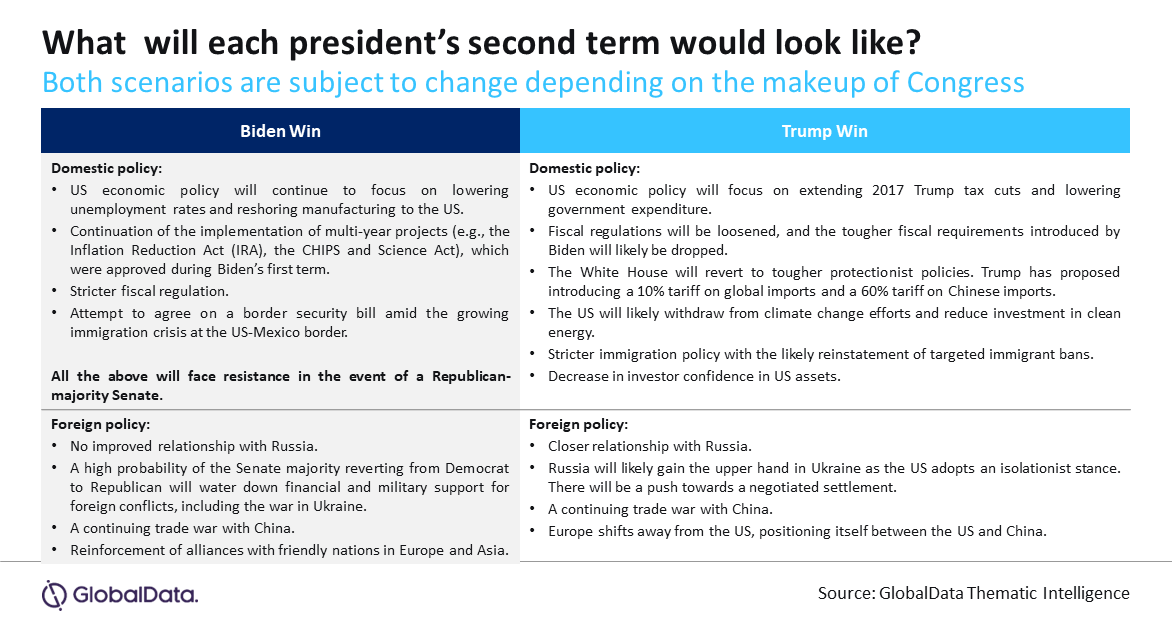
Biden 2.0 will focus on making his first-term agenda a success
In his first term, Biden passed several multi-year projects to revive US manufacturing, including the Inflation Reduction Act (IRA), the CHIPS and Science Act, and the Infrastructure Investment and Jobs Act. These bills have been passed but are yet to be fully implemented. Biden’s second term will focus on making his first-term agenda a success.
Pinto continues: “If possible, Biden will look to complement these three legislative acts of his first term with a second package, such as a CHIPS 2.0, alongside complementary legislation to facilitate implementation. However, this will be difficult in the event of a Republican-majority Congress.”
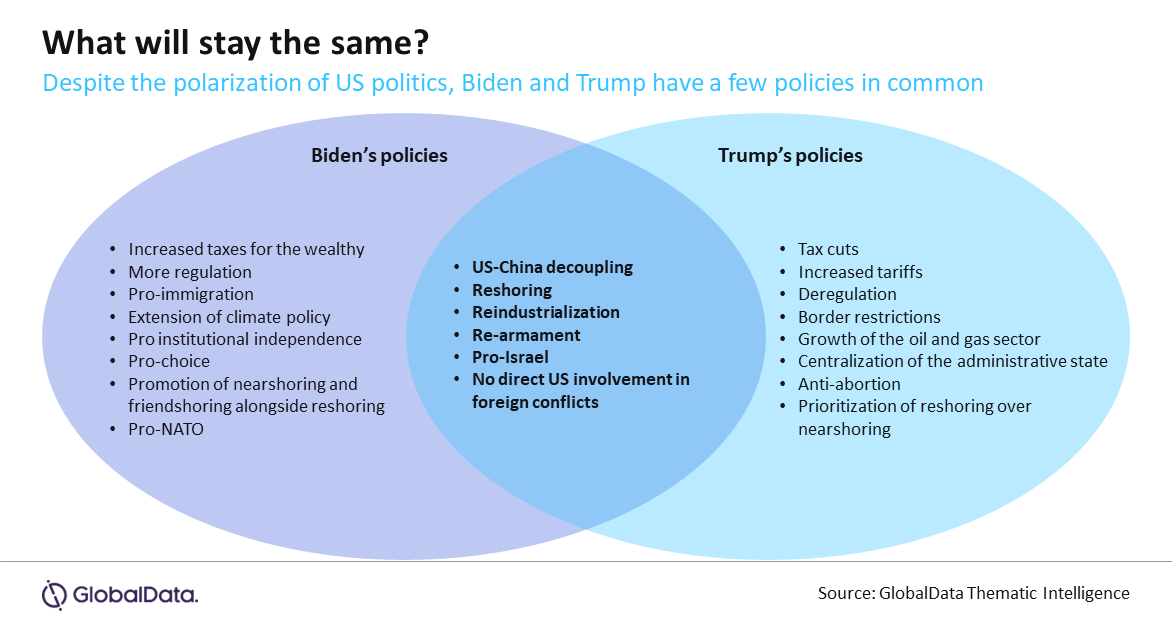
Trump 2.0 will focus on economic nationalism, tax cuts, and retribution
Under Trump, economic policy will focus on tax cuts for individuals and a dilution of fiscal regulation. The Republican party will look to extend the 2017 Trump tax cuts for individuals, which are currently due to expire in 2025. Trump has also proposed cutting the corporate tax rate to 15% from 21%, although he has wavered on that commitment given the growing US fiscal deficit. There will be some shifts in spending priorities, most notably from social security to border security. However, there will be no fundamental changes to the US budget. There will likely be a stronger fiscal stimulus and more aggressive fiscal policy if Trump is elected alongside a Republican-majority Congress.
Pinto adds: “Trump’s policies tend to be less extreme than his campaign rhetoric. His views on tax cuts, government expenditure, and abortion rights have changed over time and may change again.”
Pinto concludes: “Controlling the Senate is more important for Trump due to its responsibility in approving presidential nominations. A Republican-majority Senate will facilitate Trump’s objective to centralize the federal administrative state. However, in a divided government, Trump will focus on what he can control (e.g., agency regulations, tariffs, and global affairs) over what he cannot (e.g., budgetary spending).”
