
Insurtech Trends Bundle Report Overview
Advanced analytics technology will essentially serve as the backbone of insurance businesses, allowing them to effectively assess and underwrite risks, control fraud, forecast losses, and resolve claims quickly. Emergence of cyber insurance, rapid growth of inusrtech, and personalization of both life and commercial insurance will enhance the growth of “tech in insurance”.
As a part of this bundle, you will gain access to in-depth insights available in the following reports:
- Thematic Research: Computer Vision in Insurance
- Thematic Research: Connected Cars in Insurance
- Thematic Research: Cyber Insurance
- Thematic Research: Cybersecurity in Insurance
- Thematic Research: Insurtech
- Thematic Research: Personalization in Insurance
- Thematic Research: Robotics in Insurance
Report 1: Thematic Research: Cyber Insurance
Cybersecurity was thrust into the spotlight in 2020 as the COVID-19 pandemic forced businesses to digitize their processes and adopt remote working practices overnight. The pandemic also presented an opportunity for cybercriminals to exploit global panic, with a surge in cyberattacks occurring in 2020. This has made the need for cyber insurance apparent to businesses, but the market is not as easy to navigate as it once was. Cybersecurity was thrust into the spotlight in 2020 as the COVID-19 pandemic forced businesses to digitize their processes and adopt remote working practices overnight. The pandemic also presented an opportunity for cybercriminals to exploit global panic, with a surge in cyberattacks occurring in 2020. This has made the need for cyber insurance apparent to businesses, but the market is not as easy to navigate as it once was.
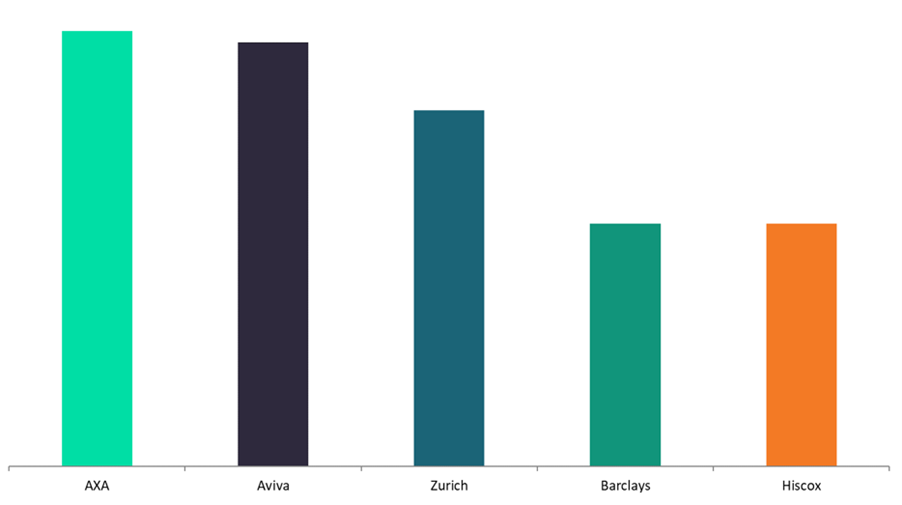
Leading Cyber Insurance Providers
To gain more information on cyber insurance, download our free report sample
Report 2:Thematic Research: Cybersecurity in Insurance (2022)
Cybersecurity revenues in the insurance sector was $6.4 billion in 2020. From 2020 to 2025, the market is anticipated to expand at a CAGR of more than 10%. The insurance sector’s cyber risk increased owing to COVID-19 since more customers were logging into their accounts online and insurance companies were offering their products online. The pandemic accelerated the need for cyber insurance, but insurers are yet to translate this into improved penetration rates. With the cost of cyber insurance rising to reflect increased cyber risk, policy uptake fell between 2019 and 2021 as many SMEs sought to cut costs.
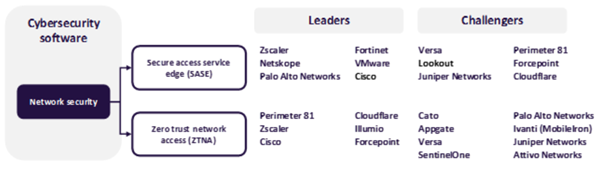
Cybersecurity Software Value Chain
For more insights on cybersecurity in insurance industry, download our free report sample.
Report 3:Thematic Research: Insurtech
It is obvious how the insurtech phenomena is affecting the larger insurance sector. Startups have championed cutting-edge technologies and procedures incorporating AI, blockchain, IoT, and big data, driving incumbents to respond and match the efficiencies these tools have brought about. The most well-known brand among well-known insurtechs in the UK is Marmalade, according to GlobalData’s 2021 UK Insurance Consumer Survey. One of the primary strategies used by insurtechs to differentiate themselves from the established competition is innovative product creation. New technologies and the startup knowledge surrounding them have facilitated the emergence of innovative solutions as well as the advancement of current goods focused on niche market segments.
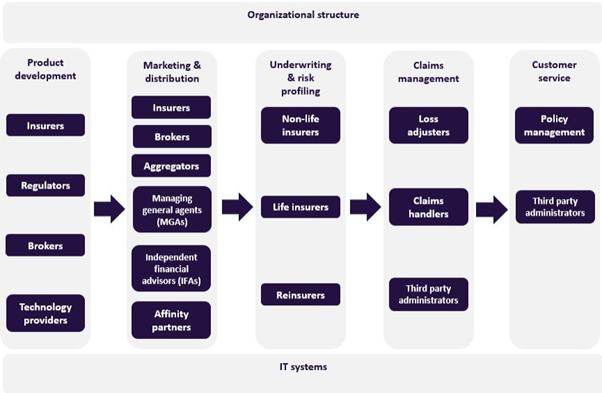
Insurtech Value Chain
To gain more information on the insuretech investments, download our free report sample
Report 4:Thematic Research: Personalization in Insurance
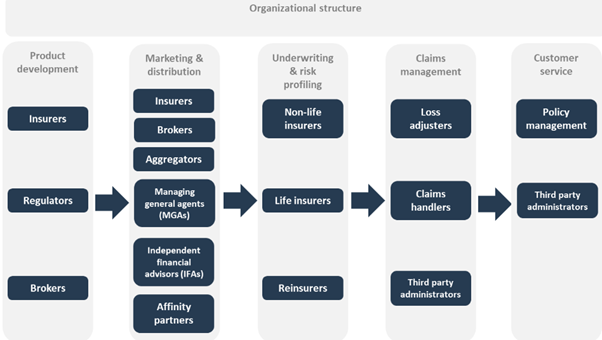
Personalization has emerged as a major theme in the insurance sector. Beyond personal lines, personalization has permeated both life and commercial insurance. This has been caused by the fact that brokers, reinsurers, and insurers are holding an increasing amount of data about their policyholders and are getting better at knowing how to store, process, and use it. This has been largely driven by digitalization, with customised insurance being purchased and managed online. The product development, marketing and distribution, underwriting and risk profiling, claims management, and customer service segments make up the insurance value chain.
Insurance Value Chain
To gain more insights on personalization in insurance, download our free report sample
Report 5:Thematic Research: Robotics in Insurance
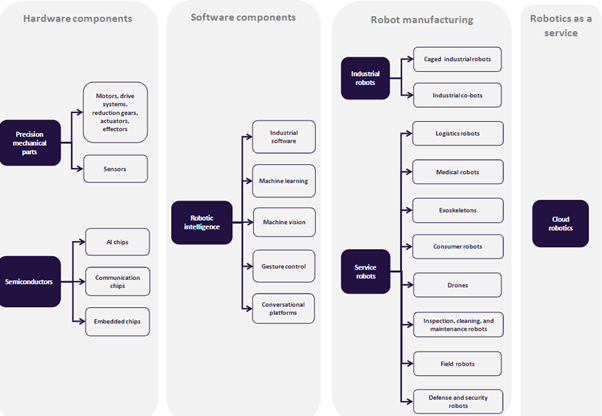
Robotics is a rapidly expanding sector, with an estimated market value of $45 billion in 2020 and a projected CAGR of 29% by 2030. Numerous insurers employed robots to carry out risk and damage analyses for crop fields or difficult-to-access regions like broken roofs. Life insurers are showing an increasing amount of interest in the fields of medical robots and exoskeletons, and they are progressively providing policyholders with access at no additional cost.
Robotics Value Chain
To gain more insights on robotics in insurance, download our free report sample
Report 6:Thematic Research: Computer Vision in Insurance
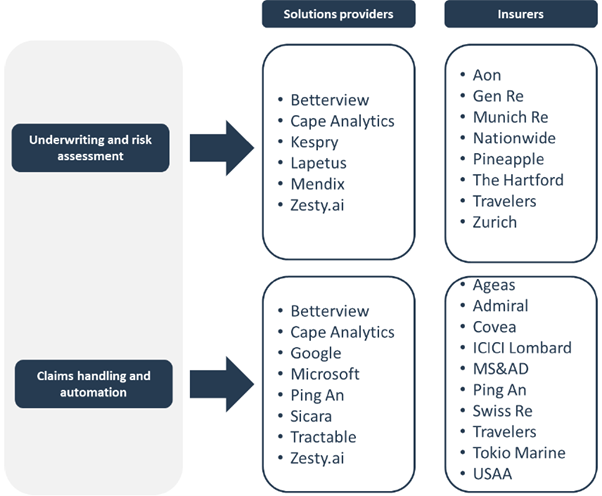
AI is used by computer vision (CV) to analyse photos and videos, recognise objects, and deliver useful information. With CV, insurers may more readily collect underwriting data and make use of previously untapped sources of information. Long-term, as technology replaces human drivers, CV will become a factor in the risk associated with autonomous vehicles, and insurance rates will be set in accordance with the level of underlying technology used by the vehicle. While insurers employ CV technology in their operations, they prefer to do so through partnerships over hiring in-house experts or buying CV technology businesses.
Leading Insurance Players Using Computer Vision
For more insights on computer vision in insurance, download our free report sample
Report 7:Thematic Research: Connected Cars in Insurance
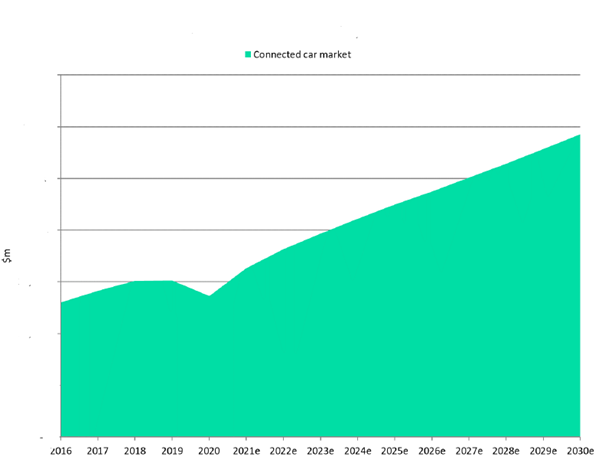
According to GlobalData, the market for connected cars will expand from its estimated value of $27.3 billion in 2020 to $58.5 billion by 2030, at a compound annual growth rate (CAGR) of 7.9%. The expansion of the connected car market flags the potential for insurers to integrate personalized aspects to how motor insurance premiums are priced by utilizing vehicle data. This will be possible because connected vehicles will already have telematics technology as part of their daily functions. As such, connected cars will lay the groundwork for insurers to access millions of data points generated by a vehicle’s ability to engage with other devices through the Internet of Things (IoT). Connected cars will assist insurers in developing increasingly accurate pricing strategies for customers.
Connected Cars Market Value
For more insights on connected cars in insurance, download our free report sample








