Energy Storage – The Key to Unlocking Sustainable Future
Powered by 
All the vital news, analysis, and commentary curated by our industry experts.

Reasons to buy the ‘Energy Storage’ report:
- The report provides insights on the innovation examples of energy storage use cases across sectors.
- The report casts light on enterprises and startups using energy storage systems across the sectors for renewal integration, grid stabilization, and power backup, among others.
- The report discusses the different energy storage operations based on storage technology.
How is our ‘Energy Storage’ report unique from other reports in the market?
- The innovation landscape report on energy storage, published by GlobalData, provides real-world examples of how leading companies and startups are advancing the deployment of cutting-edge energy storage solutions.
- The report covers key drivers and challenges shaping the energy storage theme.
- The report provides an insight into how energy storage systems (ESS) enhance grid stability, reduce costs, support renewable energy integration, and ensure reliable operations across sectors like energy, telecom, defense, automotive, and residential, driving sustainability and energy resilience.
We recommend this valuable source of information to anyone involved in:
- OEMs/Equipment Manufacturers
- EPC Vendors
- Power Generation Companies
- Transmission & Distribution Players
- Management Consultants and Investment Banks/Private Equity Players
To Get a Snapshot of the Energy Storage Report
Download a Free Sample Report
Energy Storage Report Overview
Energy storage plays a critical role in capturing and storing energy for future use, ensuring a reliable and efficient power supply. The growing reliance on renewable energy sources, including wind and solar, has significantly increased the demand for energy storage systems (ESS). The energy storage technologies range from mechanical systems like flywheel and pumped-hydrogen storage to electrochemical solutions such as lithium-ion batteries and chemical options like fuel cells. While lithium-ion batteries remain the dominant technology due to their high energy density, alternatives such as sodium-ion and solid-state batteries are also gaining traction. These new technologies offer improved safety, lower costs, and longer lifecycles, addressing some limitations of lithium-ion systems.
Buy the Full Report to Know More about Energy Storage
Download a Free Sample Report
The “Energy Storage: The Key to Unlocking a Sustainable Future” report examines the latest advancements in energy storage technologies across industries such as automotive, aerospace, and commercial sectors. It highlights innovations in lithium-ion, sodium-ion, solid-state batteries, and alternative storage methods like thermal and chemical solutions. The report also offers insights into how these technologies are shaping the future of energy storage. Furthermore, the report explores sector-specific applications, from ultra-fast charging batteries for electric vehicles (EVs) to scalable flow batteries for industrial use.
| Key Technologies | · Mechanical
· Electrochemical · Chemical · Thermal · Electrical |
| Key Sectors | · Energy
· Telecommunications · Aerospace & Defense · Automotive · Residential |
| Enquire & Decide | Discover the perfect solution for your business needs. Enquire now and let us help you make an informed decision before making a purchase. |
Energy Storage – Market Dynamics
The demand for renewable energy and the need for energy security are making energy storage a crucial component in the transition from fossil fuels to sustainable energy sources. Energy storage systems such as mechanical and thermal systems facilitate the integration of renewable energy sources by managing excess energy and ensuring reliability in supply. Furthermore, energy storage can lead to significant cost reductions in energy systems. Despite technological advancements, challenges such as the high cost of energy storage, scalability issues, and regulatory barriers remain significant. However, ongoing research and partnerships between industry leaders and governments are expected to address these issues, promoting further adoption of ESS technologies.
Buy the Full Report to Know More about Energy Storage Trends, Drivers, and Challenges
Download a Free Sample Report
Energy Storage Technologies
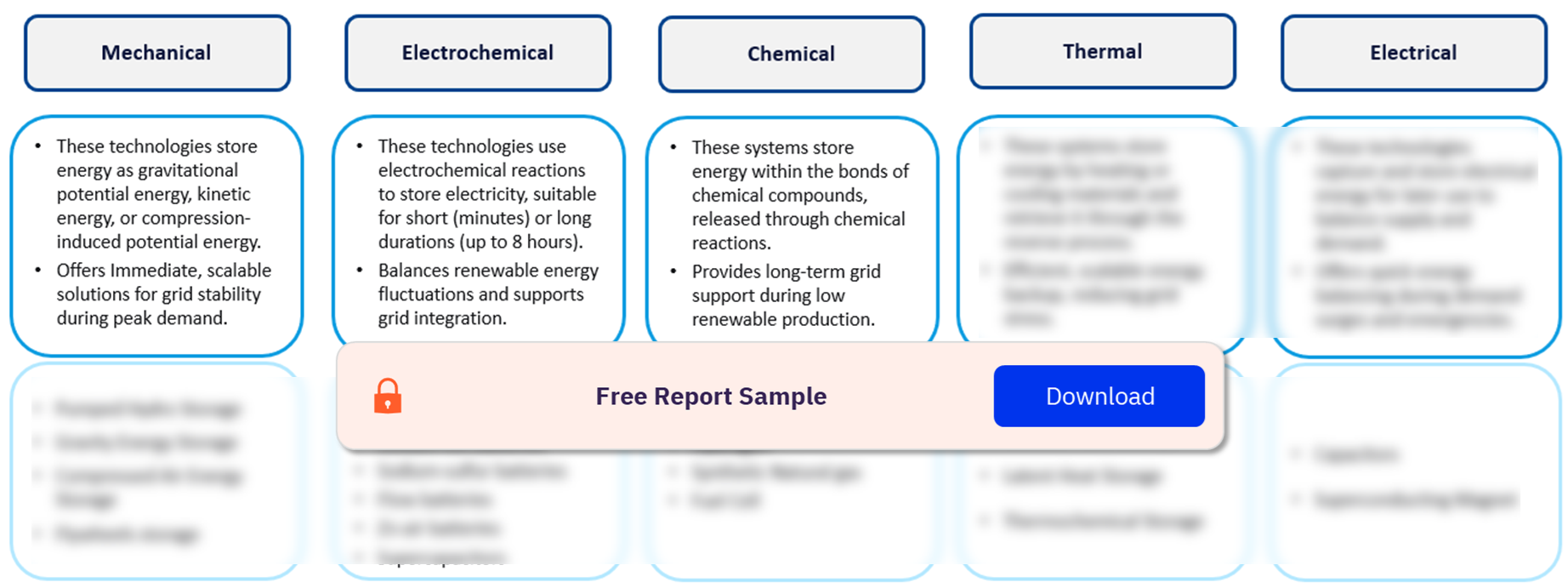
The key energy storage technologies are mechanical, electrochemical, chemical, thermal, and electrical.
Mechanical: These technologies store energy as gravitational potential energy, kinetic energy, or compression-induced potential energy. They offer immediate, scalable solutions for grid stability during peak demand.
Electrochemical: These technologies use electrochemical reactions to store electricity, suitable for short (minutes) or long durations (up to 8 hours). It balances renewable energy fluctuations and supports grid integration.
Chemical: These systems store energy within the bonds of chemical compounds, released through chemical reactions. It provides long-term grid support during low renewable production.
Energy Storage Technologies
Buy the Full Report to Know More about Energy Storage Technologies
Download a Free Sample Report
Energy Storage - Sector Impact
Energy storage systems (ESS) is used across sectors like energy, telecommunications, aerospace & defense, automotive, and residential, driving sustainability and energy resilience.
Aerospace & Defense: In the defense sector, it provides reliable portable power for remote military operations, enhancing grid independence and energy security in harsh environments. Furthermore, it reduces fuel dependence and supports advanced, field-deployable energy solutions, addressing safety and reliability challenges.
Automotive: In this sector, it powers electric vehicles and public transit while lowering emissions, and supporting the transition to sustainable transportation. Moreover, it reduces operating costs and emissions through improved energy efficiency, linking to the scalability and cost-efficiency drivers.
Energy: In this sector, it enhances grid reliability by balancing supply and demand and enables renewable energy integration through peak shaving and energy storage. It also supports the development of microgrids, aligning with infrastructure compatibility and renewable energy drivers.
Buy the Full Report to Know More about the Impact of Energy Storage Technologies on Sectors
Download a Free Sample Report
Key Highlights
- No surprise that energy storage technologies have evolved from supporting grid operations to becoming pivotal drivers of the sustainability revolution. The term ‘energy storage systems’ (ESS) has emerged as a key enabler, disrupting sectors from automotive to telecommunications.
- The urgency to adopt these innovations varies across industries. While the automotive and renewable energy sectors are leading the charge with advancements like ultra-fast charging batteries and large-scale energy storage solutions, sectors such as residential and commercial industries are beginning to follow suit. Companies in one sector can learn from the success stories in others, adapting similar strategies for transformative outcomes.
- Against this backdrop, enterprises need to understand which energy storage innovations are relevant to their sector and how companies are leveraging them to overcome efficiency, cost, and sustainability challenges. The innovation landscape report on energy storage, published by GlobalData, provides real-world examples of how leading companies and startups are advancing the deployment of cutting-edge energy storage solutions.
AiTher Systems
Allye
Ameresco
Antora
BASF
BMZ
BYD Energy Storage
Canadian Solar
Caterpillar
CATL
China Datang Corporation
Corvus Energy
Delectrik
DESTEN
DNA Tower
Expion360
Eaton
EcoFlow
Elisa
Envision
Epsilor
Evlo
Exowatt
Fluence
GetSun Power
GM Defense
GoodWe
Greenfuel
HiNa Battery
Hinen
Hithium
Honeywell
Huawei
Hydro-Québec
JLR
JSW Steel
KPIT
LiTHIUM24
Magnix
Microvast
Moment Energy
Northvolt
Ola Electric
Peak Energy
PepsiCo
Photocycle
Porsche
PowerCo
QuantumScape
Rimac
Schneider Electric
Sigenergy
Siltrax
Sineng
Sodion Energy
Superdielectrics
TailG
Talent New Energy
Tesla
Torus
Toyota
Varta
Wärtsilä
Yotta Energy
Table of Contents
Frequently asked questions
-
What are the key energy storage technologies?
The key energy storage technologies are mechanical, electrochemical, chemical, thermal, and electrical.
-
What are the key sectors in which energy storage systems (ESS) is used?
The key sectors in which energy storage systems (ESS) is used are energy, telecommunications, aerospace & defense, automotive, and residential.
-
What are the challenges of energy storage?
The challenges of energy storage include high cost, scalability issues, and regulatory barriers.
-
What are chemical energy storage systems?
Chemical energy storage systems are those systems that stores energy within the bonds of chemical compounds, released through chemical reactions.
Get in touch to find out about multi-purchase discounts
reportstore@globaldata.com
Tel +44 20 7947 2745
Sample Report
Energy Storage – The Key to Unlocking Sustainable Future was curated by the best experts in the industry and we are confident about its unique quality. However, we want you to make the most beneficial decision for your business, so we offer free sample pages to help you:
- Assess the relevance of the report
- Evaluate the quality of the report
- Justify the cost
Download your copy of the sample report and make an informed decision about whether the full report will provide you with the insights and information you need.


