
“Investors, corporate boards, and government leaders are raising expectations for progress on climate pledges owing to the unparalleled market and policy momentum behind ESG in 2021. Furthermore, ESG is forcing businesses to adapt to the new expectation that they create value for all stakeholders and not only for the shareholders.”
As a part of this bundle, you will gain access to in-depth insights available in the following reports:
- ESG (Environmental, Social, and Governance) in Aerospace and Defense
- Electric Aircraft in Aerospace and Defense
- Hydrogen Aircraft (Market Size, Advancements, and Key Programs)
- Electric Vehicles in Defense
- Case Study: Environmental Sustainability in Aviation
Report 1: ESG (Environmental, Social, and Governance) in Aerospace and Defense
Improving ESG sustainability is vital for aerospace & defense. Environmental sustainability in defense might be relevant only to industry rather than the end-user, but it is becoming increasingly important for modern militaries to adopt sustainability strategies. Therefore, implementing modern technologies in R&D can significantly increase fuel efficiency and reduce carbon emissions. For instance, sustainable aviation fuels (SAFs) will be a promising alternative to traditional jet fuel, potentially decreasing CO2 emissions by 80%. Likewise, electric propulsion and hydrogen-powered aircraft will be the technologies that drive zero-emission aircraft.
Contributing Factors and Mitigating Actions of ESG Framework

For more insights into the ESG Framework in the aerospace and defense industry, download a free report sample
Report 2: Electric Aircraft in Aerospace and Defense
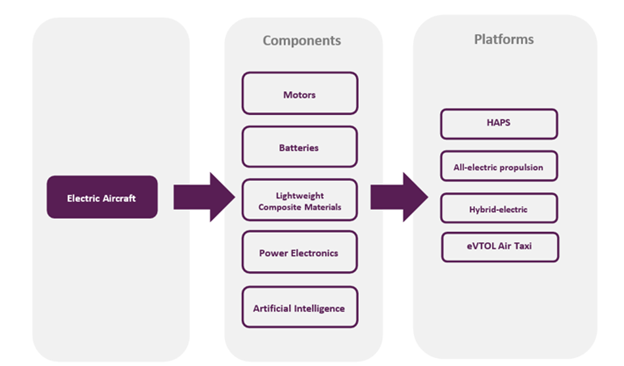
Improvements in battery technology have historically led to developments in electric aircraft technology, but the specific energy offered by batteries has always fallen below the required levels. Technological advances in recent years have made the development of electric aircraft increasingly viable. Lithium-ion batteries may be able to offer a great enough specific energy to allow electric aircraft to compete with conventionally powered aircraft in some sectors. NASA anticipates that in the near/mid-term, the potential of electric aircraft for large commercial aviation lies with hybrid-electric propulsion due to the limitations of contemporary batteries. These aircraft aim to perform a new role within commercial aerospace as Urban Air Taxis, carrying a small number of passengers on many very short distances within cities and suburbs.
Key Technologies and Products Used in Electronic Aircraft
For more insights on electronic aircrafts in the defense sector, download a free report sample
Report 3: Hydrogen Aircraft (Market Size, Advancements, and Key Programs)
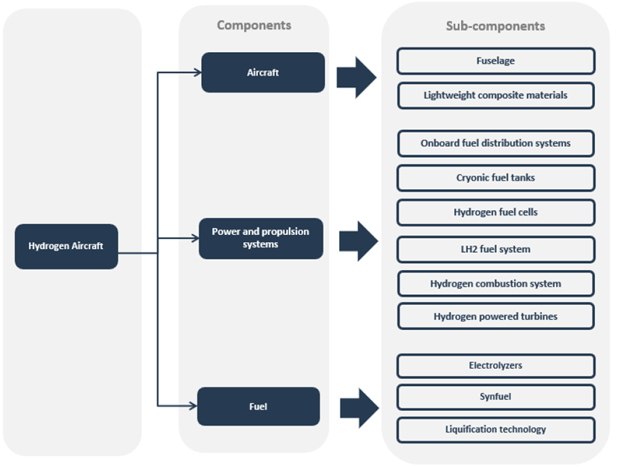
To facilitate the development of hydrogen aircraft, investment in key technologies ranging from fuselages to hydrogen fuel cells will need to be revamped. Several companies are investing in this space, but more research is needed to achieve the efficacy needed to enable widespread commercial aviation powered by hydrogen. There is a mainstream investment in the development of passenger aircraft for the commercial market on this technology and manufacturers including Airbus are working on it. Whilst the technology is mostly in the concept phase, steps are being taken to advance the specific technologies which will facilitate commercial use in the future.
The Hydrogen Aircraft Value Chain Analysis
 For more insights on hydrogen aircrafts, download a free report sample
Report 4: Electric Vehicles in Defense
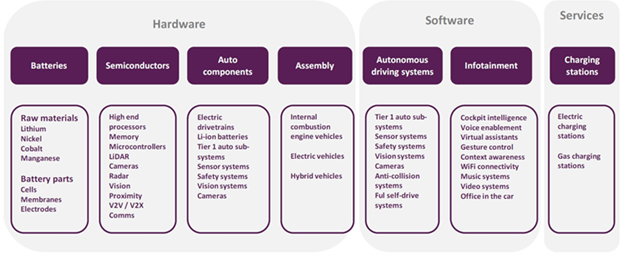
There were 10 million electrified vehicles (EVs) on the road globally by the end of 2020. China dominates the landscape for EV production as the largest market for technology. However, this domination is gradually eroding as the appetite for EVs in other regional markets is increasing and the need for more regional production is arising. Furthermore, gaining a dominant position in the fuel cell supply chain gives automakers an advantage and reduces their reliance on Chinese-made EV batteries and components. In the West, some efforts are being made to ensure global competitiveness in EVs. Also, companies like LG Energy Solution, SK Innovation, Panasonic, and Tesla are developing lithium-battery manufacturing facilities in North America.
The Electric Vehicles Value Chain Analysis
For more insights on electric vehicles within the defense sector, download a free report sample
Report 5: Case Study: Environmental Sustainability in Aviation
Environmental sustainability involves making responsible decisions that will eliminate a business’s impact on the environment. Businesses that are looking towards a sustainable and successful future must invest and develop sustainable practices. The aviation industry has now reached a point where it must assure it adopts measures for reducing its environmental impact, respond to travelers’ increased awareness of the environment and provide essential air connectivity. At present, one of the major emerging themes is for airports to become carbon neutral. To achieve this new gold standard in environmental sustainability, airports will need to make cultural and operational changes.
GlobalData’s Sustainability Framework

For more insights into sustainability framework in the aviation industry, download a free report sample







