Russia Faces Economic Sanctions over Ukraine Invasion
-
Sanctions imposed by the West on Russia led to a record fall of the ruble and an economic crisis in Russia
-
The sanctions banned some Russian banks from the interbank messaging system – SWIFT
-
Russia has suspended trading on Moscow Exchange's stock and derivatives sections to contain its losses
Russia Faces Economic Sanctions over Ukraine Invasion
The invasion of Ukraine by Russian armed forces has led to unprecedented economic sanctions from the US, the UK, Canada, and the European Union (EU) to limit Russia’s capabilities of financing its activities. The allied countries banned their citizens and businesses from transactions with the Central Bank of Russia, Russian wealth funds, and the Russian finance ministry. Overseas assets of the Central Bank of the Russian Federation have been frozen, including assets of companies and individuals close to the Russian government. Select Russian banks have been barred from using the SWIFT platform. SWIFT, the global Society for Worldwide Interbank Financial Telecom, is an interbank messaging system used by nearly 11,000 banks globally. These actions ensure that Russia's financial institutions are cut off from the international market.
Impact of Sanctions
In the wake of the sanctions imposed on Russia, S&P Global Ratings downgraded Russia's credit score to junk, and Moody's has put Russia on review for downgrade to junk.
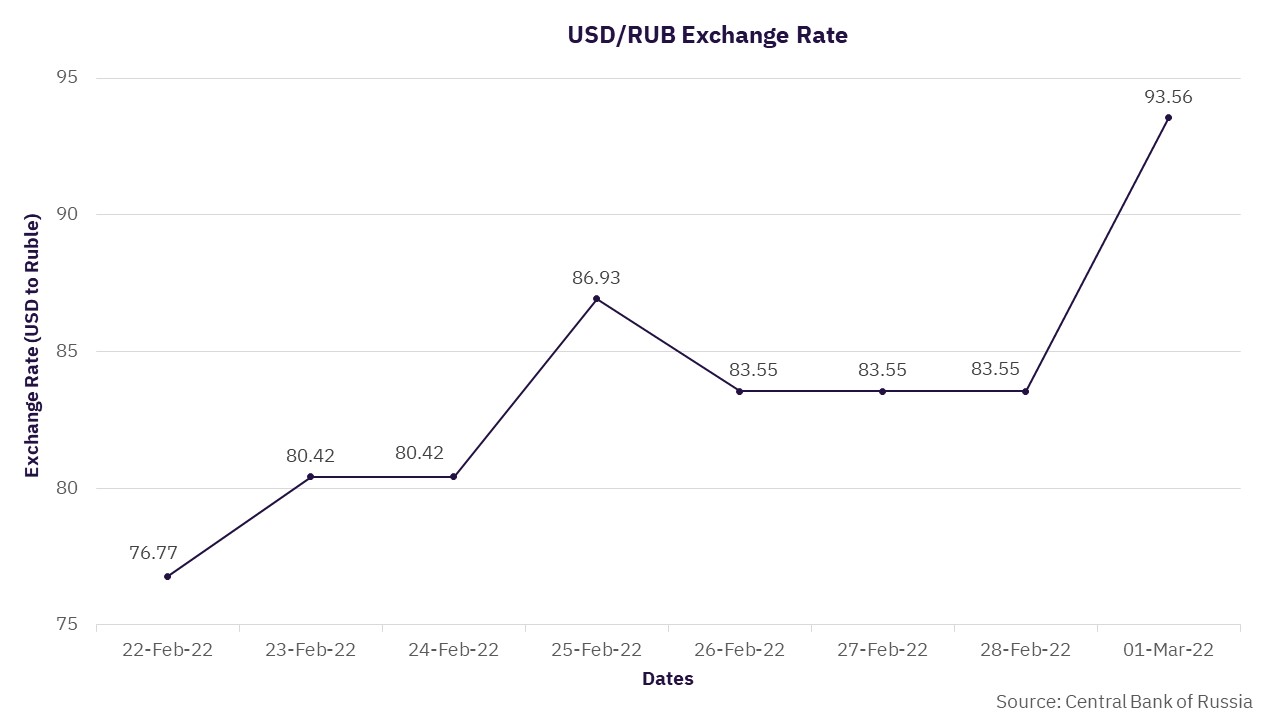
The sanctions led to a dramatic plunge of the ruble. On February 22, 2022, the currency reached its lowest value in six months. According to data from the European Central Bank, 1 euro was worth 89.80 Russian rubles on the day. The Russian ruble started plunging further when the armed conflict began on February 24 when 1 euro was worth 95.71 rubles, losing more than 6% of its value in two days. On the fifth day of the conflict, the sanctions drove the ruble's value to 115.48 per euro. The central bank reserves were projected to cushion the impact of sanctions on the Russian economy, but the president of the European Commission (EC) stated that it would "freeze" transactions of the Russian central bank. As a result, the central bank will have considerable difficulty liquidating its assets.
As for the reserves, the Central Bank of the Russian Federation had nearly $630 billion in reserves, tucked away in foreign currencies such as the dollar, euro, sterling, and gold. The US Treasury Department and the British government banned transactions with the Russian central bank, the Ministry of Finance, and the Sovereign Wealth Fund. If the western allies freeze the vast amounts of foreign currency owned by Russia but held in foreign banks, it could spark severe inflation and a prolonged recession. This is because the value of the Russian ruble is backed by the vast foreign exchange reserves of the Russian central bank, which also facilitate the import and export transactions of Russian businesses. The central bank could try to raise the value by buying rubles, but only if it has access to its foreign reserves. The financial crisis in Russia brings to mind the importance of accounting for socio-economic risks when making political decisions.
Russian Counter-Measures
Russia raised its key interest rate from 9.5% to 20%. The increase in the key rate ensures that deposit rates rise to compensate for the sudden turmoil in financial markets such as increased depreciation and inflation risks. The Russian Federation also announced other critical measures such as making it obligatory for exporters to hold at least 80% of revenue in rubles and banning residents from transferring money abroad. In a bid to minimize the financial market’s impact, Russia's central bank prevented its brokers from carrying out any sell orders from foreigners. To boost liquidity, the bank also announced that it would release RUB733 billion from its local reserves. The Russian stocks and derivates market was shut for a day on February 28, 2022, and the suspension of trade activity was extended for the second consecutive day, on March 1, 2022, to contain the losses from the financial crisis triggered by the sanctions.
Russia is one of the leading exporters of oil and gas, but many other sectors of its economy rely on imports. The SWIFT messaging system provides the financial means to carry out these import-export transactions. The crackdown on Russia's central bank and exclusion of banks from the SWIFT system will make it harder for these transactions to be carried out. A complete SWIFT ban could push the Russian Federation to use its messaging system — the System for Transfer of Financial Messages, an alternative to SWIFT.
Even though external conditions for the Russian economy drastically changed, and the current measures to ease the economic tension seem to work, the sustainability of these policies remains a question.
Related Data & Insights
Still looking?
Don’t wait - discover a universe of connected data & insights with your next search. Browse over 28M data points across 22 industries.
Explorer
Access more premium companies when you subscribe to Explorer