

Australia’s desire to maintain the security and stability of the surrounding Indo-Pacific region and the South China Sea coupled with its modernization programs will see its defense spending growing at an estimated CAGR of 3.8% over the period 2022-2027, says GlobalData, a leading data and analytics company.
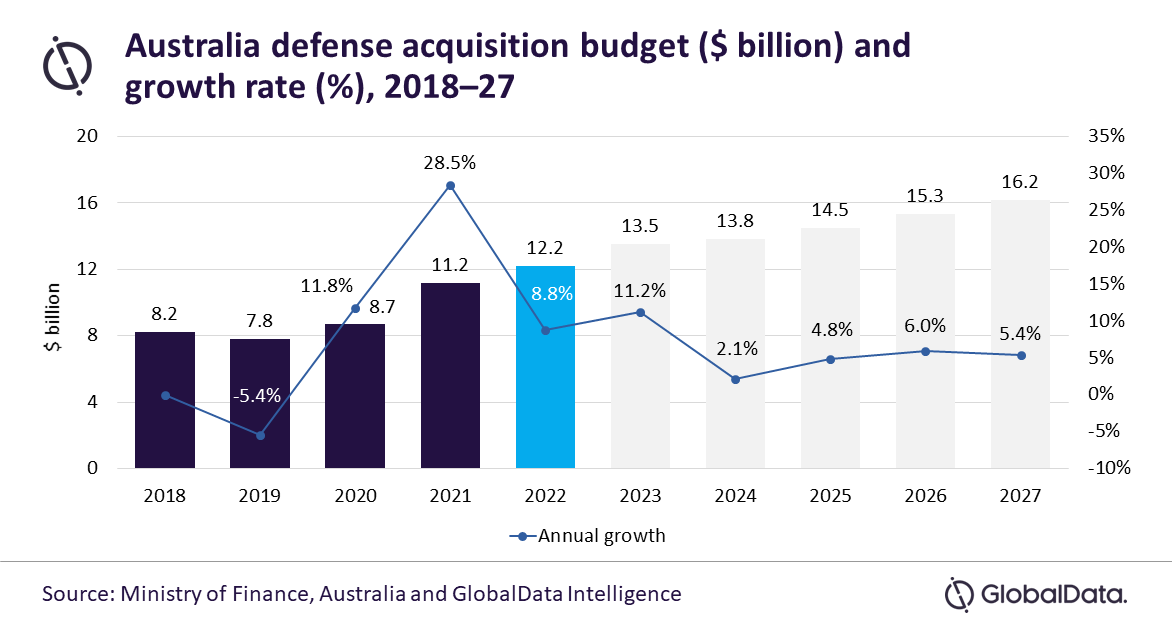
GlobalData’s latest report, ‘Australia Defense Market Size and Trends, Budget Allocation, Regulations, Key Acquisitions, Competitive Landscape and Forecast, 2022-27’, reveals that Australia’s defense acquisition, and research & development (R&D) spending recorded a CAGR of 10.3% from $8.2 billion in 2018 to $12.2 billion in 2022. The increase is largely attributed to a slew of defense procurements and R&D investments in naval vessels and submarine sectors.
China’s military assertiveness in the South China Sea and the realignment of its military capabilities towards deterrence in the Indo-Pacific region have raised tensions between Australia and China. Moreover, South China Sea is one of the most important global shipping lanes with a significant portion of Australian iron ore, LNG, and coal exports passing through the sea. In addition, the China’s construction of artificial islands in the South China Sea is considered one of the most pressing security threats for Australia and the desire to keep trade routes open has escalated tensions between the two countries.
Akash Pratim Debbarma, Aerospace & Defense Analyst at GlobalData, comments: “Rapid military modernization and technological developments in countries such as Russia, China, and North Korea are expected to create strategic challenges for Australia. Being an island nation, the modernization of its naval prowess is a necessity for Australia to protect its national security and sea lines of communication. However, the desire to increase its acquisition budget will not only result in securing its borders but will also create opportunities for the naval shipbuilding industry.”
As a part of the plan to modernize its naval capabilities and replace the aging fleet, Australia is in the process of procuring Hunter class frigates to replace its aging Anzac-class frigates and Arafura-class patrol vessels to replace the Armidale class and Cape-class patrol boats. Australia also plans to procure nuclear-powered submarines.
Debbarma concludes: “With Chinese military assertiveness over the South China Sea and Indo-Pacific region, the Hunter-class frigates will prove to be an asset in conducting anti-submarine warfare, air defense, surface warfare as well as performing surveillance and intelligence missions. However, the future procurement of nuclear-powered submarines is surely a strategic move needed to replace their Collin-class diesel-electric submarines and build a strong line of defense to satisfy the country’s security interests.
“However, for Australia, increasing its defense budget is not only a means to secure its national security but also to improve its domestic defense industry and position itself as a leader in global exports.”
