

Indigo recently ordered 30 A350-900 wide-body aircraft from Airbus, as it looks to expand its international network to long-haul destinations. The Indian carrier’s expansion plans into more international destinations underscore the strong growth witnessed in the country’s travel landscape, propelled by factors such as a steady uptick in business travel, rising disposable income, and economic growth. Driven by the booming international travel sector and passenger traffic from India, Indigo continues to remain the biggest buyer of Airbus aircraft in the Asia-Pacific (APAC) region, says GlobalData, a leading data and analytics company.
GlobalData’s latest “Commercial Aircraft Orders and Deliveries” dashboard reveals that Indigo ordered more than 1,270 Airbus aircraft between 2011 and 2024, accounting for almost 25% of the total orders that Airbus received from the APAC region during the same period.
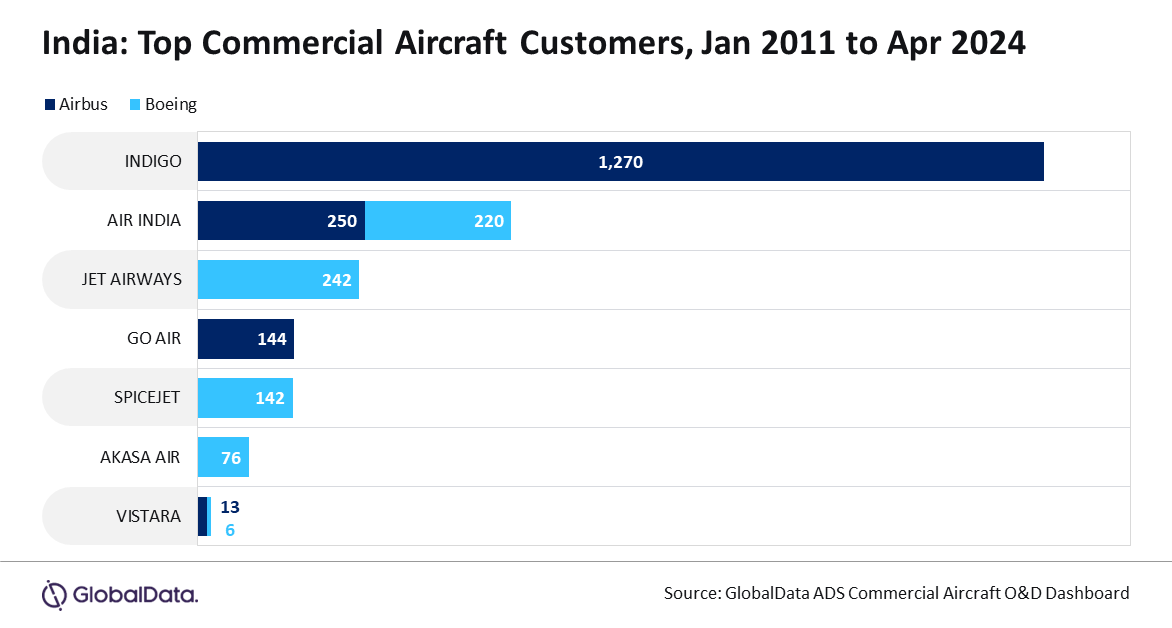
Sai Kiran, Aerospace and Defense Analyst at GlobalData, comments: “Although Indigo has been operating a leased Boeing 777-300 ER aircraft for its international Delhi-Istanbul route for the past year, the airline has chosen to order Airbus A350-900 aircraft to support its expansion plans. This shift from the Boeing 777-300 ER to Airbus A350-900 could be the result of ongoing concerns over quality standards surrounding Boeing aircraft models, especially the 737 Max. Indigo’s move also underscores the confidence and long-standing trust it has on Airbus to meet the carrier’s evolving demands for short-haul and long-haul aircraft fleet.”
With the latest order, Indigo will also become the second-largest customer in India for Airbus wide-body aircraft, trailing behind Air India, which currently has an order book of 40 aircraft in the same wide-body segment.
Kiran concludes: “Indigo continues to benefit from India’s economic growth and has found Airbus to be a reliable partner to support its growth trajectory over the past decade. Similarly, due to Boeing’s current troubles, Airbus is likely to remain a preferred choice for carriers and lessors in the APAC commercial aviation market.”
