

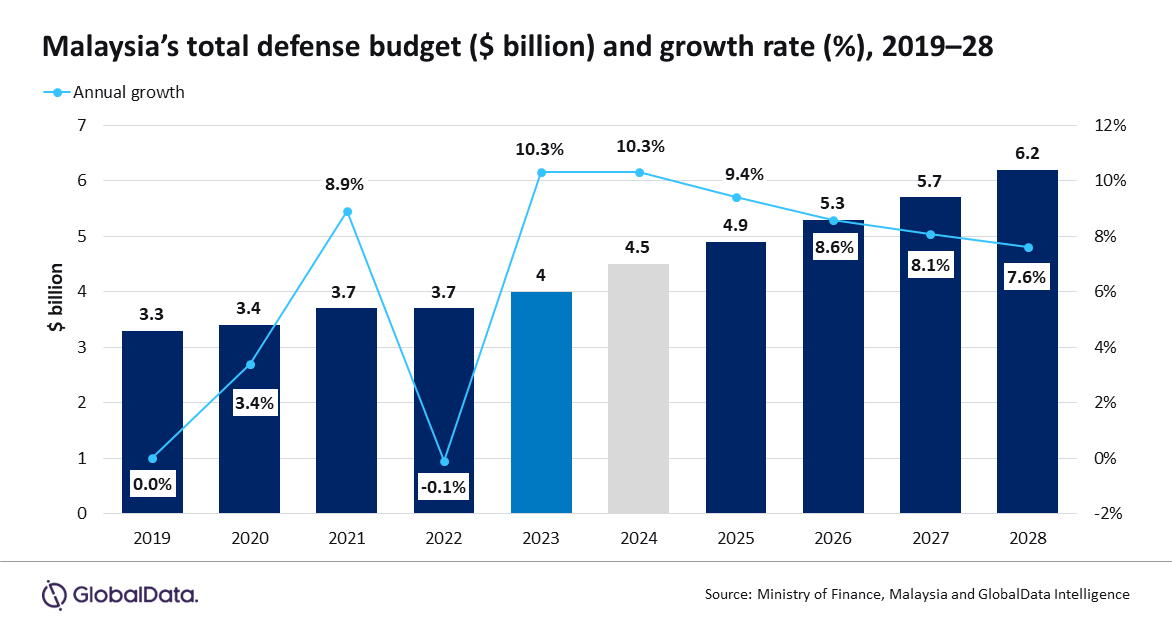
Driven by military modernisation programs to protect its sovereignty and address security threats such as piracy and terrorism, Malaysia’s defense budget is expected to experience a robust compound annual growth rate (CAGR) of 8.4% during 2024-28, reaching $6.2 billion in 2028, according to GlobalData, a leading data and analytics company.
GlobalData’s latest report “Malaysia Defense Market Size and Trends, Budget Allocation, Regulations, Key Acquisitions, Competitive Landscape and Forecast, 2023-28,” reveals that Malaysia’s defense expenditure increased from $3.7 billion in 2022 to $4 billion in 2023, reflecting a significant annual growth rate of 10.3%. The increase in the defense budget is expected to fast-track military modernization efforts, which may see the fruition and scale-up of many planned procurement programs. The budget will also support disaster response capabilities and international commitments while contributing to the country’s economic interests.
The country’s pursuit of advanced platforms, including the acquisition of second-generation patrol vessels such as the littoral combat ships (SGPV-LCS) and littoral mission ships (LMS) built by Boustead Naval Shipyard (BNS), FA-50 light attack jets, and Tun Fatimah-class vessels highlights its dedication to bolster its defense capabilities.
Rouble, Aerospace & Defense Analyst at GlobalData, comments: “Malaysia has been proactively addressing improvement areas in its air and naval capabilities by formulating plans to modernize its legacy military platforms in recent years. While military spending hasn’t traditionally held a top spot in the government’s priorities, resulting in delays and cancellations of military modernization initiatives owing to economic constraints, there is a promising development in the 2023 defense budget. Malaysia’s integrated, agile, and focused approach highlighted in its defense budget is expected to enable it to build a technologically advanced armed force that can respond to modern and evolving threats.”
Additionally, Malaysia’s defense market opens opportunities in sectors such as military fixed-wing aircraft, military unmanned aerial vehicles (UAVs), and missile and missile defense systems. The country is expected to consider acquiring more warships and ground-launched anti-ship cruise missiles to enhance its naval defense capabilities and bolster its maritime security efforts.
Rouble concludes: “Malaysia’s Defense White Paper (DWP) underscores its commitment to create a “Force of the Future” capable of operating on dual fronts of peninsular and Borneo’s East Malaysia simultaneously, reflecting the country’s strategic ambitions in a complex security landscape in the Indo-Pacific. This vision likely involves a comprehensive approach with multi-domain operational capabilities, technological advancements, and a strong emphasis on training and skill development. By preparing its armed forces to effectively address modern security challenges in land, sea, air, and cyberspace, Malaysia aims to position itself as a resilient regional player, capable of responding to evolving threats while safeguarding its national interests and contributing to regional stability.”
