
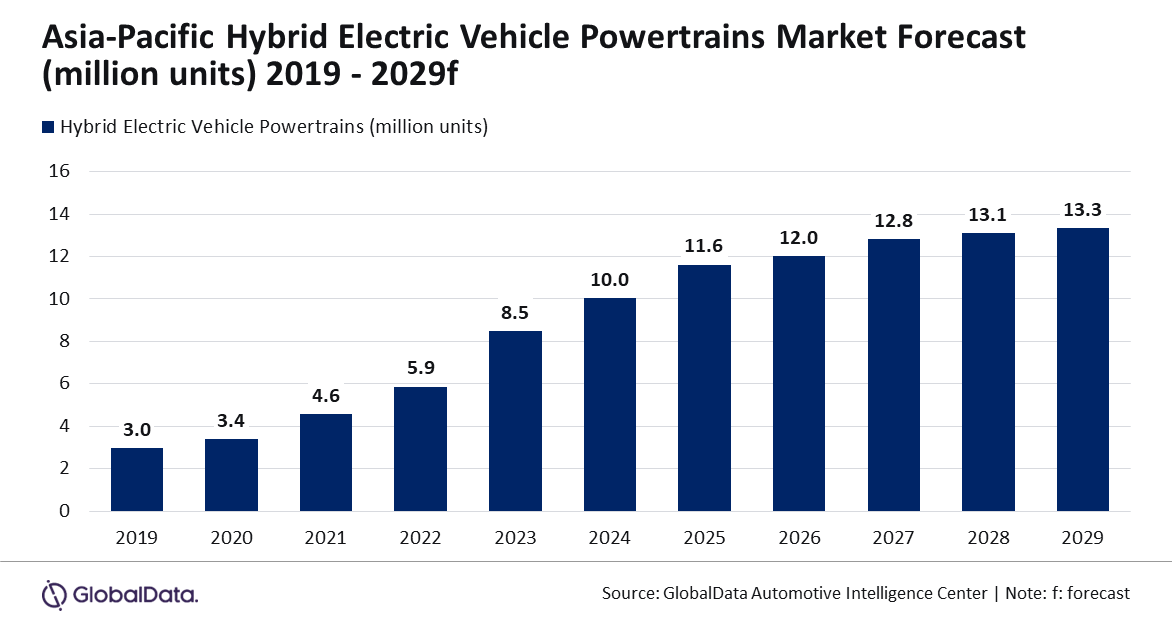
As consumers grow more environmentally conscious, they are recognizing hybrid vehicles as a practical and affordable alternative to internal combustion engine (ICE) cars and battery electric vehicles (BEVs). The Asia-Pacific (APAC) region, with China, Japan, and India at the forefront, leads the global market in the adoption of hybrid vehicles. Governmental efforts to promote zero-emission vehicles are also leading to a surge of innovations in the hybrid car sector to improve overall performance. In this context, the hybrid EV powertrains market in the APAC region is projected to experience a compound annual growth rate (CAGR) of 5.9% from 2024 to 2029, according to GlobalData, a leading data and analytics company.
GlobalData’s latest report, “Global Sector Overview & Forecast: Hybrid Electric Vehicle Powertrains – Q2 2024” reveals that the hybrid EV powertrains market in APAC is estimated at 10.0 million units in 2024 and is expected to reach 13.3 million units in 2029.
Madhuchhanda Palit, Automotive Analyst at GlobalData, comments: “Despite numerous government initiatives aimed at encouraging consumer adoption of BEVs, there has been a significant increase in the popularity of hybrid vehicles. This trend can be attributed to various factors, such as the minimal need for consumers to alter their driving habits.
“Hybrid vehicles, which utilize both gasoline or diesel engines and electric motors, can operate solely on electric power for shorter distances. This feature is particularly advantageous in urban stop-and-go traffic, offering the benefit of zero tailpipe emissions. Additionally, the ICEs in hybrid vehicles can be used for longer distances, thus reducing the need for consumers to significantly change their regular driving patterns.”
As the adoption rate of hybrid vehicles rises, manufacturers are competing to introduce innovations that improve vehicle performance and, consequently, sales. The manufacturers are focusing on innovations at various stages of application. Hybrid Electric Vehicle (HEV) predictive energy management, a maturing innovation that has become well-established within the industry, involves the use of control systems and methods to optimize energy management in electric vehicles. The control system employs predictive algorithms to manage energy consumption, optimizing the use of the electric motor and combustion engine.
Key players in the sector, such as Toyota, Hyundai, and Volkswagen, are driving these innovations. For example, Toyota has recently filed a patent for a hybrid vehicle control device that performs a reduction process to limit fuel cuts in the engine and an increase process to raise the engine’s rotational speed during deceleration. These advancements underscore the industry’s commitment to enhancing the efficiency and appeal of hybrid vehicles.
Palit concludes: “Manufacturers are adjusting to more stringent emission regulations, and consumers are increasingly considering hybrid vehicles as a viable alternative, being cautious of transitioning to BEVs due to inadequate infrastructure. In addition, the higher cost of BEVs is also weighing in on the decision making of customers in the APAC region.
“While governments commit to enhancing the EV charging infrastructure, the development of a comprehensive network remains a work in progress. In the interim, the rising popularity of hybrid vehicles is prompting manufacturers to pursue innovation, leading to improvements in efficiency and performance that are stimulating market expansion.”
