

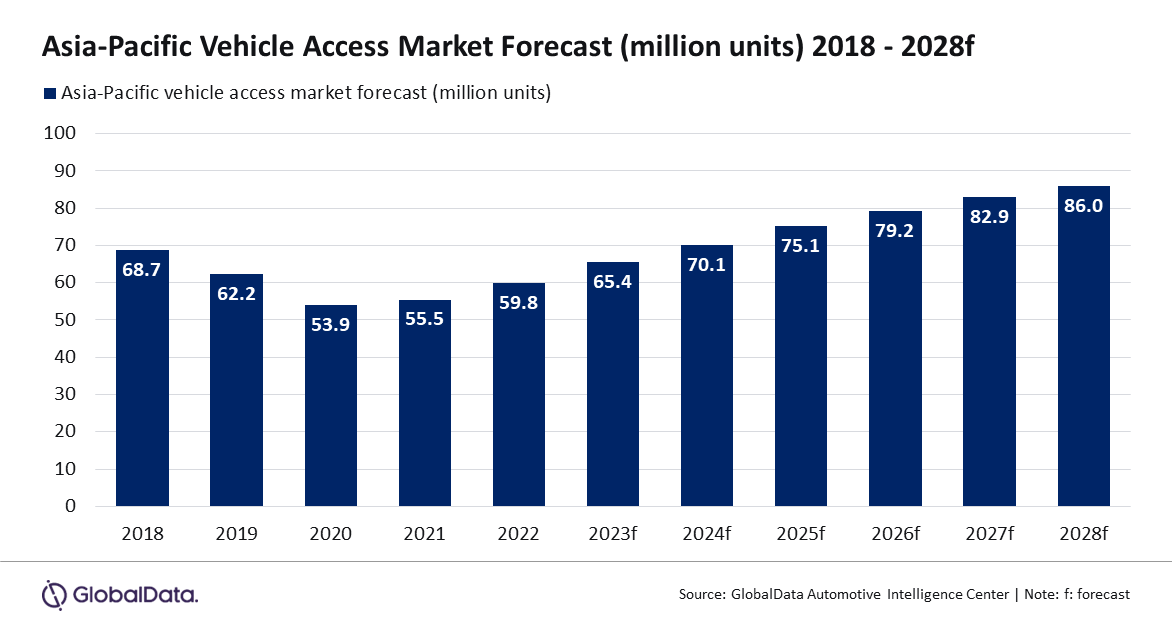
Consumers are increasingly favoring more convenient choices for various aspects of their vehicles, particularly in terms of access. The rising disposable income and a growing preference for luxury cars in the Asia-Pacific (APAC) region are driving the demand for keyless entry systems, which provide convenience and a sophisticated appearance. Against this backdrop, the automotive vehicle access market is forecast to register a compound annual growth rate (CAGR) of 5.6% during 2023-2028, according to GlobalData, a leading data and analytics firm.
GlobalData’s latest report, “Global Sector Overview & Forecast – Automotive Vehicle Access,” reveals that the vehicle access market in APAC is estimated to reach 65.4 million units in 2023 and 86.0 million units by 2028. The traditional key vehicle access segment is expected to account for a mere 26.4% market share in 2023, while the active and passive keyless entry systems collectively dominate the remaining market, capturing 51.1% and 22.5%, respectively.
Madhuchhanda Palit, Automotive Analyst at GlobalData, comments: “A notable factor contributing to the popularity of the active keyless system is its lower cost compared to the passive keyless system. This affordability has resulted in a higher prevalence of cars equipped with the active keyless system in contrast to the passive system. Moreover, the passive keyless system does not offer significant additional security or convenience benefits compared to the active keyless system, except for the ability to skip pressing a button on the remote. Given the cost sensitivity of consumers in the APAC region, this single benefit may not justify the extra expenditure.”
Despite its popularity, the active keyless entry system is not immune to security risks. In a remote keyless system, where pressing the button on the key sends a specific signal to the car for unlocking, hackers can target this process. By recording the signal when the driver presses the unlock button, attackers can later replay it to unlock the doors, posing a potential security threat.
Palit adds: “The demand for keyless entry systems is increasing despite security concerns, because of the convenience they provide. In the APAC region, most new cars now come with a keyless system, with the active keyless system being incorporated into many cars due to pricing considerations, contributing to market growth.”
For passive keyless entry systems, slow demand growth is due to both pricing factors and significant security concerns. Despite the system’s simplicity, where users only need to be within a certain range with a mobile phone, smart card, or key fob, the risk of unintentional unlocking when passing by the car poses a security threat. Additionally, inconveniences like battery drainage, misplaced mobile phones due to multifunctionality, and lost smart cards further contribute to the technology’s sluggish adoption.
Palit concludes: “Since both active and passive keyless systems have security risks, ongoing technological advancements aim to address these issues. Additionally, new keyless vehicle access technologies, such as biometric keyless systems, are being introduced. In this system, users unlock the door using a fingerprint sensor, minimizing the risk of a thief accessing the car. Although this technology is still in the development stage, it is currently available in only a few luxury cars.”
