

The card payments market in Australia is expected to grow by 8.1% to reach AUD896.5 billion ($610.8 billion) in 2023, supported by the rising consumer spending, says GlobalData, a leading data and analytics company.
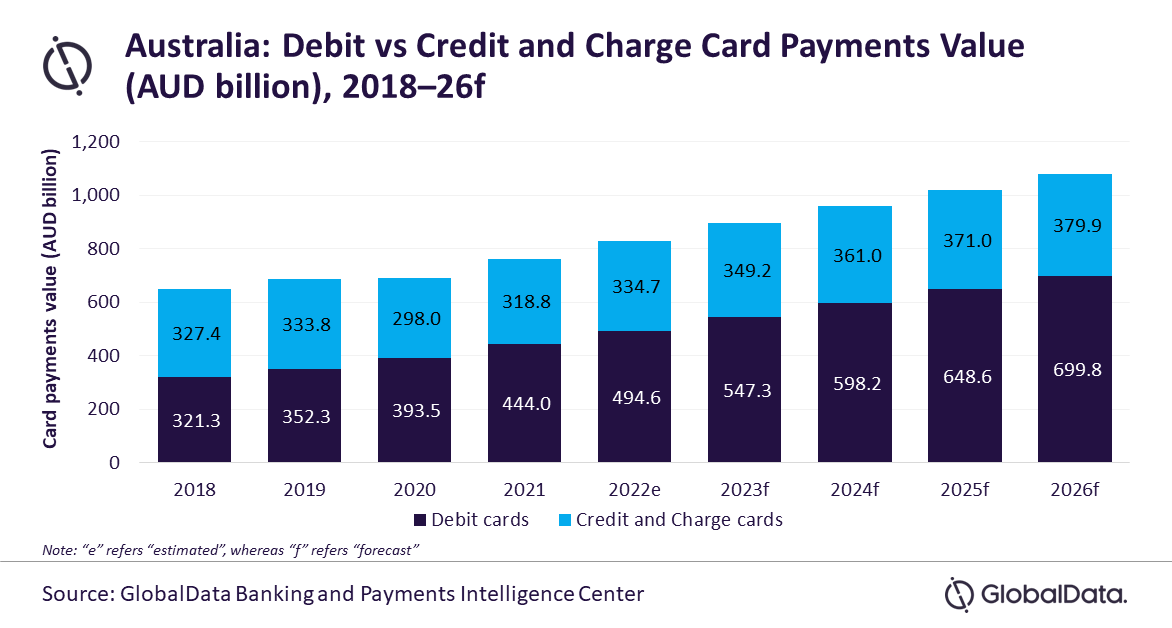
GlobalData’s Payment Cards Analytics reveals that card payments value in Australia was estimated to register a healthy growth of 8.7% in 2022, driven by rebound in economic conditions and rise in consumer spending. The value is expected to grow further by 8.1% to reach AUD896.5 billion ($610.8 billion) in 2023.
Shivani Gupta, Senior Banking and Payments Analyst at GlobalData, comments: “Australia has a well-developed card payment market with strong payment infrastructure and high consumer preference for electronic payments. The growth in the card payments has been characterized by the high banked population and shift away from cash towards contactless payments.”
The country’s payment card market continues to grow at a rapid pace with high card usage among the population. In Australia, the number of card payments per person stood at 516.7 in 2022 – compared to its peers South Korea (510.0), New Zealand (298.1), Singapore (285.9), China (180.0), and Japan (138.6).
The growth in the card payments is supported by surge in debit card payments, which grew by 11.4% in 2022, much higher than the 5% growth recorded for credit and charge cards. Debit cards remain the preferred card type for payments in Australia, accounting for 59.6% of total card payment value in 2022. Australians continue to favor debit cards over credit cards, a trend that accelerated amid the COVID-19 pandemic, as consumers want to avoid debt.
Credit and charge cards accounted for 40.4% share of card payments by value in 2022, declining from 50.5% in 2018. The decline is primarily due to consumer reluctance towards taking credit-card debt, and growing popularity of alternate financing options such as buy now, pay later (BNPL).
One of the major developments in the Australian payments market has been the high consumer preference for contactless card payments, which is displacing cash for low value day-to-day transactions. Backing from banks and financial institutions has made contactless mainstream payment method in Australia which is accepted at most retailers.
Gupta concludes: “Economic recovery, rise in consumer spending, and high contactless adoption will continue to push card payments usage in Australia, which is projected to register a compound annual growth rate (CAGR) of 6.8% between 2022 to 2026, to reach AUD1.1 trillion ($735.6 billion) in 2026.”
