

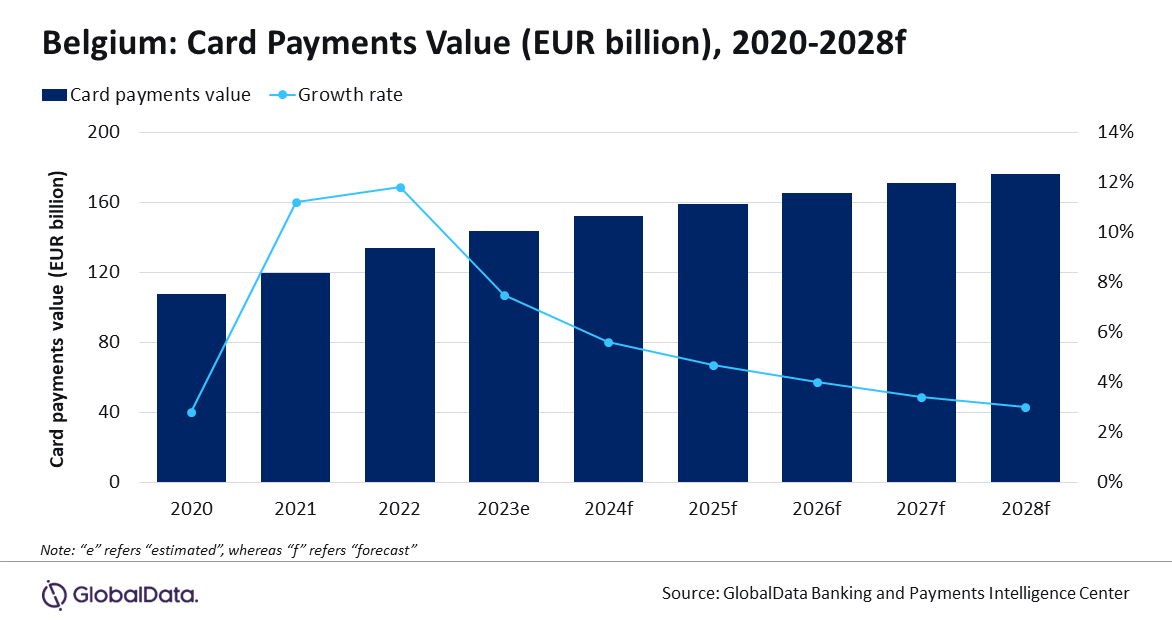
The Belgium card payments market is forecast to grow by 5.6% in 2024 to reach EUR152 billion ($164.3 billion), supported by high consumer preference for electronic payments, according to GlobalData, a leading data and analytics company.
GlobalData’s Payment Cards Analytics reveals that card payment value in Belgium registered a growth of 11.8% in 2022, driven by a rise in consumer spending. However, the value is estimated to have registered a slow growth of 7.5% in 2023 to reach EUR143.9 billion ($155.6 billion), on account of slowdown in economy.
Ravi Sharma, Lead Banking and Payments Analyst at GlobalData, comments: “The Belgian payment card market is experiencing rapid growth and innovation. The -promotion of electronic payments by the Belgian financial authorities and banks, coupled with the development of payment-acceptance infrastructure, have successfully encouraged consumers to adopt card payment methods for their day-to-day transactions.”
Debit cards dominate the Belgian payment card market, accounting for 84.9% of total the card payment value in 2023. The popularity of debit cards can be attributed to several factors, including a strong banked population and the availability of basic bank accounts. Debit card penetration stood at 170.2 cards per 100 individuals in 2023, reflecting the preference of Belgian consumers for this payment method.
On the other hand, credit and charge cards accounted for just 15.1% of the total card payment value in 2023. Consumers in Belgium tend to favor debit cards over credit cards to avoid falling into debt amid the ongoing financial uncertainty. However, banks in the country are offering various value-added benefits to increase the use of credit cards, such as rewards, discounts, and cashback.
In Belgium, payment cards are the popular payment option due to their security features, wider merchant acceptance and the availability of reward benefits. To offer wider card acceptance, banks and other card issuers in Belgium have been replacing Maestro cards with the Debit Mastercard since 1 July 2023, and this transition will be spread over a period of five years. Maestro was developed mainly for use in physical stores and hence is not accepted everywhere online.
The transition from cash to cards is evident in the expanding number of PoS terminals and rise in contactless payments. Contactless card usage is gradually increasing in Belgium, with 84% of consumers holding a contactless card and over 65% of consumers use them for payments, according to GlobalData’s 2023 Financial Services Consumer Survey.
The increase in the payment limit for contactless cards has also facilitated their adoption especially for lower value transactions. In April 2020, Belgium’s contactless transaction limit was increased from EUR25 ($27.03) to EUR50 ($54.06) per transaction.
Sharma concludes: “Looking ahead, a continued growth in the total card payments is expected in Belgium. The key drivers of this growth include the ongoing efforts to promote electronic payments, the expansion of the e-Commerce market, and the availability of value-added benefits for cardholders. However, rising inflation and ongoing geopolitical uncertainty could impact consumer spending which can lead to slower growth of the payment card market in the country.”
*GlobalData’s 2023 Financial Services Consumer Survey was carried out in Q2 2023. Approximately 50,000 respondents aged 18+ were surveyed across 40 countries.
