

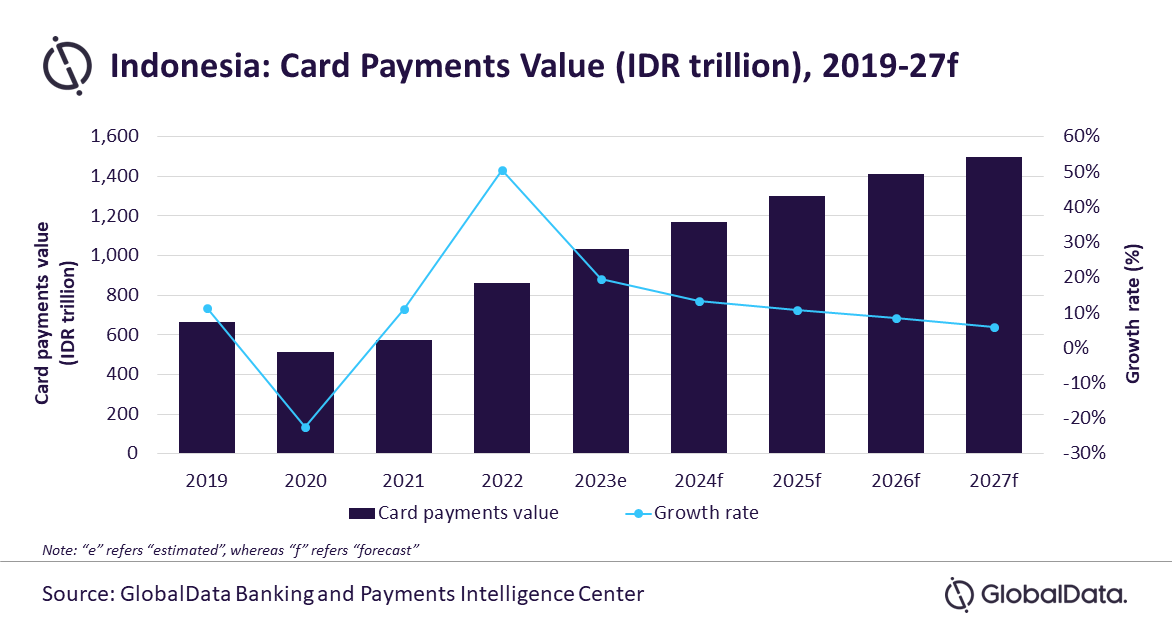
Indonesia’s card payments market is forecast to grow by 19.5% to reach IDR1,032.9 trillion ($66.1 billion) in 2023, supported by an economic rebound and growing consumer preference for electronic payments, according to GlobalData, a leading data and analytics company.
According to GlobalData’s Payment Cards Analytics, Indonesia saw a significant decline of 22.4% in card payments value in 2020 as its economy fell into recession following the impact from the pandemic. Like most markets globally, Indonesia was also affected by the pandemic, leading to a decrease in consumer spending, which negatively impacted card payments in the country. However, with the economic rebound, Indonesia’s card market revived in 2021 registering 11.1% growth, followed by even stronger growth of 50.6% in 2022.
Ravi Sharma, Lead Banking and Payments Analyst at GlobalData, comments: “Indonesia, which is primarily a cash-driven economy, has made robust progress in the adoption of card payments during the last few years. This was mainly due to various initiatives from the government and the central bank, rising consumer awareness, and growing acceptance among merchants. There has been a gradual shift in consumer preferences towards the use of cashless methods, a trend that has become more prevalent post pandemic.”
Although there has been a rise in electronic payments, a large population in the country is still outside the purview of the formal banking system, with unbanked population (% aged 15+) in the country still at 43.8% in 2023.
To increase financial inclusion and raise the adoption of card payments, the government, in collaboration with commercial banks, undertook various initiatives. To promote non-cash payments, the government passed a regulation requiring all of the country’s ministries to use credit cards to meet 40% of their office expenses (which are financed by the government) effective from July 2019. These cards can be used for purchases including office supplies, rent, inventories, maintenance, and travel.
To offer a secured payment experience and boost consumer confidence in card payments, the central bank mandated all banks to implement chip-technology debit cards and six-digit PINs from December 31, 2021, replacing magnetic stripe cards.
Sharma concludes: “The Indonesian payments card market is on a growth trajectory supported by improving financial awareness and government initiatives. An increase in consumer spending, a gradual rise in banked population, and an improvement in payment infrastructure are also anticipated to support card adoption and usage. The card payments value is forecast to register a compound annual growth rate (CAGR) of 9.7% to reach IDR1,498.4 trillion ($95.9 billion) in 2027.”
